
A regular dhole. The supposed gray one I'm talking about lives in Myanmar. It is not a pack hunter.
Of course, I’d rather not have to go to Myanmar if I could help it.
It’s not a nice place for human rights.
But it might be worth the risks for this.
***
One of the things about dholes is that they make more sense as an ancestor of the domestic dog than the wolf does.
Dholes are much more socially tolerant than wolves are. There are reports of dogs running with dhole packs, and dhole are not normally aggressive toward each other.
They also come in a red coloration that is virtually uknown in wolves, but it is common in every virtyually dog population, including so-called primitive dogs. Dhole puppies often have black muzzles. This makes them look a bit like Malinois.
Dholes are much more easily tamed than wolves. Brian Houghton Hodgson, the British ethnologist and naturalist who worked in India in the 1850’s, believed that they were the ancestor of the domestic dog, because he had known several that were kept as pets. They were as tame as any domestic dog. Hodgson noted that the skull of a dhole is very similar to a generic domestic dog, but the dhole has much larger teeth.
Yes. That would all make sense. It also lay credence to Peter Savolainen’s research on dog mtDNA haplotypes that suggests that domestid dogs are derived from Southeast Asian wolves. Although wolves existed in India and Southern China, they really aren’t well known in Southeast Asia. In fact, it may be that there were never any wolves in Southeast Asia– and there aren’t any right now. But if the dhole had been the ancestor, we would be able to make lots of sense of it.
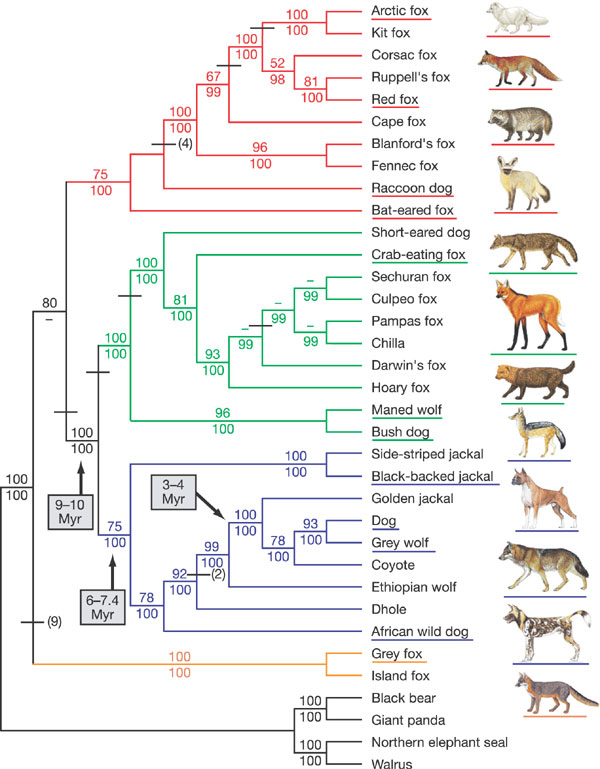
However, dholes have never produced a litter of hybrids with dogs or any other version of Canis lupus. They are not interfertile with any members of the genus Canis. It turns out that dholes are more distantly related to dogs than they are to black-backed jackals, which are one of two jackal species that cannot interbreed with domestic dogs/wolves/dingoes, golden jackals, Ethiopian wolves, or coyotes.
The dhole theory all makes sense.
Too bad there’s just one that one little glitch there.
***
Wolves historically lived in the northwest of Burma, but these gray dholes are said to be smaller than red dholes. I doubt that these are wolves.
Golden jackals are grayish compared to the dhole, but I’ve never heard of one that was very dark gray with a black muzzle. I’ve heard of dark gray ones.
It could be a golden jackal/dog hybrid.
Black muzzles are almost exclusively a dhole and domestic dog trait.
I don’t think dholes can crossbreed with anything. It would be interesting if they could.
But I’m not so sure that one could say that this animal is a dhole/wolf hybrid. I can’t imagine what one would look like, but the real problem is that wolves had a very limited range in Myanmar/Burma. They are currently extirpated from that country.
Could it be a new species?
Maybe.
And that’s why I think its worth exploring.





I love it that they actually exist. They are so beautiful. I can almost see the resemblance between this wild canine and some of our breeds. I have recently acquired a wonderful dog that I was told was Golden Retriever/Irish Setter. He is more Golden than Setter and I love him to pieces. He shares this coloration of this little beast. If I can figure out how to send a picture on here I will.
e-mail me at retrieverman1@yahoo.com
wow what a beautiful animal one of my favs other than the Fox
In the mid 90’s, I was at the Toronto Zoo, and they had a pair of dholes. They had surprisingly long bodies. They also had a sharp smell – more like foxes than dogs.
It was a pleasure to see them!
I recall that one of the surprising observations of the Belyaev was that their smell decreased or went away as they were bred for tameness.
*Belyaev FOXES
I often find the blind-alleys in science more interesting than the confirmed discoveries. If they split from the rest of the canids long enough ago to no longer be interfertile, it makes me wonder what kind of selection pressures they faced that ended up as the modern Dhole. And if they occupied the same ecological niche as other canids, they must have out-competed them to have survived; what was different about their environmental conditions that favored Dholes over wolves?
Obviously it must be the result of an intelligent designer.
That’s a very good question. I don’t have the answer.
Why would Asia have two pack-hunting canids that specialize in large game?
Not only that, but dholes were once quite widspread in Eurasia and parts of North America.
Here’s the Kipling story. Dholes actually aren’t like this at all.
http://kipling.thefreelibrary.com/Second-Jungle-Book/1-13
I’ve heard of off-colored dholes in Myanmar, but the ones usually seen are red. They are apparently few and far between there, and in the plains of Upper Myanmar (north of Mandalay) they undoubtedly range over very large areas. Not the situation in South Indian protected areas where ungulates are abundant and they have been studied through direct observation.
while it may not be common, red and “black mask” does occur in wolves — the following site has photos of both, as well as discussion and photos of wolf/dog combinations and wolf relatives.
http://hal_macgregor.tripod.com/kennel/wolves.html
Like “K” dominant black, red may or may not be a color that “has been around a long time”. It would appear to be so, since many foxes and similar canids have this color, but then the African Wild Dog is colored as close to Merle as any non dog can be. It’s not a color seen in any other wild canid. Mask is tied to E, so it’s likely that both red and mask came about at the same time.
I expect that the original domesticated “wolf” was long ago assimilated into dogs or simply exterminated, along with all the other wolf subspecies that are no longer with us. What’s interesting is why the Dhole WASN’T domesticated. If it tames easily, why wasn’t it?
Vr, Peggy Richter
That’s been my question for a long time.
If you’ve seen the old Canadian documentary Cry of the Wild, there is a wolf on that with a black mask.
Many Arctic wolf juveniles have it.
That’s a very good site, although I should tell you that I’m very skeptical about red wolves and Eastern wolves.
I don’t think they have a good handle on what is coyote and what is wolf mtDNA.
Every study I’ve seen uses a different date as an assumption about when those two species split.
And it’s fundamental to these studies to know what’s a wolf mtDNA sequence and what’s a coyote mtDNA sequence.
Hi, really interesting reading. My famil come from North India, where Punjab (plains land) joins Himachal Pradesh. I have seen jackals on there own but also more interestingly jackals and dogs together.
Do dogs team up with dholes and is this documented anywhere?
Thanks
Dogs hunting with Dholes was documented in Fox’s The Whistling Hunters: http://www.amazon.com/Whistling-Hunters-Studies-Asiatic-Alpinus/dp/0873958438
Dholes whistle– the only dogs to do so!
Golden jackals also run with dogs, and they are also capable of interbreeding with them. I have not heard of mixed packs of dholes, dogs, and golden jackals, but it could happen!
Dogs are derived from wolves, which is one of the strange things. It would have been easier to tame Dholes than wolves.
Does the book mention the dogs being an integral part of the dhole pack or just teaming up for hunting and then disbanding? Sounds very interesting!
Yes I have seen the jackals teaming up with feral dogs and also have one video footage of a dog/jackal hybrid scavenging at a garbage dump along side 7 feral dogs. This dog had a jackal as a mother and a dog as a father. The jackal bith used to come in to this small rural town and she was seen with a dog for over 2 years. Out of the 3 pups she had this was the only one that stayed in the area and although timid is very sociable with the local feral dog population.
I still think that the domestic dog must have more than the wolf as its ancestor, I am sure the golden jackal must have had a part to play as some of the indian feral dogs look so simmilar to golden jackals in apperance.
Also the coyote and simien wolf have probably all added there genes to the various types of dogs and even today simien wolves will hybridise with dogs and the offspring can be found in simien wolf packs.
Coydogs have been reported but it is said they are not all too common, although some hunters and ranchers do report that they are more common than often thought, many just don’t get documented.
Also dogs have interbred with the many varieties of Canis Lupus across the globe, in the Iranian wolf and Arabian wolf seems to have cross bred with feral dog populations producing wolves with hind dew claws and brown eyes (pure wolves don’t have hind leg dew claws and green or yellow eyes).
Also I know you mentioned that black backed jackals can’t interbreed with domestic dogs, but there is an article that I have recently found stating they can and do.
Back to the dhole, I wonder if people will start to domesticate the dhole and maybe start keeping them as pets as seems to be the craze with foxes at the moment??
Unfortunately, all genetic analysis of dogs have very strongly suggested that they are wolves.
In fact, a recent one found that they were mostly Middle Eastern Wolves:
http://retrieverman.wordpress.com/2010/03/17/dog-domestication-first-happened-in-the-middle-east/
And the original Wayne study: http://www.sciencemag.org/cgi/content/full/276/5319/1687
Dogs and wolves have been exchanging genes where ever the two have existed.
The black wolves get their coloration from dogs: http://www.sciencedaily.com/releases/2009/02/090205142137.htm
The theory about them having golden jackal ancestors isn’t new (Darwin and Konrad Lorenz both had theories that involved jackals), but the genetic evidence appears to have falsified it.
The reason why Indian pariah dogs look like golden jackals is probably do to convergent evolution– they are both eating the same things and in the same environment.
There is a dog breed from Russia that has golden jackal in it, but the jackals have to imprint on the dogs for them to consider the dogs as mates.
http://en.wikipedia.org/wiki/Sulimov_Dog
The wolf of India and the Arabian wolf are both very similar to a dingo, which is considered the most primitive of all dog breeds. Yes, it’s a dog breed, not a unique species.
The book does mention them working together as social partners.
But dholes and dogs can’t cross.
And the other two species of jackal (the black-backed and the side-striped) are more distantly related to the domestic dog than dholes and even African wild dogs (Lyacoan pictus) are.
That’s why I think that the old jacka genus (Thos) should be revived for those two species.
Golden jackals, dogs (including New Guinea singing dogs and dingoes), coyotes, and all the variants and species called wolves (save the Maned wolf) can interbreed and produce fertile offspring.
Here’s some accounts of dog belonging to Native Americans and wolves hanging out together:
http://books.google.com/books?id=eRNsbeKvuhEC&lpg=PA14&dq=alexander%20henry%20dogs&client=firefox-a&pg=PA14#v=onepage&q=alexander%20henry%20dogs&f=false
Can you find me a source on the black backed jackal hybrids?
The black-backed and side-striped jackals are very distantly related to the rest of Canis. In fact, they are more distantly related to Canis than Cuon and Lycaon are.
here is a link which has evidence of black backed jackal and dogs being able to interbreed to produce fertile hybrids.
http://www.freewebs.com/tambuku/ijakalasifromthecold.htm
best wishes
That dog DOES look like a jackal-dog. The face looks like a black-backed jackal.
However, I remember reading in old books that the basenji was a part jackal. It even has the fused digits of a golden jackal. All genetic studies on basenjis have found them to be wolf-derived.
It might be worth a study to get some DNA samples from these jackal-dogs and see if that’s what they are.
I’m skeptical. I’ve definitely heard of golden jackals mating with dogs. And one of the threats to the Ethiopian wolf or “Simien jackal” is hybridization. Domestic dogs are the source of the black color phase in coyotes and wolves. (I’m going to send you some studies on coydogs this afternoon.)
But the two “Africa only” jackals are much more distantly related to dogs.
It’s possible, and they may have the same number of chromosomes.
The thing about dogs coming from China 14,000 years ago has recently been falsified. However, the rest of this is what the research on African dogs has found:
http://www.africanis.co.za/history.htm