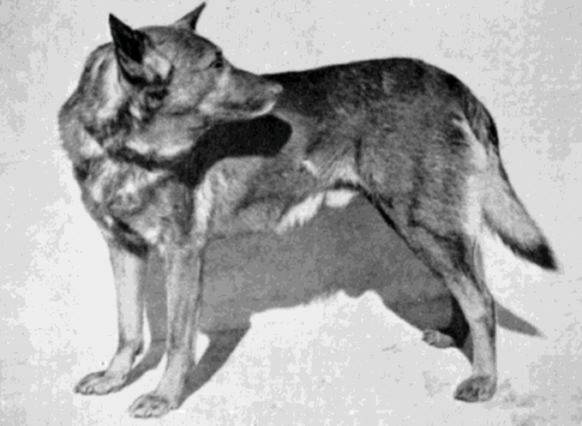
Horand von Grafrath, the first German shepherd dog, b. 1895, d. 1899. Max von Stephanitz used to him to found the breed.
I’ve decided to open up another can of worms, but I found this article by Tina Barber on the Shiloh Shepherd website:
Anyone willing to do some INTENSE RESEARCH into the past will find considerable information linking the “ORIGINS” OF THIS BREED [German Shepherd Dog] WITH THE WOLF!!
On Page 13 of the Alsatian-Wolf Dog, reference to Mons. Otto Rahm’s regarding Hektor Von Wohlen was repeated by the well-known Swiss scientist — Professor Studer — that evidence was very strong that this dog had SOME wolf blood in at least ONE generation. Phylax Von Eulau was also suspected of having wolf blood when he raised a ruckus at a dog show in Germany, while passing a group of BORZOIS!! — (Dogs that were bred and used for hunting wolves!!) The most interesting dog is Woelfi Von Wolfsnest. On Page 14, you can read the entire account of her ancestry, describing her dam’s granddam, as a full SHE-WOLF! Yet, though Woelfi retained the appearance of her wolf ancestry, she had the temperament of a sheepdog — with the exception that she did NOT MAKE FRIENDS WITH STRANGERS!! Her son, Schalk, was not particularly shy, but when bred back to his mother, produced pups that reverted back to the temperament and characteristics of the wolf.
I don’t know if any of this has been verified.
The Shiloh Shepherd that is being promoted with this website is a very large shepherd-tyep dog with a very placid, though protective disposition.
I do know that this part of the article is correct:
MOST PEOPLE DO NOT REALIZE THAT THE “GERMAN SHEPHERD” BREED IS LESS THAN 100 YEARS OLD!!! The Breed Club VEREIN FUR DEUTSCHE SCHAEFERHUNDE (SV) was formed on April 22, 1899 in GERMANY. The original dogs bred to HEKTOR/HORAND consisted of VERY SMALL “SPITZ TYPE, COLLIE TYPE, WIRE-COATED AIRDALE TYPE, BLUE MERLES, etc, etc. The dogs were chosen for WORKING ABILITY — AS HERDING DOGS — NOT FOR LOOKS!! They come in ALL COLORS and SIZES!! What we would refer to today as the MONGREL — was crossed with the WOLF-HYBRID and eventually became the foundation for the German Shepherd of today!!
I’ve not seen any genetic evidence that corroborates any of this historiography, but it is interesting to consider.




well if it walks like a duck and quacks like a duck…
from my non-scientific viewpoint, that dog certainly looks wolfish. beautiful hips, too.
As strange as it sounds, the one study I do know found that GSD’s were more closely related to mastiffs:
http://www.azcentral.com/families/articles/0520SCI-DOG-BREEDS-ON.html
That research is the very same Heidi G. Parker’s (2004) study. Mrs. Oestrander was a member of her group.
I think the mastiff-resembleness this group saw, may be correct. GSD is a mix between Central-European cattle dogs, real herders and LGD-types. The latter was used to gain the size and the robustness of the breed.
Ostrander is a very important dog geneticist.
http://www.americanscientist.org/authors/detail/elaine-a-ostrander
BTW, the Shiloah Shepherds kennel name comes from the bible, meaning an ancient town in Israel. Think the owner T. Barber may have her European-Jewish roots.
Anyway, she has made the trademark out of it with her very ordinary, but good GSDs. Bet they sell more than “The Canoe Dogs” (in retrievers). And with that “wolf-ancestry” it sells even more, woo-of!
Actually the Shiloh Shepherds are not purebred GSDs; the breed was developed by crossing large GSDs with Malamutes and possibly other breeds to increase the size and obtain a more placid dog. They were initially selected for temperament, size, & GSD-like appearance, and “plush” or long coats were favored over the normal shorter-length GSD coat type.
I do believe that GSD’s foundation stock had some then-recent wolf crosses, but that was nearly 120 years ago, and I don’t think that the breed today can be considered more “closely related” to wolves than most other breeds. Certainly their appearance is somewhat “wolfish”, especially GSD puppies, and in the early days of the breed their appearance was more so. Horand was much more wolfy-looking than are modern GSDs.
Barry Lopez in “Of Wolves and Men” mentions a study in which wolf pups were introduced to dogs of several breeds. GSDs were the only dogs with which the wolf pups interacted exactly as they interacted with wolves. In some ways GSDs often act like wolves, howling together as a pack, for instance. Male GSDs will help care for their puppies, too (so will males of some other breeds, though), and pregnant females will often dig a den if they are allowed to.
I think that the recent discovery of recessive black in a Eurasian wolf is another possible indication of a link between wolves and GSDs; GSDs, (as you know) also have recesssive black.
Speaking of GSDs being related to mastiff-type dogs, Fred Lanting in “The Total German Shepherd Dog” has an interesting theory; he proposed that GSDs are fairly closely related to Kuvasz. I don’t know whether DNA studies eventually confirmed that, but it seems obvious to me that some heavier, mastiff-type dogs, possibly Rottweiler or Tibetan Mastiff types, were used in the development of the GSD.
In his initial breeding programs, Von Stephanitz’s sole criterion was whether a given dog could work; appearance was of minimal importance. In the very early days, some individual dogs were registered as German Shepherd Dogs and also as Belgian or Swiss Shepherd Dogs. Dutch, Belgian, and German Shepherd are very similar to one another and that was even more true in the early days of the breeds. There are old photos of wire-haired, brindle, and even merle GSDs; they seem to have been lost from the breed.
The story about the borzoi’s reaction to Phylax may be apocryphal, or it may be true, but whether it’s true or not, I agree, it’s immaterial. They were simply reacting to another dog, not to something they perceived to be a wolf.
But remember, those are dog breed DNA tests.
I know of a doberman mix that doesn’t look anything like a doberman, and a doberman/lab mix that is white with brown spots (that’s unpossible)
According to that study of Parker & al, from all the 414 dogs they tested, only four (4) failed to be intentyfied to their correct breeds. So the error was less than 1%.
I dunno the procentual errors in custom-made DNA-tests.
Per DNA studies I’ve read about, there is NO wolf in the mainstream GSD lines, and none in the German imports either.
The only place it’s been verified by DNA test is in some of the fairly recent (post-1980) Czech lines, and per what I’ve seen written about imports from those lines — one very experienced breeder of performance GSDs wound up replacing ALL of them for extremely unstable temperament (mainly unpredictable, unwarranted aggression) and stopped importing Czech-lineage GSDs as a result.
As to the breed-identity tests for dogs, their accuracy is at best questionable. A year ago I talked to someone who had a 100 lb. Chow-type mutt, that according to the breed-by-DNA test, was half Yorkie. Right….
First dog I trained completely through Open FT work was a Lab/Dobe cross (dam was a registered black Lab bitch from good old field lines). Looked like a black-and-tan Lab. Acted like a Lab and could do all the work — except he would NOT touch a bird. He’d pick up bumpers, sticks, rocks, cans, dead rats, chunks of deerhide, and other random objects — but NOT birds.
Oddest but beautiful cross I’ve seen: looked like old-type Queensland Heeler X either Pharaoh or Ibizan Hound. You could plainly see both types in the dog.
Doesn’t look wolfish to me — eyeset is level, body is too broad, too much angulation, and not enough leg for a wolf. Looks more like the basic Castro type but with upright ears.
Reminds me of a farm-shepherd type that’s common in Montana, except those are invariably golden-tan with white feet, tail tip, and blaze (but never any body white or white collar).
Do remember when reading old accounts of what went into a breed’s development… that back before public stud books, individual kennel strains (what we would now call foundation stock for a new breed) were treated like trade secrets. The owners told all sorts of fanciful stories to prevent other breeders from figuring out what breedings they’d done.
The Golden Retriever origin myth (as being “Russian tracker” or “Russian circus dogs”) is a typical example. The only way to verify or debunk such stories is through access to the private stud books themselves.
Romantic fantasy, apart from how much any dog has wolf in them. (And more commonly in breeds which still live in areas with wolves and so periodically interbreed.) We see many wolf hybrids here (though they’re not legal and will be destroyed if taken in by authorities) and crossing with wolf does not produce a good temperament for herding or guard work.
It’s different if you want a dog with great endurance — my understanding is that Czechoslovakian wolfdogs are excellent for endurance sport and SAR, for example — but that doesn’t necessarily produce the qualities desired in a dog that works with livestock and people. Of course it’s impossible to say 100% what is in any dog of uncontrolled ancestry, and the root stock of the GSD was indeed diverse, but personally I strongly doubt any real wolf influence, if only because wolves had been mostly eradicated from where it was bred and the wolf was not very romanticized at the time — it was viewed as vermin to be eradicated, not a desireable outcross!
You can actually see some interesting contrast between purpose bred wolf hybrids, and dogs which are merely bred to resemble wolves if you compare the Tamaskan dog, the Saarloos wolfhond, the Utonagan, and the Czechoslovakian wolfdog. I’ve met a few Shiloh shepherds because I was interested in the breed (I’d love to get a dog like the GSD, but without the health problems). My conclusion was that the Shiloh was a nice companion breed, but as for wolf ancestry? No. And also not remotely like the old herding landrace in Germany. Comparatively the Shiloh’s drives are very low, which is a good thing in a pet dog (or some service dogs), but not for a herder/guard dog.
I am very skeptical of all of this.
It hasn’t turned up in any genetic studies.
Shilohs are meant to be toned down a bit and be family pets.
Shilohs are meant to be toned down a bit and be family pets.
Which is fine, but the breed founder is trying to tout them as being closer to the “original” GSD type. That’s most emphatically not true — GSDs were diverse, yes, but considerably smaller than 120lbs., and they were bred for working drive, not to be family pets.
I ultimately decided against the breed not because of temperament (I can deal with drive but I can also do without since I’m not working the dog) but because of the large size. I do a lot of hiking and climbing, and take the dog. If something happens to a 110+lb. dog out there, how am I going to carry him or her out to safety on my own? People looking for police or military dogs have similar concerns — who is going to lift a huge dog like that through windows or over obstacles? (I’m assuming active work here, as opposed to just guarding where size is an asset.) 60-90 lbs. is about right — big enough to stop a man if necessary, but you can easily throw the dog over your shoulders and carry it if necessary. As with the large size lot of the other claims behind the Shiloh breed are… questionable. The dogs are nice, though, and might be a good choice depending what the prospective owner is looking for.
I don’t know if the Bavarian landrace shepherd was bigger and more gentle.
I do know that the animals we knew as children are often larger in our memories than they actually were.
Perhaps this is what happened here. She knew them as normal-sized dogs, but she remembered them as huge.
LOL
I remember thinking of my babysitter beagle as a big dog.
Then I saw a foxhound.
I thought it was a giant.
I can’t speak for the dogs a century ago, but I can tell you that the generic “farm dog” shepherd that still exists in that area is a sort of medium to large (because they vary a fair bit of course). All of the “herding” landraces in that part of the world seem to be similarly sized — the various Belgian shepherds, the Dutch shepherd, the Berger Picard, etc. and it’s medium-large, not giant.
I had thought of that “every dog seemed enormous to me as a child” explanation too. :D I certainly remember my childhood dog as enormous, and he was a bit oversize for a European bred GSD (at around 26″ or so in the shoulder and roughly 100 lbs.), but nothing exceptional. The difference was I know he was larger than average, and hadn’t been bred that way deliberately. People who fancy “oversized” GSDs can’t seem to accept the ample pictoral evidence that the breed has never been particularly large:
http://www.gsdcsaz.org/Old%20Pictures.htm
I think it’s only in the USA, Canada, and Great Britain that very large, oversized GSDs are really popular. Especially here in the good old USA, where “bigger is always better” (unless it’s toy dogs, in which the opposite seems to be the goal).
This is a very interesting subject I have had some experiences with over the years when I kept wolf hybrids–especially since one of the commonest breeds wolf hybrid breeders use for the cross(after Malamutes and Siberians) are German Shepherds–in fact, there was a strain around for awhile called “Timber Shepherds”! I have seen F1 crosses, first generation animals whose parents were well known(a LOT of B. S. in the wolf hybrid world, and you learn to question “percentages” of wolf and other exagerrations and misinformation purty quickly if you have much experience with the phenomenon!) that were exactly half wolf, half GSD, and man, they looked AMAZINGLY like some of the “foundation dogs” shown in GSD breed histories! My experience discussing this with American and English breeders is their vehement reactions–NO WAY, NO HOW! But in talking with several German breeders over the years–they readily admitted some of the early foundation dogs were part wolf–there is even a story of a particular wolf bitch used by Von Stephanitz(originator of the breed) himself. But I have to agree with those German breeders who pointed out that that was SO LONG AGO, and without continual addition of new wolf blood, it makes little or no difference as far as influencing anything of the modern dogs we have today–it is just an interesting factoid(?) that reflects cultural views on wolves(English and American tend to be very culturally negative towards wolves, Germans have a long history, among Europeans, at least, of admiring and using wolves as a positive cultural symbol…) Will it ever be proven one way or the other? I doubt it…..Another interesting thought on the development of GSD’s, which might be taken into consideration for anyone who wishes to try and restore the breed to it’s former physical glory(instead of the crippled genetic wrecks they have become)–there is also a little known or discussed possibility that Norweigan Elkhounds(or a similar type dog) was also used in the original crosses! The breed histories just say they came mostly from indigenous shepherd type dogs–some of the Northern Spitz type shepherds were very Elkhound-like in looks and temperment! Elkhounds are, in fact utilized as common farm dogs in Norway, as well as being hunters, and some herding abilities are reported in the breed. Some evidence of this, perhaps, is a wolf/Elkhound cross I once saw–it looked amazingly like a purebred GSD! I had a wolf hybrid who was a hodge-podge of wolf and dog breeds–mostly wolf and malamute, but also some Elkhound and collie way back there. There was a touch of GSD, too, but it was the least genetic influence(by numbers alone, at least), yet this animal had amazingly GSD-like markings(he took the wolf bodily structure, thank goodness), and most people mistook him for a GSD cross. I actually had two seperate GSD breeders go over him with a fine-tooth comb(he was very well socialized)–and both thought he was a straight-up F1 cross between a GSD and a wolf. They were suprised when I revealed that GSD was the least recent blood in his background–but that he had more recent Elkhound and malamute influence to his breeding(none of his littermates, by the way looked anything like him–they were all very wolfy/malamutey looking)–I have come to believe that a wolf/Elkhound cross is very possibly in the GSD’s developmental background. I haven’t read of any DNA tests comparing Elkhounds with GSDs. I do find it interesting, too, though, how in some breed descriptions of Elkhounds, they are described as being like a “compact GSD in appearance””–perhaps it should be noted that GSDs are REALLY like an elongated Norweigan Elkhound in appearance!
>>>>>>that was SO LONG AGO, and without continual addition of new wolf blood, it makes little or no difference as far as influencing anything of the modern dogs we have today–it is just an interesting factoid(?) that reflects cultural views on wolves>>>>>>
Lane, you so right with yours.
In Central-Europe, wolves are accepted better than in the Northern Europe.
In Fenno-Scandia the case is ill. Poachers and national killings have lessen the population nearly into extinction. In Sweden, they shooted wolves from the helicopter till there is less than 100 animals left. In Norway, it’s even worse, only 40. In Finland about 170 is left and in the Finnish Lappland, no more wolves there because of the poaching wolf-haters and reindeer-breeders.
Very good point about the Elk Hund and GSD likeness. The mask, the coat, also the head and body types are identical.
“Phylax Von Eulau was also suspected of having wolf blood when he raised a ruckus at a dog show in Germany, while passing a group of BORZOIS!! — (Dogs that were bred and used for hunting wolves!!)”
This is just plain stoopid.
I was not pleased with that one.
My guess is those borzoi hadn’t a bloody clue what a wolf was.
Had never seen a wolf.
Wold probably wet themselves in terror if they ever did.
My dog went nuts at the sight of a Weimaraner.
That has to mean something!
And you wonder where Lysenko got his ideas…
The purebred coonhounds went nuts when the Persian cat walked by their yard – ergo, the Persian cat must have raccon blood, and all of it’s kin are suspect of having racoon blood?
The Rhodesian Ridgeback dogs (said to have been bred to hunt lions) went nuts when your cousin walked by – watch out your cousin is really a lion – the ridgebacks said so.
People don’t believe every dog that barks.
well, the Belgian shepherds do have some DNA evidence of (relatively) recent wolf blood since they are W6/D6 MTDNA clade. I’ll note that the Belgian Goyet cave study (Fossil dogs and wolves from Palaeolithic sites in Belgium, the Ukraine
and Russia: osteometry, ancient DNA and stable isotopes) found the jaw range of the German Shepherds and
Malinois overlaps largely with the one of the recent wolves.
This isn’t to say that Belgians are like a Saarlooswolfhond. Relatively recent is probably a few thousand years or so. But it’s more recent than most GSD. I say “most” since the boundary between Belgium and Germany was rather porous since both became “countries” only in relatively modern times. In Caesar’s time and after, tribes were going back and forth all over the place. It’s highly likely that some “altdeuchers” and a few GSDs have more than a smattering of “Belgian” behind them. Dogs aren’t always great respecters of political boundaries.
The myth of “wolf dog” GSD is pretty much based on Hollywood and Jack London. Much easier to have a GSD play the role of a wolf for film than to try and get a real wolf to do so. Cheaper too.
Peggy Richter.
My understanding is that these dogs were bred to look like wolves so sheep would respect and fear them more.
That’s the rumor I heard.
I think this borzois-reacting-to-a-german-shepherd-story is hokey, too(it is rpeated in the National Geographic book on dogs), but it is not THAT far-fetched IF certain things were true–mainly, had these particular borzois been used to hunt wolves? Show dogs at a prestigious dog show? Not likely, but NOT impossible–borzois DO continue to be used to hunt wolves in Russia–I had a Russian acquaintance send me some photos of one just a few years ago posed beside the young wolf it had just killed single handidly–so there is a microscopic chance there might be some truth to this tale. However, I would want to see how those borzois reacted to all the other dogs nearby before I’d accept they were focusing their excitement and aggression on just this GSD with supposed wolf genetics. Sighthounds like borzois ARE visually oriented more than other dogs. I also got some bizarre reactions from dogs(unusual or abnormal according to their owners) when they encountered my wolf hybrids–extreme aggression in dogs not normally aggressive to other dogs, and fearfully submissive and peeing all over themselves from dogs who WERE normally aggressive and assertive with other dogs(and this irregardless of how my wolf-dogs were acting towards them). So, do dogs have breed/racial memories or instincts regarding other animals? At first glance, it seems preposterous, but then how do breeds like bird dogs have such immediate obsession with birds, or scent hounds like foxhounds a decided preference to trail foxes over other animals, or herding dogs automatically interested in moving livestock around? SOMETHING in their breeding certainly influencing this behaviour. One of the most interesting and blatant examples of this possible racial instinctive memory I witnessed with some of my own dogs, and it was unmistakable(and quite unexpected!). Working at a zoo, I come home with all manner of exotic scents on me on a regular basis–my dogs sniff me with great interest and roll their eyes at me as if to say, “WHERE DO you go every day?”! One day at work, I had to help carry and move a POLAR BEAR around that had to be anestethized for a medical procedure(this takes A LOT of participation, as you might imagine!)–I was thouroughly coated with polar bear scent in the process. When I got home that evening, all my various dogs were very interested, not suprisingly, but my Siberian Huskies went frikkin NUTS! They clawed and pawed and yapped and reacted ten times more excitedly than any of my other dogs! I had also helped handle both grizzly bears and black bears on other occaisions, and the huskies had been interested in these scents too, but NOTHING to compare to the polar bear scent!!! I find that amazing and fascinating…..And none of my huskies have been anywhere near a polar bear in many, many generations! Makes you wonder…..
Lane, interesting about the huskies and polar bear scent.
One person once said that what we call “sled dogs” weren’t really sled dogs to the Native peoples in the Northlands. Instead, these husky-type dogs were really hunting dogs, bred to find seal breathing holes in the ice – perphaps the breathing holes for other marine mammals as well. Perhaps even polar bears – basically anything the people could eat, feed to the dogs, or use the oil from to light/heat their homes.
Yes, the dogs help drag the dead seal, or other dead animal back to the camp, and yes when the hunter went out with his dog-pack to hunt on the ice, he tied the dog-pack to a sled so that the dogs could pull him, but the real point was for the dogs to hunt something for the man to kill.
He told me, that the Native Americans of the North, really didn’t have any place else to go to to use their dogs for transportation – not like they were driving the dogs to the movies, grocery store, or to court for a speeding ticket.
On the idea of inherited knowledge, this was proven a long time ago with flatworms, by putting a bunch of them in water, hooking the water they were in to a shocker which went on whenever their light was turned on. Soon the flatworms scrunched up (curled up) whenever the light went on – even though the shocker had now been turned off. The heads of these trained-to-scrunch flatworms were ground up and fed to untrained flatworms, and after that, the untrained flatworms scrunched up when the light was turned on.(science can sometiimes be cruel). Not a genetic learning, but one that could be inherited from the mother, or carried somewhere in sperm.
I think it was on this blog (retrieverman) that somebody mentioned this idea in relation to big cats in the British Isles? What’s the name of that show on TV with the cool ad that has the close up of something like wolf eyes, and it growls? They had an episode on people reporting giant birds – thunderbirds. And, I think they mentioned the idea of old inherited memories in people?
The question is: are these animals real, or are old genetic memories being triggered by being in similar backgrounds?
Might huskies not be the only ones to have automatic feelings from things that happened to their ancestors long ago? Are the things that you do now, imprinted on all of your future children? Things hidden, but able to be triggered by some events? Aren’t You and I are animals too? Since bird dogs have an instinct for birds, border collies inherit a desire to herd, horse to run, burros to stand still – why believe that people were left out when knowledge was ‘handed out’? Maybe we inherited the knowledge that we can learn to speak?
Though similar in appearance, and no doubt having a common ancestry, some types of Nordic dogs were distinctly selected as sled dogs as opposed to hunting dogs; the West Siberian Laika, which looks very much like a Siberian husky, was developed and selected more for hunting ability. However, all sled dog types(Siberians, Malamutes, Canadian Eskimo dogs, Greenland dogs, etc) still maintain a LOT of hunting instincts(they were often left to forage for themselves in summer months, so HAD to maintain some hunting/foraging ability to survive), and were used for chasing and holding polar bears at bay specifically, so this is something probably deeply entrenched in their breeding. Being alert and reactive to polar bears is certainly condusive to survival in the Arctic anyway, regardless of going out to purposefully hunt them! So, have Borzois been selected for hunting specifically wolves long enough for such an instinct or tendency to be passed on to non-hunting offspring? To where they might react more strongly towards a more wolfish-looking breed than towards other dogs? How many generations are needed to instill such instincts? So maybe, just maybe, there might be something to this story…….
I believe huskies are derived from a strain of the East Siberian laika that were living around the Anadyr River in the Russian Far East.
It seems a bit Lamarckian to think that show borzoi bred in the West would have exactly the same reaction to a wolf-like dog that the actual hunting borzoi in Russia would have.
My dogs flip out at the scent of rattlesnakes. They have done that from day one, it’s not a learned response. In fact, even when we lived in Florida, they were really interested in snake smells.
I don’t think they have them in Afghanistan, the snakes, I mean.
It’s interesting, because golden retrievers tend to ignore snakes.
But my golden boxer reveled in gutting them and tearing them into many, many pieces.
Every time a piece of the snake would squirm, she’d sail onto it again.
Don’t use such big words on me, Retrieverman—-Lamarkian? Is that a Limerick that doesn’t rhyme?
http://en.wikipedia.org/wiki/Lamarckian
Retrieverman – getting into deep old murky waters there. Teachers use to laugh at Lamarckian ideas, but some scientist find bits of evidence that they believe might point to environment causing some ‘mutations’ to be made in a helpful direction.
Then there is epigenetics. Nobody really understands epigenetics well enough to explain it to the rest of us, so I’ve worked out my own rough idea of it. I know that my simple view of it is probably 99.99% wrong, but I have to have some view point, so until a better one manages to make itself know to me, here is mine:
Human cells, those little things that make up our body, are hoarders – you know – like those people on TV that hardly ever throw anything out? One a cell has a code to make something, it keeps it – oh it may NEVER use it, but it won’t throw it away.
And when a cell reproduces, it copies all the codes that it knows and gives each of the new cells a copy too. This has been going on since the first cell, since the first spark of life, since the first little single celled ameba.
Yep, you read it right, every cell in your body has a whole copy of The Book of Life within it. Book of Life??? Well, we have to call it something don’t we? I mean each cell has a (mostly) complete code of all of it’s ancestors. (Speaking, of course, as a species, not as individuals).
Within each of your cells is the code to make gills. So why don’t you have gills? Because that bit of code is hoarded away in some dusty cabinette under generations of new stuff – or if you want me to say it less poetically, “those genes are turned off” – they are there, but unused.
Epigenetics is mostly about what turns genes on or off – what digs them out from under piles of new junk, and what causes them to be left on the floor and covered up. Not gone, but forgotten.
Epigenetics is the maid come to deep clean the hoarder’s mess.
When something seems to be happening in a Lamarkian way, it COULD be, not that new genes are made, but that old buried genes are being dug up from the bottom of a pile, and restored to be used again. Or, straighter said, genes that have not be used in generations, are turned back on.
But basically, Lamarkian ideas are horse droppings 99% of the time. That’s why teachers laugh at them.
But if anyone can explain it better (for my simple ears), I’d love to learn more.
Everything you say here is absolutely correct.
However, to say that borzoi have a genetic hatred of wolves is, um, Lamarckian.
Retrieverman – I 99.99% agree that borzoi (the ones I have seen at shows) are no more likely to have a genetic hatred of wolves than any other dog – and I find no evidence that dogs hate wolves without having had prior bad experiences with them, or training to hunt them.
Strangely, Chihuahua owners often claim that Chihuahua dogs only like other Chihuahua dogs – that their Chihuahua knows the difference between Yorkies, Pomeranians, and other Chihuahua dogs.
I never really believed that – but Chihuahua dogs were a new World breed, somewhat seperated from Old World breeds – but anymore, the idea of ‘purity’ in most tiny breeds in the US is in doubt.
Well, supposedly Chis lived wild in Mexico for a time.
However they aren’t really a New World breed in terms of genetics.
They are mostly European toy dog.
It is commonly said that Salukis (or insert your sighthound of choice here) only like their own kind. I haven’t found that to be completely true, although mine occasionally tend toward playing in breed specific groups (Afghan, Azawakh, and Saluki.) The male Afghans do have a righteous hate-on for the male Azawakh, though I think that’s due to the Azawakh penchant for barking obnoxiously at them, rather than their being a different breed.
I think a more interesting question is NOT do German Shepherd Dogs have wolf in them, but should show GSD lines have wolf added to them? – sacrificing temperament for health and the ability to move right?
Should the GSD club, add an appendix for wolf-shepherds, so that when bred back to 7/8 pure, they can be shown and their pups (from pures) be registered as pure?
Of course, no breeder would be asked or forced to breed to any of these, but those who wanted to use this outcross to improve their show lines could. What do you think this would do the breed?
One of the finest German Shepherd Dogs I ever met was a 4th-generation removed from a surreptitious outcross to a half GSD / half Canadian wolf. She was an absolutely gorgeous dog, tall for a bitch but slender compared to a normal GSD, not quite as long in the back. She was black, but with a beautiful dark silvery-gray undercoat and silver in her neck fur. She was a friend’s personal pet & he also participated in SAR with her. She was very aloof, but not aggressive, and extremely intelligent. Her color was really breathtaking. She had golden-yellow eyes and a very black face & head, framed by that silver & black neck fur. He named her Sioux, which may be an odd choice for a GSD, but it suited her. She lived to be about 14 years old, and never developed hip or back problems.
The other 2 pups from that litter were a lighter, sable color, also with yellowish eyes, also built taller in the leg than most purebred shepherds. I don’t know what eventually became of those two.
My friend died a few years ago and I don’t know what became of his dogs, or whether any dogs from his lines exist today. I don’t think that outcrossing GSDs to wolves is necessarily the best solution to some of the health problems within the breed, though. Most of the wolf hybrids I’ve known, including a litter that I raised from 3 days old, became very predatory as they matured, especially toward children. There are plenty of GSDs (but precious few in “show” bloodlines) that are less extreme in conformation, and more like what the breed was intended to be. I don’t claim to be an expert in the subject, but I think that a good start would be for inbreeding and linebreeding to be sharply curtailed, or better yet, eliminated altogether. Judicious outcrossing to less contrived breeds such as Norwegian and Swedish Elkhounds might also be a good idea. Requiring breeding stock to achieve working titles could help (although when I look at some of the German-bred Schutzhund-titled dogs, I shudder to see their hunched backs & hindquarters).
I’ve had GSDs all my life, and the healthiest, happiest, best dogs I’ve ever owned were from working lines, rescues, or just plain old PETS. The only GSDs I’ve ever had with serious health problems were from show lines.
no, the Belgians and GSDs weren’t bred to look like wolves to intimidate sheep. Here’s what the foundation Belgian looked like: http://commons.wikimedia.org/wiki/File:PicardDuc.jpg Picard is one of the main foundation dogs. Duc was his son and also a major player in the Belgians. The von Stephanitz book showing early HERDING German dogs and the look of the still-existing Altdeutcher disproves the “intimidate sheep” theory. Briards and Beaucerons aren’t particularly “wolfish”, and certainly Pulik aren’t. Now to intimidate PEOPLE, that’s likely. Keep in mind that the first official police dogs were Belgians, followed by the GSD. Also the “basic wolf look” is very sound, very functional, very versatile. So “form follows function”.
Black or dark colors tend to intimidate stock (both sheep and cattle). It also is easier to spot a dark dog across a herd of white sheep. And it’s also better for the role of police/military dog for the dog not to stand out in low light and in a variety of environments (which is why white isn’t desireable).
As for fixing GSDs, there are plenty of GSDs without the show exaggerations (either the German “banna back” or the US “super hock”). One can go to the working herding dogs (there are still some lines out there), the working police/military lines or the guide dogs. Or use a KNPV “GSD” that has a heavy dash of Malinois/Dutch in there. It’s not necessary to use “wolf”. For that matter, I’ve seen a few GSD/Doberman crosses that weren’t half bad.
Peggy Richter.
Okay–I’ve had my Lamarkian lesson now(it was near Lamaze in the dictionary, but I don’t plan to need that….)–restore GSD’s by crossbreeding with wolves NOW? Despite the FACT that you COULD produce some splendid, functional animals that way, there is NO WAY that the politics and emotions that will forever swirl around anything “wolf” would ever allow it! Take it from someone who has been interested in and involved with the wolf-hybrid phenomenon for several decades now! It COULD be done sensibly, but when has being sensible ever been a part of humans breeding dogs–at least with something as controversial as this? Something like this brings out the weirdest and quirkiest individuals imaginable in our species! With conformation show people ready to kill each other over even accepting a different color in a breed, or an outcross from another registry in another country, just seriously SUGGESTING adding wolf blood may get you forever ostracized from dog society! Only people who just want to do their own thing, live isolated and could care less about being accepted by dog society at large(or ANY human society, for that matter!) should even consider it–even then, boy howdy, you better do your homework, be dedicated as heck to your animals, and be happy being a recluse! Restore the GSD? I hope it happens, but yes, better off using existing dog breeds like the various Belgians, and maybe experiment with that Elkhound suggestion I made. If you slip a bit of wolf in there, KEEP IT SECRET!!! Even with the most magnificent, functional, amazing new GSD’s in the history of the world, the conformation show people would still never accept them(like the Shiloh Shepherds and White GSD’S–which you should consider utilizing in your restoration process)…….
I have a neat book(that I purchased with my first paycheck from my first real “white man” job–at a Pet Shop, lo these many years ago…..”The International Encyclopedia Of Dogs”, edited by Stanley Dangerfield and Elsworth Howell; originally published in England in 1971–it has a very “British” take on dogs. In the section on the German Shepherd it goes into this controversy, and I’d like to quote it here for interest’s sake–“The age-old question of whether there is in fact some wolf blood in the background of this breed must now be examined. Most people would admit that it is at least genetically possible that at some time in the past crosses were occasionally made with wolves(although normal wolves and dogs are mortal enemies). However, these would be so far back that they could not be of any interest at all today, and could have little, if any, bearing on the breed’s temperment. The suggestion that crosses are still made is clearly without foundation. No breeder in his right mind would take his modern, highly developed, intelligent, biddable, streamlined German Shepherd and cross it with a wolf which is savage, badly conformed, and often mangy and motheaten in appearance.”—boy, talk about a SERIOUS wolf prejudice!!! And obviously, serious wolf ignorance(which tends to always be the twin of prejudice, of course). But this well illustrates the “English” view on wolves compared to dogs, and this is also common in America. The Germans, who originated the breed, did NOT have this negative view so much, and throughout history have used the wolf as a positive warrior symbol(a very good reason WHY the British may have such a vehement view towards wolves as a culture! Hence their preferred term for the breed–“Alsation”!). It is very plausible, in my opinion(and after talking with German breeders who blatantly accepted some crossbred wolves WERE utilized in the early development of the breed) that a German military Captain(Von Stephanitz), wanting to create the ultimete war and guard dog, would at least consider the addition of wolf blood–it would have been hard not to at least experiment with it, if a wolf/wolves were available(as I’m sure they were). Ironic how this quote mentioned that wolves are “badly conformed”, when in reality, they happen to be some of the most purely TRULY functional(AND BEAUTIFULLY moving) creatures on the planet, and what terrible straits the GSD’s are in now as genetic wrecks and as poorly moving and functioning a breed as has been screwed up by this “highly developed” form of modern breeding practices!
….And while looking up this bit in my enormous dog-setion of my library(the homemade bookshelves chronically groaning in agony from their excessive burden), I looked up where I had seen that comment about the Borzois reacting to a German Shepherd at a dog show. It was written by Freeman Taylor in the 1st edition of the National Geographic Book On Dogs(1958), in the intro section to the Hound Group. He did NOT positively identify the GSD as the breed there, merely saying it was a dog of possible recent wolf ancestry–I always assumed he meant a Malamute, the breed usually most closely associated with wolves, so I was actually suprised to find out on this post it was a GSD he had been talking about!
So, even though one writer for the National Geo Dog Book’s impressions on some borzois reactions to a GSD at a dog show he attended as the source of this tale, may not be the most(ahem!) convincing of research–still, could not borzoi have an instinctual recognition of wolves that might influence their behaviour to more wolflike dogs? How would that be any different than bird dogs fascination with birds, or instinctive herding or retrieving skills and behaviour bred into other dogs? I’m not saying I believe it, just that it COULD be possible. I remember now reading an account of a person training a borzoi to course and kill coyotes in this country, and his borzoi automatically coursed and killed another dog when it was quite young, and this person was worried his borzoi would then be incompatible with other dogs(it was not, and ended up being a superb courser and killer of coyotes, working with a pack of other sighthounds)–so might borzoi have an instinctive tendency to course and attack other canids in a general sense? Not just wolves, specifically, in other words. Of course all sighthound types instinctively chase whatever they see running(but then most dogs do! Sighthounds are just better at it!) It is an interesting thing to ponder–we need some Borzoi People to chime in with their thoughts and experiences here(especially if they actually hunt with their dogs….)
Send me a wolf, I will test to see what my Tazi thinks, they are used on wolves. Her parents came from Russia and Kazakhstan, so her instincts should be pretty strong still.
LOL
I’ve you’ve a spare gazelle lying around I’ll test the Salukis, too.
Ha! I had a “desert bred” Saluki who was half Turkish breeding(yes, Jess, I can tell YOU some funny stories involving AKC saluki snobbery–I took this dog several times to the Saluki Specialty at the Horse Park in Lexington, Kentucky–just imagine a backwoods Appalachian hillbilly to the core mixing with the usual conformation snobs who most certainly DID NOT approve! Yet I DID meet a few really neat, sensible, functional humans there too!)–he was huge(for a Saluki)–30″ at the shoulders–more of a borzoi standard size! Apparently they breed them bigger in Turkey, and one reason is they hunt wolves with them. Anyway, I was given a rescue wolf hybrid pup(around 3/4’s wolf–so mostly wolf in looks and temperment) just when this Saluki hit a year old, and both being the youngest in my large pack, they bonded very closely and were inseperable! So much for being “natural enemies”(they were both intact boys, too!). What was so funny is that in playing, the wolf-dog usually took the role of the chased, and the Saluki eagerly coursed him! It was never much of a contest as far as speed went, but the Saluki could rarely pull the wolf-dog down–he would just shrug the saluki off and keep going! But I had lots of fun telling people I regularly coursed “wolves” with my Saluki(who really was more Tazi-like, or maybe even Taigan-like, than like typical AKC Salukis….) As for gazelles–never had the chance there, but I have seen my share of whitetail deer courses(none intentional, of course!)……
[…] have sustained progeny in the Czech GSD gene pool, along with the expected negative side effects: Reziac Per DNA studies I’ve read about, there is NO wolf in the mainstream GSD lines, and none in the […]
in colorado a pack of wild dogs killed many people and the pack was led by a germanshepard dog if there is no wolf in them then whi did the dog know haw to lead a pack?
LOL.
There are killer dog packs all over the world that have no German shepherd in them whatsoever. In the 1970’s, my grandpa shot a whole pack of dogs that were attacking people that was led by a very aggressive bluetick coonhound, and when had foxhound and they were trialed, it was not unusual for poorly trained foxhounds to run off in packs and kill deer, cooperatively hunting just as wolves do.