
The artist and author Vero Shaw depicted a “Scotch bob-tailed sheepdog” in his Illustrated Book of the Dog (1879). In his description of the bob-tailed, rough-coated droving dogs, he claims that the breed has nothing to do with collies, but then he goes onto confound the rough-coated droving dog with the “rough-coated” (bearded-type) collie. This rough-coated drover, as depicted above, is what an Old English sheepdog used to look like.
This dog is likely not a Scottish sheepdog at all. The rough-coated drover’s dog was common in the Lake District and the West County of England, where the dogs used on massive stock drive to market. Droving dogs had to control large flocks and herds as they traveled down roads, which is different from the gathering dogs, which bunch stock together and then bring them to the shepherd.
Some bearded collie historians have locked onto Shaw’s depiction of the “Scotch bob-tailed shepherd” and claim that the two breeds were one and the same. This is probably incorrect. Bearded collies were gathering dogs, while the rough-coated bobtails were drovers. The Highlands of Scotland are not that close to the Lake District or the West Country, where these rough-coated drovers were developed. This dog that Shaw depicted was not likely from Scotland. It was most likely an English dog.
Often, Old English sheepdog historians have responded with the fusion of their breed with the beardie in some nineteenth century accounts that they have gone down an even more spurious route. One often runs into accounts that the Old English sheepdog is derived from the South Russian Ovtcharka or the Komondor, breeds that don’t even herd. They are livestock guardian dogs, and tend to exhibit very little predatory behavior– which is the basis of droving and gathering. These dogs bond with the sheep and guard them from predators, treating the sheep as if they were their family unit.
However, one should note that there are many active herding breeds with these shaggy coats. The Schapendoes of the Netherlands, the Schafpudel of Germany, the Briard and Picardy Shepherd of France, the Bouviers (cattle dogs) from Flanders and the Ardennes, and the various rough-coated dogs that are part of the greater German herding dog landrace.
Even those dogs, however, do not closely resemble the bob-tail in Shaw’s depiction.
Take another look at the dog.
Imagine it without the beard.
What do you see?
I see another droving breed: the Australian shepherd.
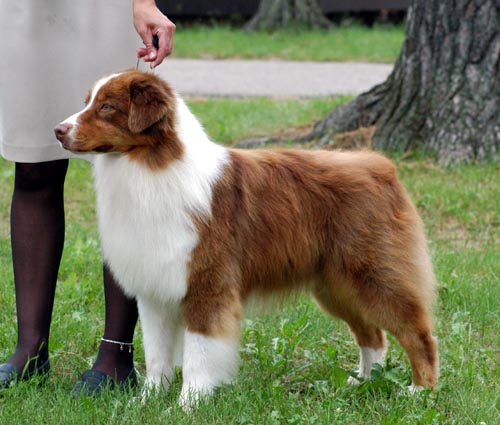
Australian shepherds, of course, are not from Australia. They developed from several different herding breeds that were brought to the Western US in the middle of the nineteenth century. Much has been written about their relationship to Pyrenean shepherds, to German “tiger dogs,” and to a Spanish breed called a Carea Leon.”
Although I would certainly not want to deny any contribution from these continental breeds, which I certainly believe is there, it is also likely that the the bob-tailed droving dog played some role in its development.
Bewick depicted a smooth-coated bobtailed droving dog in his A General History of Quadrupeds (1790).

Bewick’s description of the dog goes as follows:
Is a trusty and useful servant to the farmer and grazier; and although it is not taken notice of by naturalists as a distinct race, yet it is now so generally used, especially in the North of England, and such great attention is paid inbreeding it, that we cannot help considering it as a permanent kind. In the north of England, this and the foregoing are called Coally Dogs.
They are chiefly employed in driving cattle ; in which way they are extremely useful. They are larger, stronger, and fiercer than the Shepherd’s Dog ; and their hair is smoother and shorter. They are mostly of a black and white colour; their ears are half-pricked ; and many of them are whelped with short tails, which seem as if they had been cut : these are called Self-tailed Dogs. They bite very keenly; and as they always make their attack at the heels, the cattle have no defence against them: in this way, they are more than a match for a Bull, which they quickly compel to run. Their sagacity is uncommonly great: they know their master’s fields, and are singularly attentive to the cattle that are in them. A good Dog watches, goes his rounds, and if any strange cattle should happen to appear amongst the herd, although unbidden, he quickly flies at them, and with keen bites obliges them to depart.
Similar to the Cur, is that which is commonly used in driving cattle to the slaughter: and as these Dogs have frequently to go long journies, great strength, as well as swiftness, is required for that purpose. They are therefore generally of a mixed kind, and unite in them the several qualities of the Shepherd’s Dog, the Cur, the Mastiff, and the Greyhound. Thus, by a judicious mixture of different kinds, the services of the Dog are rendered still more various and extensive, and the great purposes of domestic utility more fully answered.
This dog strongly resembles a smooth-coated Australian shepherd, and although it was being used to herd cattle to market, it was a droving dog, just like the rough-coated dogs that were being depicted a century later. Bewick made things a little confusing when he combined this bob-tailed drover with the “coalley” dog, which were gathering dogs.
The most interesting part of Bewick’s description is the discussion of the “self-tailed” dogs. English drovers had to dock their sheepdogs to avoid a tax– at least that is the story that has been traditionally told. Some shepherds bred for natural bob-tails in their lines, a trait that exists in both Australian shepherds and Old English sheepdogs. The gene that causes anury in the Aussie has been identified, but it has not been found in the Old English sheepdog (yet). However, the Aussie shares this bob-tailed gene with the Polish lowland sheepdog, which may be origin for the rough coat in the nineteenth century bob-tailed droving dogs.
In colonial America and in the early days of the republic, massive stock drives were commonplace. Herds of cattle and flocks of sheep were marched down country lanes from homesteads in the interior to port cities, such as Philadelphia and New York. Later, when the port of New Orleans became open, Cincinnati became a major destination for herded livestock, where they were shipped down the Ohio and then the Mississippi to the Gulf of Mexico.
It is unlikely that many of these dogs were bearded, but some could have been. However, Americans likely tried to keep their dogs clean faced, simply because they were easier to care for and did not suffer in the extreme heat.
These dogs mixed with other British herding dogs, those from Germany, and later the various Iberian herders. Out of that admixture came the Australian shepherd.
However, the bearded dogs took over the bob-tailed drover type in England in the nineteenth century. They then became a fancy show dog that was bred to be quite different the collie-ish drovers. It became a fashionable pet at several times in is history as a non-working animal, and over time, it lost any similarities it might have with its probable relative in North America.
The hint to a common origin are these nineteenth century depictions, which clearly show the bob-tailed drover to be something like a bearded Australian shepherd.
If only it could be proven that the OES and Aussie share the gene for anury, then the relationship could be confirmed– at least a little.
The reason why I say this is the Pyrenean shepherd and the Carea Leon have naturally bob-tailed individuals, but even if they do, it would still not negate the possibility or even likelihood that Australian shepherds are at least partially derived from the English bob-tailed droving dog. It merely means that the Aussie has other dogs in its gene pool besides those from the British Isles, a fact I whole-heartedly accept.
But there is no denying that Shaw’s “bob-tailed sheepdog” looks like a bearded Australian shepherd. The similarity cannot be a mere coincidence.




The natural bob-tail gene was once common in the original Scotch Collie landrace, which is why you find bob-tail gene in many of derivative breeds today such as the Australian Shepherd, English Shepherd and old time Scotch Collies. The Aussie people have selected for this trait and the Rough Collie people have selected against it but there are lots of written references and pictures of these bob-tailed collies back in the day.
a naturally bob-tailed collie 1995
We know that the rough faced drover dogs were crossed with collies into the early 1900s, so it’s no surprise that there are similarities. Before the concept of the “pure-bred” dog there was little reason not to breed two good working dogs of different types together. The fact that the MDR1 gene exists in the Old-English Sheepdog is proof of this crossing too.
I didn’t know that the same gene causes anury in OES and dogs of the “collie” type.
I thought it was assumed to be the same because the inheritance was similar.
Hey, I’m far from a genetics expert, you probably know way more than I do on the subject. But I do know that there was a good deal of crossbreeding between the OES and the collie types so I was assuming it was the same gene.
Sorry, I tried posting a picture in my comment and I guess it got removed, not sure if this is even doable. The image is here if you want to see it http://www.oldtimefarmshepherd.org/wp-content/gallery/old-time-farm-shepherd-foundation-stock/Dunrovin%20Keppie%20-%20natural%20bob%20tail%20female%20-%20litter%20mate%20to%20Ole%20Shep.jpg
Actually, that dog looks a lot like a Pyrshep, to me. :P
Thanks for expanding on the topic.
And I would have to disagree on the guardianship breed comment. Yes, they don’t have the same predatory drive as the gathering and droving dogs, but they are still expected to help out with guiding the livestocks from fields to fields and to the markets sometimes; so they do have some way to “herd.” However I doubt they could handle large herds, or with a stubborn steer. After all, like you said, their primary job is to watch over the herd– not move it.
The guardian breeds don’t “handle” anything.
They just go with the sheep and guard whenever a predator shows up.
That’s why a lot of sheep people have Pyrs to guard the sheep from coyotes and border collies to manage them.
The only reason why I disagree is because there are accounts of guardian dogs fetching stray livestocks and moving along the ones that fall behind. I can believe it somewhat because when you look at how families raise their dogs, the dogs are super-gentle with the kids, sleep with them, watch out for approaching strangers and be cuddly with the kids; but as soon as the heads of house tell the kids to go to bed, the dogs “herd” the kids to beds. So obviously, the dogs have an on and off switch. So it’s still a possibility that the Old English had guardianship breeds in them. However it’s more logical to reason using breeds with similar instincts.
The other thing why this can’t be an Ovtcharka or something else is that Britain and Ireland have no tradition of these dogs– at all.
All of these livestock guardian dogs have very low prey drive.
Patricia McConnell writes about selecting her pyrs to guard her sheep, and she selected for only those dogs that weren’t very active or playful. One of her dogs wound up being too playful and reactive with her lambs, so the dog was removed during lambing season.
Livestock guardians aren’t raised like herding dogs. Herding dogs are raised to listen to commands and bond with people and to behave in a predatory manner toward sheep. Livestock guardians are raised in the pen with the sheep and bond with the sheep the way normal dogs bond with people. They are selected to have almost no predatory behavior– although they always have some– and to require a great deal of stimulus before they will show predatory behavior. Wolves are typically on the other end of the spectrum, where just a little flailing can set one off. They are also selected to bond with just a small family unit, which is why these dogs tend to make super guard dogs when kept as family pets.
Caucasian ovtcharkas are being promoted as the ultimate guard dog these days.
I’ve watched my veterinarian dock tails on quite a few Aussies. Some of the pups have tails from a fraction of an inch long to longer than a “normal” pup tail. Some are kinked or ankylosed. Likely this variance was a part of reason to dock.
A droving dog can and often is a “gathering” dog. My own breed (Belgian Sheepdog) was developed as a “droving” (or as it is also known, tending) breed and certainly they “gather”. They just don’t regularly gather the way a Border collie would. Nor has any OES that I ever saw (and yes, there are OES that do still herd. I’ve seen several). The major difference is the DISTANCE (close working vice wide working) a dog will go in gathering and the width it gives it’s stock in doing so. BCs can and do “drove” in the US, and I’ve seen some natural bobtailed BCs.
I would NOT say that the OES resembles the Australian Shepherd. They do have some strong resemblances in working method and style (all of which are genetic) to the German “sheep -poodles” & some of the Altdeuchers. And some to the Beardie. The OES was selected to be more “massive”. The PNAS article here
http://www.pnas.org/content/101/32/11725.full?sid=7417f9c6-81d6-4ac1-b422-e9e73caa207c shows the current thought on relationships with the various existing UK dogs.
As for outward appearance as opposed to working characteristics, it can be deceptive. Keep in mind that the Belgian “shepherds” are closely related to the Bouvier des Flanders and probably also to the Bouvier des Ardennes (much rarer and resembling a standard schnauzer).
And yes, some LGDs do “gently guide” flocks — the Great Pyr is known for this, but it isn’t the same as herding. Herding dogs dominate a flock or a herd, whereas LGDs are generally “members of the flock/herd”. I’ve yet to see a LGD capable of taking a flock (or herd) through a designated course of any kind. (This isn’t a challenge. There are exceptions to every breed “characteristic” and LGDs aren’t intended to do these tasks).
Peggy Richter
I didn’t say the modern OES resembles an Aussie. I’m saying the original dog did, and if you do a google search of the old photos of these dogs, they Aussie-sized and have Aussie/collie-ish features.
The modern dog is much larger and has lost most of these features.
I agree, the original OES was much the size of the modern beardie. I’ve seen some of the old photos & illustrations. Nevertheless, the WORKING style of the OES isn’t much like the working style of the Aussie, and these characteristics are genetic. They aren’t selected for in conformation dogs, but they aren’t selected against, either, as the vast majority of conformation dogs never see livestock. So it is “latent”. The original working Aussie history is probably best documented by Jeannie-Joy Hartnagle here: http://www.lasrocosa.com/aussiehistory1.html
the record on the OES is more likely the common “Gaul”/”Celt” European ancestry of “sheep-poodles” (Schafpudeln), The Dutch dogs (Schapendoes)
Briard types (the briard is less old than the Beauceron) and even Rottweilers (brought in via Romans). The OES uses shoulder-shoving, does not use a “bounce” as a power tool, does not use low heel, does not use much eye, does use bark.
Size and coat are two of the easiest things to alter in a dog. Working style is a lot harder as it is based on multiple genes and is also not readily dicernable to a “conformation” fancier. Consequently it is much more likely to be unaltered even when the size/coat is.
Herding styles are a spectrum and it is entirely true that you can get “eye” in a Belgian Sheepdog, but IMO the arguement that the OES is more closely related to an Aussie than say, a smooth Collie is doubtful. Their style is much more similar to the latter than the former. The existing DNA information does not show a close relation other than both being on the “collie” family tree.
Peggy Richter
I actually link to that Las Rocasa page in this entry.
And I say clearly that I don’t deny that dogs from the European continent have a role in the Aussie, but it seems to me folly to say that British breeds played no role.
You cannot make comparisons about working style with modern OES and those old droving dogs. OES are not typically bred for working ability, and they have all the collie-ish features bred out of them.
The Scotch bobtail, even has merling, a feature that is somewhat rare in modern OES but very common in Australian shepherds.
Yes. There are continental dogs in Aussies. I specifically say this in the post, but it also seems likely that Anglo-Saxon drovers with bob-tails have a role.
The bob-tailed cur in Bewick’s account comes from exactly the same region in England as the OES.
The Schafpudel type could have arrived in England during the Hanseatic years or later.
If you don’t breed for working characteristics, you lose them. It takes longer than Donald McCaig says it does, but it happens. And that’s what happened to the OES.
The OES is much bigger than the old droving dog. That alone will change the way the dog moves and behaves.
I only have the experience of seeing OES work livestock over a period of 20 years. Those that work have a consistent style and it is not “Aussie”.
As for Mr. McCaig’s comments, I am aware of his opinions. I also am aware of the large number of Belgian Shepherds and other dogs that have proved his assertion is not necessarily true. If a characteristic is not selected against, it is often retained and can be recovered.
Merle occurs throughout the various herding breeds and only vanishes when it is selected against in conformation. The occurrence of merle in Aussies is the result of active selection for this color and is not evidence of close relationship.
As my previous comments indicated, I in no way assert that “British breeds played no role” — I in fact referenced PNAS which shows a clear relationship between the OES and collies. OES appear to have an incidence of the “ivermect” gene MDR1 that indicates the mutation occurred very close to the separation of the OES from other British herding breeds. http://www.pnas.org/content/101/32/11725.full.pdf+html
I am simply disagreeing that the relationship of the OES is particularly close to the Australian Shepherd, which is not a primarily “British” breed. I’ve seen a few collies (smooths mostly) that had similar style to the OES — and in fact more of them were similar than Aussies. And again, this is based on being active in the herding field since 1984 and seeing the dogs in action. I’ve agreed that the OES was originally smaller (more like a Beardie) — and yes, the influx of similarity to the Dutch (and other European dogs) probably did come in during the Hanseatic period (or earlier), although as you have noted in a number of cases, a “dash” of something to “improve” a conformation appearance is hardly unlikely during the time when the OES conformation appearance was being established.
See also Genetic structure of the purebred Domestic Dog by Heidi G. Parker, et al, Science 304, 1160 (2004) DOI 10.1126/science.1097406 This does not show a close relationship between the OES and the Aussie. The study on collie eye anomaly (Breed relationships facilitate fine-mapping studies: A 7.8-kb delegation cosegregates with Collie eye anomaly across multiple dog breeds by Heidi G. Parker, Anna V. Kukekova, Dayna T. Akey, et all, Genome Research 2007 17: 1562-1571 originally published online Oct 4 2007. shows the OES even less related.
Peggy Richter.
Okay.
What I’m saying is something like this:
Newfoundlands can do retriever work.
And historically, they were great retrievers.
But now that they are so much larger than they once were, their behavior is fundamentally different. No one wants to use them for that work, although they do have water trials for them.
I don’t know how one can think that OES always herded that way, when the breed went decades without breeding for anything like herding instinct at all. They bred them to be fuzzy and cute and big.
I don’t know why you think that the herding behavior of OES today can even remotely be compared to the original dogs.
Australian shepherds also have part of their history in the US and do have the influence of those continental breeds. That could explain why the behavior is different.
In the 1890’s, this is what happened to the OES: A bunch of rich fanciers ran around the English countryside and bought up all the bearded drovers dogs. No one bred them for working characteristics– not until the kennel clubs started doing herding instinct and trials.
I did not say that the Australian shepherd and the OES are the same thing. I’m saying they have a common ancestor.
You cannot use the herding behavior of the obviously different OES of today to make comparisons about relationships.
Google Wall-eyed Bob and then google any double merle Aussie.
I don’t know how you can say they don’t have similarities.
I agree. The OES and the Aussie have some common ancestors. So, by the way, does the Bouvier des Flanders and the Belgian Sheepdog. I agree, the OES was smaller than it is now. So, by the way, were most Bouviers.
However, IMO, the separation between OES and Aussie came before the separation of Aussie from Border Collie — or rather, the dogs that BECAME Border Collies. The ISDS type trial system drove a development of the UK Border Collie in one direction, the use of the Aussie for large flock droving, ranch work and cattle work drove the Aussie in another. Moreover, the influx of non UK dogs in the development of the Aussie (particularly in California, one of the locations known for development of Aussie lines) changed these dogs. Therefore it is my view that the OES is more closely related to the BC, the smooth collie and the Beardie than it is to the Aussie. And from what I have seen of the research, the DNA evidence bears that out.
The history of the Aussie is clearly one of “generic British dogs” (that is the landrace that later gave rise to BCs, Welsh sheepdogs and others, including OES that were brought into the US starting as early as the 1600s) + European dogs (brought into the US as early as the 1600s) + Border Collie (a second influx in the later 1920s & after) http://www.lasrocosa.com/aussiehistory1.html. For that matter, there’s evidence that Belgians were used in the mix (see the book Basques to Bakersfield. 1920 photos and documentations of the Lost Hills dogs). Aussies were bred to have a low heel to work cattle as well as work large sheep flocks. Low heel is not generally seen in dogs that are sheep specialists. In general, the original working Australian Shepherd had a much closer resemblance to some of the “generic” BCs than it does to the conformation dogs that are sometimes referred to within the US as small “Bernese Mountain dogs”
Incidentally, I have seen a Bouvier des Flanders heel cattle, despite their size. Bouvier retain the instinct despite the size increase for conformation. I’ve yet to see it in a Belgian Shepherd.
Peggy Richter
In the early years of Aussie people holdilng conformation shows (well before AKC recognition!) I was asked to judge at a few shows. It was noticable then, that there were both “working types” and “show types”; the latter being more substantial, with more profuse coats, and “prettier”. But the working types were honest, athletic, practical dogs. In many ways, I preferred the latter…and hope that there are still some around.
Bouvier are not OES.
I believe I’ve found the missing link here. The surviving drovers dog without the beard in Wales:
http://www.workingaussiesource.com/stockdoglibrary/dechant_welshbobtail_article.htm
These dogs did play a role in Aussies, but they seem to me to be almost the same as the bob-tails that were ancestral to OES but they don’t have beards. They are normal collie-coated dogs.
The Aussie seems to me to be a breed that has a lot of different dogs behind it. It is a working landrace dog of the American frontier. Some dogs might have an Iberian or Pyrenean influence more than others, which might have a more of German or British influence.
Not all Aussies that are show type are show dogs or are even registered. Most of the ones here look like the show dogs, which probably denotes a different ancestry to those on the West Coast.
That page says they are derived from Pyrenean shepherds. It is just assumed. It seems to me more likely they are derived the from the same stock as Bewick’s drover’s cur.
I know what you’re saying. That’s because Aussies have German and Iberian breeds in them, as I said that post. However, they do have British breeds in them. Nowhere am I denying that.
However, take the bobtail and breed it to the Welsh gray and you’ll get a dog very similar to the dog at the top of this post:
http://www.gis.net/~shepdog/BC_Museum/Permanent/AdelineJones/WelshSheepDog.html
I can buy off on the Welsh Gray & OES being very closely related and on the Welsh dogs having some serious input in the Aussie. The piping Shepherd could be either a Welsh Gray or an OES — http://collections.vam.ac.uk/item/O93394/painting-the-piping-shepherd/
And yes, there are still working type Aussies around although it is harder to find them than the conformation type.
Peggy Richter
Aussies (I haz ’em) are not such good drovers in general — they are gathering dogs. I don’t doubt that the bobtailed dogs you are writing about went into their stewpot, but the end result were dogs that could and should gather. They tend to work a lot closer, and be bitier, than collies and this is because they were supposed to be able to work any kind of stock, including recalcitrant cattle, that would not be moved by “eye.”
Most educated Aussie people agree the breed came from a whole lot of roots and is quite international in flavor. (And the name is ridiculous.)
As for the LGDs, I think it’s a mistake to say they are not predatory. They are not supposed to be predatory toward stock, absolutely — that would be self-defeating. However, LGDs can and will kill predators that are attempting to predate on the flock under guard. Killing behavior is based in predatory motor patterns, just as herding is based in predatory motor patterns. It is just that the predatory motor pattern has been modified in a different way, with a different object and different truncation points. I am aware of a case where a Maremma killed an alpaca — pretty hard to do if you have little in the way of predatory instinct or drive.
Aussies partially were derived from droving stock, as were English shepherds.
They may not be now, but that’s not what I’m arguing.
I’m arguing that the Welsh bobtail, an ancestor of the Aussie, and the OES are relatives.
how much does one of these dogs cost?
They are now extinct.