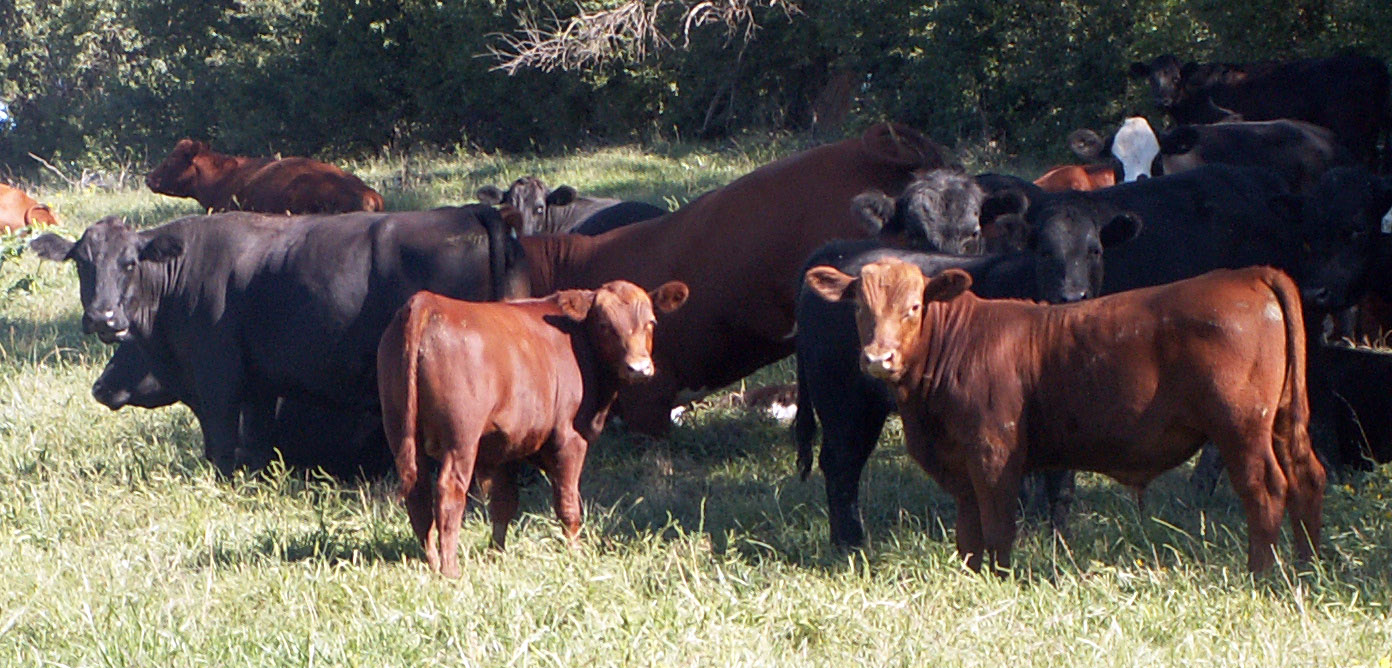
I have a little pet hypothesis on Scottish cattle. It is a bit controversial, and it may require some imagination to see what I’m saying.
My hypothesis is this: Highland and Aberdeen-Angus cattle are derived from the same root stock, but both experienced different selection pressures to produce very different phenotypes.
The only thing these cattle have in common now is color. Aberdeen-Angus come in black and red, and so do most Highland cattle. The Highland breed is derived from two root stocks, one of which was red and the other black. That is the same distinction in Aberdeen-Angus, which is greatly magnified in the North American registries. (There are some rare brindles in Highland cattle, but they are not a significant part of the breed.)
Besides color, the two breeds are quite different in every way. Aberdeen-Angus are naturally polled, and Highland cattle are quite long-horned. Aberdeen-Angus have extensive marbling in their meat, which is one reason why the are in such demand these days. Highland cattle are known for having low fat content in their meat.
But I think all of these differences result form different selection pressures that were put upon these cattle. In my analogy, the Highland cattle are like wolves, which evolved to live independently of man in a very harsh environment, and the Aberdeen-Angus are like an improved breed of domestic dog that is meant to be kept as a cherished family pet, like the modern Newfoundland dog.

The Highland cattle lived much as Texas longhorns did. They were given total free range in very wild country, and they had to contend with predation from wolves, which ran about the Highlands until the eighteenth century. They also had to deal with heavy snows, which prevented easy access to good grazing. These cattle had to be able to defend themselves from predators and defend their own access to feeding grounds. So they needed horns.
In fact, the history of this breed is so ancient that it may have not evolved much from the European aurochsen from which all cattle descend. These animals calved naturally for a very simple reason. They were calving in the wild at a great distance from both the crofters who tended them and the nearest veterinarians. If a cow couldn’t give birth properly, she died, as did her calf, which is a very effective culling mechanism.
The Highland cattle were also not kept in byres, the Scots word for a “cattle barn.” These animals had to live in a frigid, snowy country, and with no barn to protect them, they had to grow their own barn. They evolved this very yak-like pelt that keeps the warm in the worst of conditions.
When I first saw a Highland cow as a boy, I mistook it for a yak, which is an entirely different species of cow. The Highland cattle are just modified taurine cattle, while the yak represents a species native to the Himalayans.
Highland cattle have lived in their mountainous habitat for centuries. They are still domesticated enough to be quite docile animals, but cows are quite protective of their calves. If a cow couldn’t protect her calf, the wolves would surely have it. So there has been a selection pressure towards good mothering instincts.

Now, in the Lowlands of Scotland, very different selection pressures were in existence.
Aberdeenshire and Angus are not in the Highlands, but they aren’t very far from them.

They are historic counties within the Scottish Lowlands, where the culture was heavily influenced by English notions of livestock improvement.
Cows of the Aberdeen-Angus type are quite old, but the actual Aberdeen-Angus breed developed in the nineteenth century. The Lowland farmers of that region produced polled cattle that were called Angus doddies. They were kept in barns and grazed on smaller pastures. Because they lacked horns, they were easier to keep as oxen or to keep as beef cattle at relatively high densities.
As the Aberdeen-Angus breed began to improve, it was selected for more fat in the meat. The fat was suppose to marble the muscle, making the flesh more tender.
The Highland cattle living in the mountains grew a thick coat to protect themselves from the elements. They had no real need for a particular layer of fat to insulate them, and as a result, their flesh remained relatively low in fat content.
The Angus doddie landrace and the Highland breed may have continued to exchange genes after the separation, which is why their coat colors are so similar.

However, the modern Aberdeen-Angus cattle were largely founded by a breeder named Hugh Watson, who used all of the Bakewell-style breeding methods to improve his stock. Virtually all Aberdeen-Angus trace their ancestry to two cattle in Watson’s herd, Old Jock and Old Granny.
Highland cattle are an unimproved breed, although they do have some characteristics that some beef producers might like, such as their ease in calving and low fat flesh.
I do not know of any genetic studies that have examined the relationship between Aberdeen-Angus and Highland cattle. The animals are not very similar in their traits or conformation, and very few genetic studies have been performed on cattle.
But they come in essentially the same colors and come from regions that are adjacent to each other.
That alone should lead someone to wonder whether there is a relationship between these two cattle breeds.
However, I don’t know of any genetic studies that have examined this possibility.
If there is no relationship, we can still say that the Aberdeen-Angus was derived from an animal that is very similar to the Highland breed. The aurochs of yore was much larger than a Highland bull and far less shaggy. It also had larger horns.
Although it is now extinct, the recreated aurochs, the Heck cattle, do have some Highland cattle ancestry.
But I still think that Highland cattle and Aberdeen-Angus have a relationship.
Only genetic studies can falsify or prove the hypothesis.
But the study just hasn’t been performed yet.




There is a study done in 2003 — http://www.nature.com/hdy/journal/v93/n6/full/6800566a.html which concluded : There were three clear clusters: Ayrshire–Friesian, Hereford–Highland and Dexter–Jersey. Aberdeen Angus appeared to be most closely related to the Friesian–Ayrshire group. The relationship of Guernsey to the other breeds was not consistent between the two distance measures, although in both cases the breed did not cluster with the Hereford–Highland pair. The lengths of branches leading to the individual breeds were not substantially different from each other, although those of Highland, Jersey and Guernsey were slightly longer than the other breeds.
How accurate the study was is another matter.
Peggy Richter.
400 markers is interesting, but it seems very similar the mixed breed DNA studies.
The SNP chip analysis that determined the relationship between dogs and Middle Eastern wolves had 48,000.
I’d like to see something similar for cows.
if you come across it, please post about it. I’d like to know some of the relationships also. I don’t think there’s been one for sheep, either.
Peggy Richter
Just wondering if you try to credit owners of photos that you use from flickr. The photo of the red angus bull belongs to me and the bull also belongs to me. While he is an awesome herdsire I can tell you that he is not registered and in fact is not purebred
I do, but only if I got it off of Flickr.
Those images wind up everywhere.
Yeah, that’s why I cite the site I get them from… so the copyright holders can go after the site owners instead.
It might be of interest to note that Dudley Coutts Marjoribanks, first Lord Tweedmouth, was well-known in his lifetime for breeding and showing Aberdeen Angus cattle. I have see a very large painting done circa 1890 by Gourley Steell, showing several of his prize cattle, including champion Field Marshall of Guisachan (and two yellow retrievers) in a landscape. So at least some Angus cattle did come to the Highlands.
The imposing Guisachan cattle barn still stands proudly, although it has been converted to holiday apartments. And the shaggy Highland cattle can still be seen locally.