I think there was some confusion about my post on the golden retriever/toller cross.
I need to point out that golden retriever varies a lot more in type than the toller does. Goldens are much more common than tollers and have been adapted to a wide variety of disciplines.
Some goldens look very much like Zelstone, especially dogs from English or European conformation stock.
But there are other goldens that are very lightly boned and somewhat more “wolfish” in terms of their head shape. These dogs are fairly common in working lines, especially in the United States. Think of a drop-eared, long-haired retrieving dingo.
When I said that I would have a hard time telling a toller/golden cross from a pure golden, I was thinking more of a dog like this.
So after perusing the internet for images that showed a golden of this type juxtaposed with Nova Scotia duck-tolling retriever, I found what I was looking for. I found this photo on the Dynamic Goldens website. The dog on the right is a toller, and the dog on the left is a smaller, dark working-type golden of the type I just described.

Now, look again at the toller/golden cross. Which dog does he more strongly resemble?
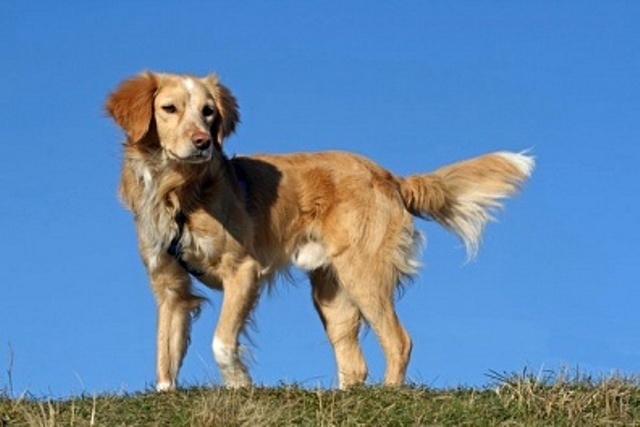
The golden traits seem to be prepotent over the toller traits. And don’t assume that white markings mark the toller either. On the Dynamic Goldens website, there is another dog with some white on her.
Some goldens, especially field line dogs, have the brown skinned trait, which may be accompanied by dudley nose. Some of these dogs can also have a lot of white on them.
Although most tollers are brown-skinned, there are black skinned tollers.
So there are traits where the two breeds converge, and identification is actually quite difficult.
The way I tell tollers from goldens is that toller invariably have a collie-type appearance, whereas goldens of this working type will remind one more of a setter or spaniel. The red decoy dog from England was likely a collie relative, and tollers have a bit of farm collie crossed into their strain as they were being developed in Nova Scotia.
Now, it is possible that goldens were crossed with tollers at once point, but their original ancestry is not the same. They both derived from the old wavy-coated retriever and the St. John’s water dog, but the toller has the red decoy dog at its base. Goldens, as far as I know, have no relationship to red decoy dogs.
I can tell the purebreds apart, but I would have a hard time telling a golden/toller mix from a pure golden from working lines. The areas where the two breed converge in appearance get muddled, and because tollers are so rare, I just assume that it’s a working-type golden.




I know the difference between show type and field bred Goldens. Strictly based off the head piece, the mix looks more like the Toller to me.
Not me.
It looks like my old golden retriever, who had a white-tipped tail.
I’m still not sure if my Abby is part toller. Alot of people believe her sister (who looks like Abby) is a toller and this is from Toller breeders.
a dna wouldn’t tell me as most don’t test for tollers in their breed lists. It doesn’t matter if she is, infact I had been looking at tollers before I got Abby and decided the cost and the fact that some tollers squeal or scream when excited. I’m not sure my neighbours would enjoy that.
A toller x field golden retriever mix would be a great mix for me.
I enjoy both breeds and a smaller dog would be a great when travelling.
Also do field goldens usually carry their tail curled over their backs so that the tip touches. Abby’s does and so does Bellas (her sister) not sure about the rest of the litter.
It would be weird for them to carry their tails like that.
But in field dogs, they don’t select for tails as much.
I have a hard time telling tollers apart from some field goldens.
The first Toller I ever saw in a book I mistook for a golden.
It looked more like the dog I had than the “white” dogs on the next page.
I can see clear traits from both a toller and golden in this dog – the squared off head and short muzzle comes from the Toller and the longevity,taller body and shorter tail comes from the golden (a Toller’s tail is the same length as the body from the bottom of the neck to it’s rump); I can understand how a picture can be confusing but if you were to see this dog in person, the cross breeding would be a lot more apparent by the size alone.
@ abby9wks – the Toller scream is quite rare and more often exists in the dominant pup of the litter. Each time my Toller has barked, it was a surprising and memorable experience. I’ve never heard him scream, even in his most excited state; he’s a quiet and confident go getter.
I’ve been trying to research my dog…she’s an SPCA rescue. She looks like a red golden retriever. In fact we thought she looked very much like an Irish Setter/Retriever cross. Her total body type and head is that of a Golden, but she’s red red with golden hightlights across her longer fur. Her nose is red though, and I though all goldens had a black nose only? Can someone clarify that? She’s small, long body, shorter legs, and she does squeal/whine when she gets excited, but that could be just her and not so much of a trait…absolutely fantastic with kids and nothing can get on the farm without her knowing about it, but hates most other dogs and has been known to attack them…Someone suggested they thought she was toller, but she doesn’t have any white, and her head is leaner than that of some of the Tollers pics I’ve seen…if I could find a way to post a pic of her on here, that would help.
https://retrieverman.wordpress.com/2009/03/24/red-golden-retriever-with-brown-skin-pigment/
https://retrieverman.wordpress.com/2011/07/13/brown-skinned-recessive-yellow-to-red/
https://retrieverman.wordpress.com/2011/08/30/another-dark-golden-with-brown-skin/
Brown-skinned dogs are quite rare in golden retrievers, but they are more common in working-type dogs, which are also often quite dark in color and setter-like in body.
[…] though they superficially resemble dogs of that breed. I also suggested that we should think of the toller as a small retrieving collie. It also suggests that the recent cross-breeding of a toller to an Australian shepherd actually […]