Posted in wild dogs, wildlife, wolves, tagged black wolf, Himalayan wolf, tame wolf, Tibetan wolf on October 21, 2011 |

Stories of easily tamed wolves are not unique to North America. In 1866, a British colonel and big game hunter named Alexander Angus Airlie Kinloch–who was then serving in the King’s Royal Rifle Corps in Ladakh in northern India– managed to procure two black wolf pups that grew up to become very tame adults. He recounts the story about the tame wolves in his treatise on the big game animals called Large game shooting in Thibet, the Himalayas, and northern India (1885):
On the 5th June, 1866, I was encamped at the foot of the Lanak Pass, between the Tsomoriri Lake and Hanle, when one of my servants brought in a young Black Wolf apparently about three weeks old. He had procured it from some wandering Tartars, and informed me that they had another one. I at once recognized the value of my prize, and sent off a man to secure the other cub, which arrived next morning. I had only heard of one other Black Wolf having been met with by Englishmen, and that had been shot the previous year in the neighbourhood of the Mansarovara Lake. I was, therefore, particularly anxious to keep the young Wolves alive, and in this I was fortunately successful. Emptying a ‘kilta’ I converted it into a kennel for the cubs, which I fastened to opposite ends of the only dog chain I possessed. I made the middle of this fast to an iron tent peg, which was driven into the ground, and thus the little beasts were secured. They fed ravenously on raw meat, and before long became pretty tame. When I marched they were bundled chain and all into the ‘kilta,’ the lid of which was then tied on, and thus they journeyed to the next halting place, the ‘kilta’ being slung horizontally either to the pack saddle of a Yak, or behind a coolie’s shoulders. On camp being pitched they were taken out and pegged down. One night they managed to draw their peg, but they were fortunately discovered next morning, the chain having become entangled in a bush, about a mile from my tent. They accompanied me for more than two months, and before that time had become a good deal too large for their abode: they gnawed holes in it, and used to travel with their heads sticking out at opposite ends.
As I was quartered at Meerut, whither I had to return by the 15th of August, I was afraid that the heat of the plains would be too much for them ; so I left them in charge of a friend at the hill station of Kussowlie, near Simla, till the end of October, when I had them sent down to me. By this time they had immensely increased in size, but although they had not seen me for so long, they recognized me, and also my greyhound, of which they had previously been very fond. They soon became much attached to me, and would fawn on me like dogs, licking my face and hands; they were always, however, ready to growl and snap at a stranger. I took them down to Agra at the time of the great Durbar there, and used to let them loose in camp with my dogs, so tame had they become.
I presented them to the Zoological Society, and they reached the Regent’s Park gardens in safety: they lived there for eight or nine years, and produced several litters of cubs.
All the cubs were black, a fact which, I think goes far to prove that the Black Wolf is a separate species, or at any rate a permanent variety, and not a mere instance of melanism, as some naturalists have supposed (pg. 40).
Kinloch was simply wrong that the black wolves represented a unique species. It is simple melanism, but it is not clear if these wolves got their melanism through crossbreeding with domestic dogs, as is the case with modern black wolves in North America and Italy, or are black as the result of another mutation. In dogs, we have two forms of black. The most common– and the one that was transferred to modern wolves and coyotes– is called dominant black. It is very easily transmitted through a population–just because it is a simple dominant trait. The other is called recessive black, and it is pretty rare in domestic dogs. It has not been observed in any wild canids, and because it’s recessive, it is pretty difficult to get transmitted intergenerationally. These black wolves could have had an entirely different genetic basis for their color, but if it were dominant, it could be transmitted in a single population, which would give it the appearance that we were looking at a different species.
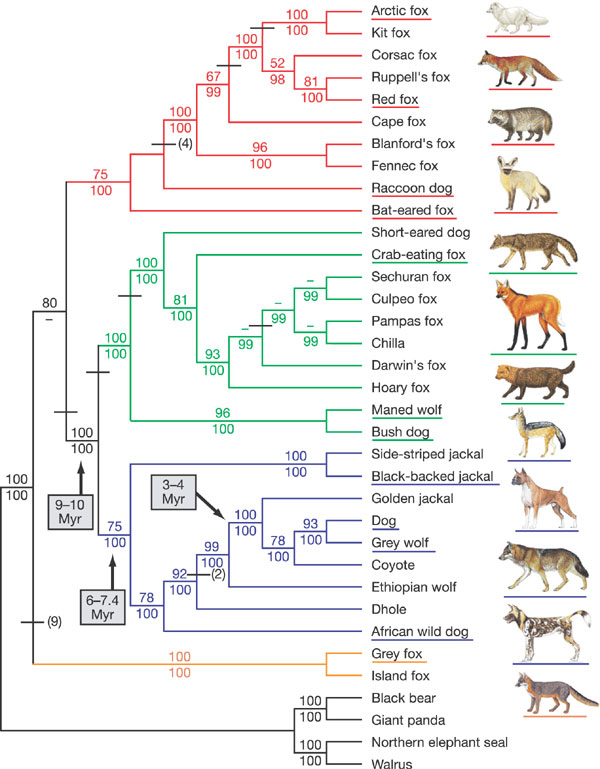
I hate to burst everyone’s bubble, but despite all of this speculation that has gone on for centuries, the extensive nuclear DNA studies are suggesting that there is only one species of wolf– unless one counts the Ethiopian wolf as a wolf. However, it is more distantly related to the wolf than the golden jackal . Domestic dogs, dingoes, and New Guinea singing dogs are also part of this species. The s0-called red wolf is a recent hybrid between the coyote and the wolf, and the proposed Eastern wolf species is a wolf with some coyote ancestry. Although some Indian and Himalayan wolves have unique mtDNA sequences, genome-wide assays have not found any unique characteristics.In at least one nuclear DNA study, Indian wolves were found to be closely related to domestic dogs, which probably means that their supposed uniqueness may exist only in their mtDNA, which reflects nothing more than an ancient matriline.
The newly discovered African wolf may be truly unique, but only its mtDNA has been examined. Nuclear DNA analysis might reveal it to be something unique, but it could just as easily turn out that it is part of this species.
There are many accounts of people taming wolves. The black coloration is usually mentioned as a prerequisite for taming, but it could be that black wolf pups were those most likely to be stolen and kept as pets.
***
NB: The Indian wolf I’m referring to in the post is Canis lupus pallipes, which is a smaller, primitive wolf subspecies. The wolves that Kinloch procured in northern India were likely Canis lupus chanco. The pallipes wolf ranges from India to Israel and Turkey, and it may be an ancestor of the domestic dog. Some pallipes wolves in India have a unique mtDNA sequence, which has led to some speculation that that they are a distinct species.
As we have seen with East African black-backed jackals, possessing quite divergent mtDNA sequences is not necessarily indicative of unique species status.
See earlier posts