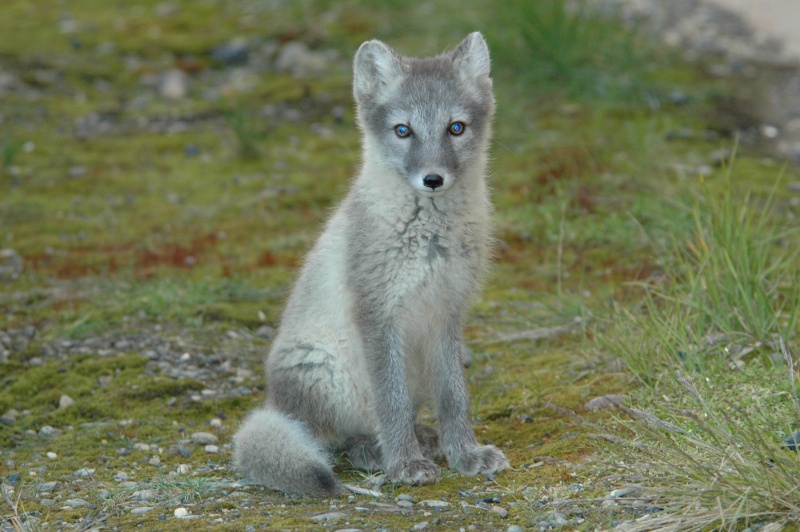
This arctic fox looks a lot like a swift fox.
Classifying the various dog species has become a bit contentious in recent years.
Assays of various types of DNA has called into question the validity of many assumed and proposed species.
For example, a study that involved a large sample of nuclear DNA from coyotes and wolves from many different populations found that the s0-called red wolf (supposed Canis rufus) is actually almost entirely coyote in its make-up. It does have some wolf ancestry, but this wolf ancestry comes from the Holarctic wolf (Canis lupus), not any supposed endemic North American wolf species.
Now, wolves are fairly charismatic animals. They have quite a following in the popular culture–there is even a “wolfaboo” subculture on the internet– and in many ways, they have come to symbolize the modern conservation movement. People know that dogs are derived from wolves, and most people are willing to accept that dogs are part of the wolf species, even if there is still some institutional and cultural resistance to that notion.
Science knows a lot about wolves, and the popular culture knows a lot about them, too.
However, wolves are not the only wild dogs in which genetic analyses may reveal that species status is a bit more blurred than one might expect.
Let’s take three foxes in the genus Vulpes.
Vulpes is the big fox genus that currently includes almost everything called a fox in the Old World– the exception is the bat-eared fox (Otocyon). The red fox (Vulpes vulpes) is the most widespread of the genus, but there are several lesser known species, like the Tibetan and Blandford’s fox.
Among these less known species are the kit fox (Vulpes macrotis) and the swift fox (Vulpes velox). Both of these foxes are found in Western North America, and there is a huge debate about whether these foxes represent a single species or two distinct species.

This swift fox looks very much like the arctic fox at the top of this post.
Now, at the crux of classifying these species is figuring out how closely related they are to their closest relative, which is, surprisingly, the arctic fox (Vulpes lagopus). Traditionally, the arctic fox has been placed in its own genus (Alopex), but the great preponderance of the genetic evidence shows that it belongs in the genus Vulpes.
These foxes all have 54 chromosomes, and the swift and kit foxes regularly interbreed in West Texas and New Mexico, where the two “species” have overlapping ranges. Dragoo and Wayne (2003) examined kit and swift fox morphology and nuclear and mitochondrial DNA, and they found that the bulk of the evidence suggests that kit and swift foxes represent a single species. The authors contend that most of the greater genetic diversity within arid land foxes is actually result of them not dispersing great distances from their natal territories. Over time, populations in certain localities wind up with very distinct genetic characters, which might resemble those of a unique species. Animals that travel a great distance from their natal territories, like lions and wolves, tend not to have such distinctiveness within a local population. There was always a gene flow across wolf and lion populations that may not exist at the same extent with smaller, less mobile species.

Animals identified as kit and swift foxes regularly interbreed in parts of New Mexico and West Texas. For whatever reason, hybrids have not been confirmed in southern Colorado and Western Kansas, where their ranges also overlap.
Now, the notion that swift and kit foxes are part of the same species is not universally accepted, and this is where the arctic fox comes into play.
Mercure (1993) examined the mitochondrial DNA of kit, swift, and arctic foxes and found that kit and swift foxes different from each other as much as they differ from arctic foxes. At the time, arctic foxes were still listed as belonging to their own genus, and this study was used as evidence to suggest that swift and kit foxes really were unique species. (Wayne was also an author of this study.)
However, now that we know that arctic foxes are actually in the genus Vulpes, we have another issue that needs to be considered.
Yes. I’m aware that mtDNA studies can be quite flawed. They examine only maternal inheritance, and very often, these studies have unusual biases. For example, initial mtDNA studies underestimated the date when forest and savanna elephants, which are now classified as separate species, split from each other.
But it doesn’t mean that these studies are inherently useless. When combined with studies that look at more of the genome than mtDNA, they can provide an interesting picture about the evolution of a species.
And here, I think these two studies are suggesting something quite radical:
Not only are swift and kit foxes the same species, the arctic fox is part of this same species.
Now, going with this classification is very contrary to what is generally accepted.
Arctic foxes are believed to have evolved in Europe 200,000 years ago. That is when they first appear in the fossil record, and the ancestral swift fossils have been dated to 500,000 years ago. The Mercure study strongly suggests that arctic foxes evolved in North America, even though the earliest fossil remains were found in Europe.
However, it is also possible that the ancestral swift fox fossils are not in the same lineage as modern swift and kit foxes and that they actually evolved from the arctic fox. Traditional accounts of arctic fox evolution trace them to a common ancestor it share with the red fox, Vulpes alopecoides.
It is possible that arctic, swift, and kit foxes all radiated from that ancestor, or arctic foxes are actually the ancestors of the swift and kit foxes. Perhaps, these foxes of arid and semi-arid lands are nothing more than arctic foxes that have adapted to a very different climate.
Further, there are several relatives of the swift/kit fox and arctic fox in Asia– the corsac and Tibetan fox. They are relatives, but they aren’t as closely related as swift/kit foxes are to arctic foxes. The fact that these three have such a close relationship with each other is really quite interesting.
The truth is we simply don’t know how these three foxes evolved, but it is clear that they are very similar to each other.
In fact, they differ less from each other in terms of their morphology than different breeds of dog or even different subspecies of wolf do. It is very likely that fertile hybrids can be produced with arctic foxes and either swift and kit foxes. Arctic foxes live well to the north of where both swift and kit foxes are found, so no wild hybrids have been documented.
Thus, it might be more useful to think of them as representing a single species in which some populations have specialized adaptations. Kit foxes living in desert environments have big ears and pale coats, while arctic foxes have pelts that change colors depending upon the season.
More research must be performed on these three foxes, and the possibility that the represent a single species with three specialized subspecies has to be considered.
We know far less about the evolutionary relationships of these three foxes than we do about wolves, but they appear to have the same problem that wolves do. Wolf taxonomy is always in flux these days, mainly because the studies don’t reflect what has always been assumed.
But it may be that wolves are not the only part of the dog family that might have these sorts of surprises in their DNA.
To me it is obvious that this foxes are different species from wolves, and because arctic foxes produce only infertile hybrids with red foxes, it pretty obvious that they aren’t the same species either. It’s when you start to find a great deal of interfertility between two wild “species” that are also as distantly related to each other as they both are to a third species that one really should start to reconsider the taxonomy.
Perhaps the most parsimonious action would be to declare a single species for kit, swift, and arctic foxes.
I know that this is an extreme minority positions, but I think this reflects what has been found thus far.
See related posts:
- Is the island fox (Urocyon littoralis) a valid species?
- Arctic fox/red fox hybrids
- The creature formerly known as the red wolf
- No unique “Eastern wolf” species




I would think it would be possible to see if artic fox could breed successfully with Kit or Swift foxes by the simple method of housing them together at a zoo (yes I know, Horrors! a hybrid. But it would effectively answer the question if a fertile offspring were produced, particularly a male one.) Second, one hopes that at some point in the future it will be possible to process DNA from fossils. We can’t do it now, but technology might make it possible to verify ancestry in the future. And finally, the arid part isn’t that different. The artic is actually very arid. It’s the heat/cold and the snow creating a requirement for different coloration that are the bigger differences.
If arctic foxes and red foxes will make mule foxes in captivity, then I’m 100 percent certain you can make arctic/swift fox hybrids.