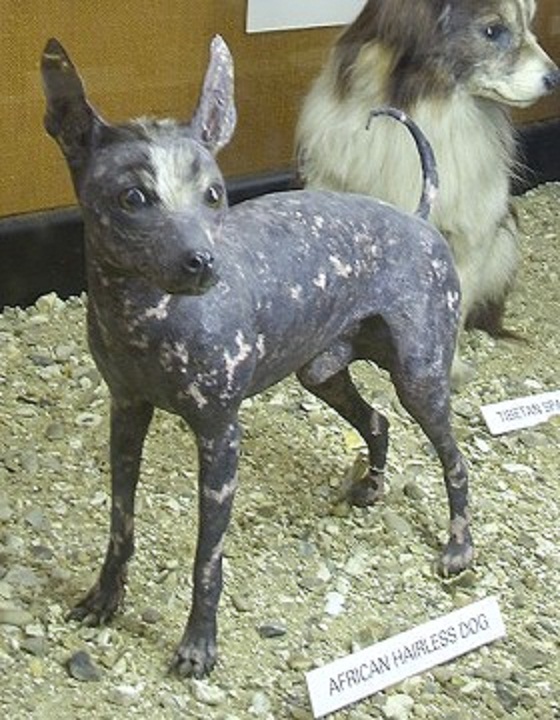
A taxidermy of a so-called African hairless dog at the Walter Rothschild Museum in Tring, England.
Breed origin myths have been able to gain a life of their own.
Dog breed historians are often historically illiterate, are prone to nonfalsifiable speculation, and are quite prone to confirmation bias.
Many are also quite prone to flights of fancy, as we have seen with the science fiction writers who think that chihuahuas are derived from fennec foxes.
It’s not just chihuahuas who have a bizarre and probably incorrect origin myth.
The so-called “Chinese crested dog” is said to have originated in China, where they were kept on junks for rodent control and as emergency ration.
This is a very strange story, for there is virtually no record of hairless dogs existing in China. Just this past week, a wandering Chinese crested in China was mistaken for a pig. Probably the best reason why it was mistaken for a pig is that Chinese crested dogs aren’t actually Chinese.
Over time, this origin myth has faded in certain quarters– only for an even worse one to be contrived.
Pai, my eyes and ears in the hairless dog community, brought it to my attention that certain members of that community were now promoting the theory that Chinese cresteds and other hairless breeds originated in Ancient Egypt.
That’s actually not particularly original, for there are dozens of very poorly reasoned dog origin stories that take place in Ancient Egypt. I’ve heard that dachshunds originated there, even though they are actually a very recent development, and we all hear the nonsense about pharaoh hounds and Ibizan hounds being derived from Egypt’s ancient tesem dogs. There is no evidence to support the origins of any of those dogs in Ancient Egypt, but it’s a fantastic tale that everyone wants to repeat.
But this time, they decided to get a DNA study that supposedly proves the theory.
They have to dig a bit to get a study that fits their preconceived notions, and the one they find is an mtDNA study by Robert Wayne in 1999.
This study was thrown at me– as if I hadn’t read it– to debunk what is the more likely origin for the Chinese crested. The most likely origin is that the Chinese crested was developed in the West by breeding small xolos to fuzzy little lap dogs from Europe. Much of this development happened in the United States at Debra Wood’s Crest Haven kennel, which was in operation in the 1950’s.
Now, this explanation fits another important piece of evidence that was revealed in 2008. Peruvian hairless dogs, the xoloitzcuintli, and the Chinese crested dog all have the same mutation that causes their hairlessness. The mutation first appeared in Mexican dogs 4,000 and then was transmitted to the others via crossbreeding. Because this trait is semidominant, it is easily transmitted to new dog populations with minimal crossbreeding.
Which brings us to the Wayne mtDNA study from 1999.
This is one of those studies that suggests a very ancient origin for the domestic dog– 100,000 or more year ago. I think this might be a bit of an overestimation. Mitochondrial DNA (mtDNA) studies have made some notable errors. They’ve underestimated when savanna and forest elephants in Africa split. They’ve also have suggested that dog originated in southern China, when the nuclear DNA evidence points to Middle Eastern wolves as the primary source for the domestic dog.
So we need to be careful reading too much into mtDNA studies.
However, the point of Wayne’s research into the xolo wasn’t to prove the origin of xolos. It was to find out if domestic dogs were derived from North American wolves. In terms of their mtDNA, they are not. They have diverse mtDNA haplotypes, all of which are found in Old World dog breeds. They don’t share mtDNA with Chinese cresteds, which has led some “internet experts” to declare that it means Chinese crested couldn’t be related to xolos.
This shows ignorance about what mtDNA is. Mitochondrial DNA is DNA extracted from the mitochondria of cells. This DNA has its own genome, but it also only a tiny part of the whole genome. It can be a very biased sample, for a very simple reaon: it is inherited only via the matriline. It tells you nothing about paternal inheritance.
So if the hairless trait in Chinese cresteds was introduced via a few male xolos, one could not figure this out using mtDNA.
What’s more, if just a few male xolos were used to develop these strains many generations ago, then the Chinese crested dogs would not have a very close genetic relationship with xolos, even if the hairless mutation had been introduce via a limited number of xolo males.
Also, one needs to be a little bit more skeptical of another aspect of Wayne’s study. Wayne examined only living xolos. Xolos are Latin American dogs, but they aren’t likely entirely of that ancestry. Indeed, it is much more likely is that living xolos are mostly European dog in ancestry, but because the mutation that causes them to be hairless is semidominant, it was able to last within Latin American dog populations, even as the main indigenous dog population became extinct. This trait was able to exist in the same way that black wolves in North America got that mutation from domestic dogs. North American wolves have very little dog ancestry, but at least one black dog did contribute the dominant black gene to their populations. The wolves are almost entirely wolf by now, but the melanism from dogs still exists.
The mtDNA study on living xolos revealed them to be a very diverse breed in terms of their mtDNA sequences– which makes sense. This dog existed as a landrace in Mexico for centuries after the conquest. People bred them to whatever they could find, and the dogs themselves bred with other street and farm dogs. Until recently, the Mexican Kennel Club, allowed hairless dogs from diverse backgrounds to registered as xolos, and over time, different sizes of xolo have been developed. The chances of someone using an African dog– including a basenji– as an outross would have been very high, and the likely use of these outcrosses to produce the xolo means that we need to be skeptical of studies that use living xolos to make generalizations about Native American dogs from the past.
Now, trying to figure this sort of information out from the available evidence is a bit of a challenge. It requires critical thinking and an understanding of how breed formation might happen.
But if you’re using it as evidence that all these hairless dogs came from Africa, you’re in big trouble.
To postulate an African origin for these dogs, you’ve got to figure out a way for these animals to be in Mexico at least 4,000 years ago.
And you can’t do that.
To get that to work, you have create some pseudohistory– maybe the Egyptians came to Mexico!
Never mind that there is no evidence for that at all– and no, please don’t try to claim that the Olmecs were African. There is no evidence for that, except speculation about supposed African features depicted in Olmec artifacts.
Of course, you could get an “ancient astronaut theorist” to come up with some way that allows one to create an African origin for the hairless dogs.
And that would probably be your best bet.
Now, there is some evidence that there were hairless dogs in South Africa, but there is no evidence that they originated there. The Portuguese and Dutch sailors had a connection to Spain’s colonies in the New World, and they would have been able to bring hairless dogs from there to South Africa. Dogs that were imported from South Africa could have been called African hairless dogs or African hairless terrier, which may be a hint that they crossed their hairless dogs with terriers.
All the other theories about the origins of Chinese crested dogs and other hairless dogs appear to be nothing more than flights of fancy or marketing stories that were initially pumped up by dog dealers.
Of course, this origin is far less exotic and fantastic as proposed the Chinese or African origins postulates.
This one is much more parsimonious. The others require assumptions about the historical record that are either impossible to prove or are simply false.




Once again, Occam’s Razor and the KISS Principle prevail.
Thanks for this reprise!
The true origins of the Chinese Crested are buried in the fake history Deborah Wood and Ida Garrett made up for their 20th Century creation cobbled together from Peruvian Inca Orchid Stock as well as several other hairless varieties besides the the xolos, plus those fluff genes from some secret places!!! Ancient Chinese, my foot! And the breed, less than 50 years after its creation (Frankensteinian put-together is more like it) is going to hell with rampant hairiness.
The egos of those two women indulged in little to no research- they had no clue how to manage the restricted hair gene, as I prefer to call it. They made it up as they went along, but the gene itself got away from them. The restricted hair gene (HH or Hh) acts among other things, as a single coated gene in the CC, thus, completely coated single coated dogs are not unusual among CC breeders.
In fact, some breeders have given up pretending they know how to use the HH gene and are simply shaving their hairy cresteds- so now, for all practical purposes the CC “look” is nothing but a haircut! And those powderpuffs! (I have one) Their coats are impossible for an ordinary person to keep long and fluffy. I have to shave my little guy every 3 months or so to keep it under control!
This is a case of breeders gone mad! Ida Garrett was one to have the vision of creating her own dog breed and probably invented the name, but she got sidetracked by Chihuahuas and gave her stock, collected from all over, including Tucson, to Deborah Wood in a half-realized collection of HH gened dogs. Ida had a huge ego and desperately wanted to be known as the creator of her own breed, because being know for the re-creation of a breed is the ultimate ego trip for the dog fanciers of the time-1880’s- 1930’s. I do not know why she didn’t finish, but perhaps it was simply age.
Dos preguntas:
1ª.- ¿Cual es el origen del podenco de los faraones y sus variantes?
2ª.- ¿El perro con pelo situado en la parte posterior de la imagen, es el ” Spaniel Tibetano?.
Gracias un saludo.
1. Malta. Podencos are an old Mediterranean landrace. Xenophon describes dogs very similar to them in Greece.
2. I’m not sure what that dog is. In the same display is Ah Cum, one of the first pekingeses in the West.
I’m still not sure where the claim that ‘Hairless dogs are depicted in Ancient Egyptian art’ comes from, either. I’ve never heard of such a thing from anyone other than a hairless dog person, so I have to assume it’s another breed club fairy tale.
there tends to be a view of “if it’s imported, it must be better” for many things, including dogs. Consequently you get fake backgrounds for all kinds of things in an effort to make them appear more desireable.
While the gene for HH has been traced back to 4,000 (presume this is accurate — http://www27.brinkster.com/taisetsu/Chinese_Crested/FOXI3_Hair_Development.pdf) years or so, is that when the genetics experts think it started? Or is it possibly older? The hairless characteristic has cropped up twice — the American hairless terrier (http://jhered.oxfordjournals.org/content/79/1/69.1.extract) is hairless based on a recessive gene and apparently doesn’t have some of the other characteristics (missing teeth) of the HH type. The ha type appears to have cropped up fairly recently compared to the HH type.
It’s not older.
Kate has some great stuff on this: http://hairlesschiwawa.wordpress.com/2011/07/18/a-laymans-quick-look-at-the-foxi3-gene-and-its-mutation-causing-pattern-baldness-in-dogs-part-one/
I’m not really concerned about the American hairless terrier. It’s caused by such a different genetic basis, and there’s really no debate at all about how the American hairless terrier developed.
There’s a lot of absolute stupidity in the vein of Ancient Aliens-type historiography about Chinese crested dogs.
Thanks for the plug, but I doubt I have anything to tell Peggy!
I have a xolo friend who posted a couple of times as ‘el xolototl’ An even more elderly than me, Mexican biologist. Anyway, he has said that the new xolos only have the dominant hairless gene, but the the hairless recessive was in play too, by the old style breeders before the “The Expedition” for xolos in the 50’s. (when my friend was in his 20’s and doing field work). He was vry into the xolos because ofI have heard that said from 2 credible sources. Which my friend says is why some dogs were born fuzzy then became hairless through the application of some fluid, as the Spanish described it. No fluid was needed, because the dogs shed their fuzz naturally.
Anyway, this means that certain lines of hairless were 100% hairless. The dominant Hh made up to 80% of the dogs hairless, and the recessive came into play on the dogs who would have had a coat in ordinary breedings. The fact the recessive hairless gene is recessive means it can be buried very deeply, with little chance to manifest, unless it is mated with another one with the same recessive allele but, like blue eyes, can be brought out with the correct mating. except no one but Mexicans ever sought it. LOL
I have more to say, but my schedule just caught up with me and I have to leave this minute!
Guinea pigs have two different hairless forms, too, that are caused by very different mutations.
http://margaretshairlesspigs.webs.com/
It’s kind of interesting how this has happened.
There are even ‘hairy hairless’ guinea pigs (and cats).
Yup, and there are also some sort-of hairless apes!
What poor freaks of nature those must be! =P
You mean humans?
My biologist friend thinks the restricted hair mutation is on the same gene Fox13in humans and works to the same effect. Hair on parts of the body, but it is scanty hair and hair on the head which is much thicker. I am not saying he is correct, but it is an interesting thought that needs to be ruled out.
The hairless dogs are not actually hairless, The H gene restricts the hair from everywhere except the head, toes and tail in the xolo or the dog doesn’t have the mutation and is fully haired. In the Cresties the hair patterns are much more marked than in the xolos- especially the H pattern and the overall hairy hairless. Pai thinks maybe the PIO were the source of the crazy hairiness- probably because the people who took Xolos to Peru had no idea how to get 100% hairless and put something that started the ‘H’ pattern baldness in their breed. We know that Gypsy Rose Lee and Deborah Wood used dogs with something in there that made the Hh gene almost run away with all its variations.They were sorcerers’ apprentices and just culled anything they didn’t like without examining it closely for the way the genes worked. And other breeders follow them to this day. I dare say neither of them knew much about dog genetics- there wasn’t much to know when they were cobbling together their “masterwork”.
Neither were the ever-so-fancy fanciers of the xolo. They were classic AKCists, out to ‘recreate a breed’ in kennel club terms, so they could join that elite club of the fanciest fanciers- Lords and Ladies, real duchesses and wannabee duchesses. Kennel Club Xolo breeding was a very upper class thing, at first, as was most kennel club breed-creating at the time. They were just buying dogs they liked and barely even noticed there was a hairy version- they automatically culled them ALL until just this past couple of years. They acted like the hairy ones didn’t happen and fought the people who saw they needed to be included in the breed for more heterogeneity.
According to my friend, who was around during the 50’s and kept an eye on them. He was a former communist and friends with Diego and Frida through their mutual interest in politics.He knew the xolos and had respect for how they were bred- by people who knew what they were doing. The exporting fanciers did not deign to ask the poor Indian breeders how they did it; the ‘Expedition’ had no respect for them -they couldn’t possibly know as much as a Kennel Club about dog breeding.
The Nahuatl speakers were very flowery thinkers, every noun had dual meanings, the literal translation -say “Feathered Serpent” Everyone knows that Quetzalcoatl means Feathered Serpent. That is the literal meaning of the word. Quetzales- feathers were the most highly prized trade good, so the other meaning of the word is “Most precious thing” Coatl means serpent, but the flowery meaning is ‘here together, intertwined’, so the word for their top energy form really means “Our togetherness is the most treasured thing” BTW Quetzalcoatl is not a god, but an energy form- in this case a patriotic love for their own peoples.
So, I think it is crucial to to the breeding of xolos, that the flowery meanings of the words are more important than the literal meanings and we have much to respect Nahuatl cultures for- in their expertise of breeding dogs. And much of it is available to people who understand how to translate Nahuatl into its flowery meanings. There are still Nahuatl speakers around, millions of Aztecs and even more, if you include all the Uto-Aztecan languages spoken in the US today, ie, Hopi, Comanche, Yaqui and many more.
Whew! I am manicky today- Writing all over R-man’s blog, but native dogs are what floats my boat!!
Dang! One more thing to Peggy:
“Consequently you get fake backgrounds for all kinds of things in an effort to make them appear more desireable”
I think the fancy backgrounds were a game people played during the “Exhibition” years, when the Fancy first began. People started out bringing their own dogs in, all dressed up in crazy outfits, with pipes n their mouths, but quickly the one-ups-manship of the exhibitors facilitated exaggerations about their dogs, where they came from and suchlike. This was ingrained when the Kennel Clubs stated registering the re-created and imported breeds. The tall tales were incorporated then- and tolerated this day. There are CC breeders who have no clue how the breed arose- they still think it is Chinese, perhaps because China was exotic and Mexico was full of Mexicans. Not even the Chihuahua re-creators bought dogs in Mexico, but claim they came from the border towns like El Paso and Tucson.
I think the fake backgrounds were expected, at first and everyone knew it was a joke. The best jokes won the prize. The Exhibitors in the beginning were out to make people laugh and marvel- and pay the fee to get in. They won based on how tall their fish story was and how exotic the dog looked. A few hairless dogs made it – and the story about the Chinese, the junks, the rats and the plague were made up for the audiences’ entertainment. (They had JUST found out that rats caused the plague, but the old time Sailors had no clue how the plague started). The so-called Chinese Crested dogs back then were Exhibition Dogs, earning their owners prize money, with out-crossed PIO’s, who had more furnishing than the ordinary xolos and a lot more pink polka dots.
I did a little research on those Exhibitions which were very popular and gave rise to the Kennel Club dog shows, where only members’ dogs were exhibited, or “shown” as it came to be known. I am not checking my sources again, for this post, (if I could even find them!) but that is what I remember
In the second sentence: “. . .are prone to nonfalsifiable speculation. . .”
Perhaps it should have read “unverifiable speculation”?
No. I mean it in the Karl Popper sense.
This differs from nonverifiable. It means they come up with theories that are so speculative they can’t be falsified or proven wrong.
Faking backgrounds — you see this with the Australian Shepherd and some other “working” breeds as well. In antiques, you see the faked background — because the value is in the antiquity more than the quality. Saying “hey, I just bred two dogs that I happened to come across and liked” isn’t as impressive as some tale regarding clipper ships, Chinese ancestry (tyiing it to the rare “peke” and other dogs, etc. You see the same with Shar-pei, etc. The same tendency to invent an impressive background/ancestry is seen with “native Amerindian dogs”.
The mutation for hairlessness is interesting as a mutation that has occured fairly recently and is then spread, not because it has any particular functional value, but because it is “different” and having some rare exotic animal is always appealing to those who are “keeping up with the Joneses”.
The H gene isn’t much different from Merle — in the heterozygous form it can cause defects beyond the desired trait — in the case of the hairless gene, it’s defective teeth and a lower survivability (http://www.la.rsmjournals.com/content/27/1/55.short). In the homozygous form, like merle, it is usually lethal. Apparently the recessive (ha) gene that occurs in the hairless terrier (http://jhered.oxfordjournals.org/content/79/1/69.1.extract) is less detriimental. My view is that breeding of the H hairless is as objectionable as Merle, Harle and NBT, especially as there is a clear alternative with the ha gene, although apparently one doesn’t get the desired crest and tail with the ha.
Lower survivability? In the heterozygous form? Maybe in some lab – who knows what the conditions were – , but in my experience Crested puppies are vigorous and thrive.
The hairless terrier is a very different dog to the Crested, with in my experience an inferior temperament….I don`t like aggressive dogs.
Elizabeth
I’ve read that ‘lower survivability’ study. Mortality rates of hairless newborns rose to normal levels once they turned the heat up in the room they were in, it says so right in the paper.
Go figure. =P
Hi,
So, I have a Chinese Crested Powder Puff (I do have to brush and bathe her quite a bit to keep her coat fluffy and unmatted) and I had a beloved Golden Retriever for 14.5 years. I’m not a biologist and really had to skim this article – can someone say in plain terms, where the Crested originated from? Is it from the Mexican Hairless? I also have a long coated Chihuahua and read with interest the stuff about the hooey with the Fennec Fox – I’ve seen that all over the place and always kind of went, huh? (That bit on the water drinking was funny – if you have a Golden and a Chi, the Chi barely ever drinks water, but Goldens really do drink a ton!) I’d love a brief history of where the Crested might have actually come from… I’ve had a super hard time imagining my Crested being on a boat or hunting in Africa – she is a complete flibbertigibbet!
As an aside, my Crested is the most playful, loving, affectionate, silly and funny dog I’ve ever had. Loved my Golden, but the Crested is off-the-hook precious.
Thank you!
The hairless mutation originated in Mexico. It then spread to Peru and the Great Andes through trading what was likely a small number of hairless dogs into South America from Mexico. The Spanish Empire conquered these areas and then they spread the dogs all over the world, including possibly European colonies in China and definitely to South Africa, where they were called “African hairless dogs” or “Abyssinian sand terriers.”
From the historiography I’ve read, the crested is derived from crossing hairless dogs from either South America or Mexico with European toy breeds.
Because the allele that causes the hairless is semi-dominant, it is easily transmitted from one dog population to another with very limite crossbreeding.
There were two women who developed these strains that became Chinese cresteds starting in the 1880 with Ida Garret in Upstate New York. Her work was continued with the foundation of the Crest-Haven Kennel in Homestead, Florida that supposedly started with eight dogs from a German circus. The stripper Gypsy Rose Lee also started a line, which I think was based upon Garret’s dogs.
So the breed originated in the United States very recently.
Gypsy Rose also collected any random hairless dogs that she came across traveling around the country. Her foundation pool was more diverse than Debora’s, as a result.
All you have to have is a dog that is heterozygous for the mutation, and then you can breed it with anything to perpetuate the trait.
The original breed standard is vague enough to allow for the diversity that the original dogs had (both in body and in crest length). Gypsy Rose, at least, was more about the phenotype rather than obsessing over ‘purity’.
Some (particularly a big show person here in Tucson), have accused my hairless Ruthie dog of unregistered ancestry, of being a chihuahua, CC cross. Never mind that she looks like a typical xolo of her size, more than a CC, and more importantly has the xolo temperament. CC’s are much more willing to cooperate, on average, than xolos. My PP CC Ollie, is adorable, sweet, highly trainable, though sensitive.
Ruthie only works on a quid pro quo basis. She will do her tricks like “sit” for food. Recently I have gotten her to sit when I open the door and wait for my release to dash outside. That only came after I closed the door on her when she wouldn’t sit and took the other two out. Next time, she sat, but it is still a quid pro quo. Sometimes she gets so independent, I put her on a leash and keep her with me for most of a day. She comes out of a day like that, much more willing to return on a call. The leash also works when she is freaking out. It seems to give her security. She never leaves my side, except when she is roaming off leash on our small, but multi-acred, homestead or I go to town.
This is not typical cc behavior, but I hear in various groups that a lot of xolo owners have similar dogs. Intense early socialization with xolos seems far more important than the normal socialization CC’s, need. And many people have rescue xolos that are so shy, they can’t be touched or picked up. Ruthie was not taught any manners as a pup- I didn’t get her till she was three months old, and she was a mess. I had to start potty training her, it took a long time and she still has relapses at 3.5 years old. Sometimes when it is wet or cold outside, but other times?go figure . I keep a variety of small cotton rugs on the places she goes- it is always in the same place in the living room, and in a corner of the bedroom, and have to rotate them out when she goes. Better than going on the wood. When ever i think Ican remove them, she has a relapse.The other two NEVER go inside.
I had Basenjis as my first breed and the xolo temperament is more fearful but just as independent. I never met a shy Basenji! Even though xolos may have euro genes, there is still a basic temperament difference from euro dogs; they are not as eager to please, they easily go totally shy and fearful, if not handled properly.
One more thing, I did not understand the nature of the hairless gene when I acquired Ruthie and had no qualms about breeding. Now, I do understand what a lethal dominant is. I really do want to do one more breeding in my lifetime. I am trying to find a really good looking deer Chihuahua or Techichi, as I like to term them, to breed her to. I would not breed Hh to another Hh, but rather to a dog similar in phenotype, but with hair. Statistically I will get 1 in 4 hairless, as opposed to 50% in an Hh to Hh breeding. I have a number of homes wanting them, and believe me, they already know about the lethal dominant, but at least the ones with hair will be deer Chihuahuas and easy to find homes for -as that is the popular “Chihuahua” in Tucson. None of the hairy pups will ever throw hairless; the gene is eliminated in the hairy ones.
I really know how to raise Techichi dogs properly, because I understand their temperaments are so amenable to a regular routine as to require it, need it, to function without neurotic glitches. I intend to keep the puppies more than 8 weeks, so I can have a couple of weeks to let them experience a healthy routine, and begin to experience basic manners and tricks, like “sit”, thus the older the pups when they leave home, the more likely they will always be amenable to a consistent routine that covers their needs, including their curiosity. They will react to anything and everything that is out of their normal routine, and that is one of the traits they were bred for, long before the 5 pound Chihuahua was a gleam in the AKC”S eye.