“Hound Coursing a Stag” (1762) George Stubbs.
The dog is one of those big “deer greyhounds” that appear in some of the breed literature.
Posted in dog breeds, history, tagged coursing, deer coursing, greyhound, greyhound coursing, live coursing on January 27, 2011 | 3 Comments »
“Hound Coursing a Stag” (1762) George Stubbs.
The dog is one of those big “deer greyhounds” that appear in some of the breed literature.
Posted in golden retriever, golden retriever history, tagged golden retriever, Noranby golden retrievers, Noranby Sandy on January 27, 2011 | 2 Comments »

Noranby Sandy was born in 1910, and he was a middle to light gold dog. Had either pale gold or cream shadings. He was run in field trials, but he never won a conformation championship. He was just two years older than Noranby Campire, the first champion in the breed.
He was a Noranby dog with Ingestre ancestors. His dam was Yellow Nell, born to Ingestre Scamp and Ingrestre Tyne, dogs that can be easily traced to the Guisachan dogs. His paternal grandsire was Fox of Melbury, and the Melbury dogs were owned by the 7th Earl of Ilchester. All the Melbury dogs were founded by Ada, one of the bitches born to the original Nous/Belle breeding.
He was a different color than the dogs Mrs. Charlesworth normally bred. Within fifteen years, she was producing dogs like Noranby Jeptha, which were somewhat darker in color.
The name Sandy denotes his sandy blond coloration, a color that many modern golden fanciers really like.
His lighter shadings are really quite attractive. I remember seeing a photo of a dark golden dog that we might call a “golden red,” but he had very light shadings in almost the same places that Sandy had them. It is not something someone sees very often, but it is possible for a dog to be quite dark and have light shadings.
I saw a golden in Munich with a similarly contrasting shading. I didn’t get a chance to take a photo, although I do have one of an undocked Welsh terrier.
***
I put him on here because he reminds me of someone:

Posted in creationism, dog domestication, evolution, wild dogs, wildlife, wolves, tagged Caniformia, Caniforms, Carnivora, creationism, dog domestication, Dog evolution, intelligent design, Ray Comfort, young earth creationism on January 27, 2011 |
He takes down Ray Comfort’s nonsense. Comfort has no clue.
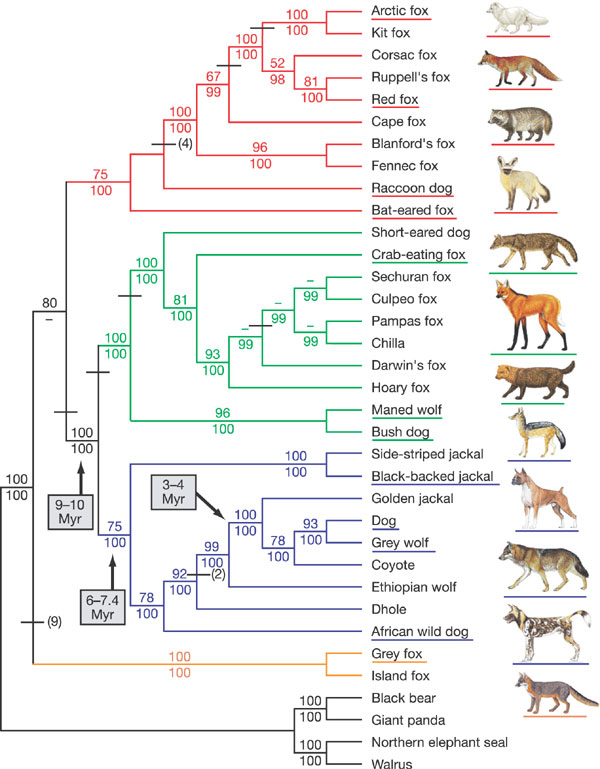
He also argues that Lycaon pictus ought to be in the genus Canis, for exactly the same reason I feel it should be. It and the dhole are more closely related to the other species of the genus Canis than the black-backed jackal and side-striped jackal are. Xenocyon lycoanoides, the extinct ancestor of the African wild dog, should also be part of this very important genus in the dog family. (See the dog phylogenetic tree).
He is a little off on the origins of the dog. The East Asian theory of dog origins seems to have been falsified through the genome-wide study that utilitized SNP chip technology found that dogs had greater genetic similarity with Middle Eastern wolves, which suggests that the Middle Eastern wolves, not the East Asian wolves, are the main ancestors of domestic dogs.
Epicyon and the Amphicyonids make an appearance in this video, as to the “dog-bears” (Hemicyonids).
The Caniformia suborder of Carnivora has the most diverse species. Not only does it have domestic dogs, which have greater diversity in head morphology than the whole order Carnivora combined, it includes the smallest member of the order (the least weasel) and the largest (the southern elephant seal). Yes, Carnivora includes the seals, walruses, and seal lions, which are now classified within the Caniformia suborder.
Red pandas are fascinating because of their status as a “living fossil.’
And giant pandas are bears with fused chromosomes. The two animals evolved their bamboo diet and their very similar s specialized wrist that acts like a thumb in parallel with with each other. Their common ancestor in the basal Caniformia didn’t have that thumb wrist or the specialized bamboo diet. Because both of these animals are derived from meat-eating Carnivora ancestors, they have not developed the ability to digest cellulose, so they have to eat tons of bamboo to survive. If these animals had been designed, one would think the designer would have put in some digestive bacteria in them to help them digest cellulose.
Please note that hyenas are missing from the Caniform cladistics video. Simple reason: Hyenas are not in Caniformia. They are in the other big suborder of Carnivora, Feliformia. Yes. Hyenas have a closer common ancestor with cats than with dogs.
This is a very good video.
Posted in wildlife, tagged American black bear, black bear, Kentucky on January 27, 2011 | 1 Comment »
The first black bear killed was in Pike County, which borders on West Virginia.
West Virginia had a record bear season this year. West Virginia has had bear season for many, many years. Every county has bears, but not every county has a season.
Kentucky has had bear season for only two years, but the one last year opened at the beginning of a major snowstorm, which meant it was hard to get out in the wood an the bear were likely going to their dens for hibernation.
***
The world record black bear was supposedly killed in Grant County, West Virginia, but it was actually killed in North-Central Pennsylvania– when bear season was closed in Pennsylvania.
The hunters got a West Virginia tag and checked it in at a Grant County station.
When the hide was sent to the taxidermist, an investigation began.
It ended with all three hunters being fined $800 in Pennsylvania.
Posted in wild dogs, wildlife, tagged coyote on January 26, 2011 |
This anatomically incorrect depiction is of a coyote. The artist obviously had never seen one alive and likely based all of this depiction off of a pelt.

The muzzle and face are kind of correct, but the legs and body are way off. The tail is way too long. The skull and neck look nothing like any living dog I’ve seen, except maybe some bulldogs.
Posted in dog breeds, Retriever history, tagged Irish water spaniel, Irish water spaniel history on January 25, 2011 | 13 Comments »

The above photo and the following description come from The Encyclopaedia of Sport by Henry Charles Howard, 18th Earl of Suffolk, 11th Earl of Berkshire:
The Irish water-spaniel is a dog in every respect the antipodes of any other of the varieties of spaniel, excepting only an animal known as the English water-spaniel, of which sight has now been lost, but which, when in existence, might be considered a link between the curlycoated liver-coloured retriever and the Irish water-spaniel. The early history of the Irish water-spaniel is such that no authority has ventured to say much about his origin; all that is known about it is that there were at one time two, if not more, varieties in the north and south of Ireland, and that the type recognised in the south has been taken as the modern one. About the same height as a retriever, in colour he is rich liver with a puce shade. He has the appearance of a strong and dashing dog, with quaint and very intelligent expression, the quaintness being emphasised by the peculiar topknot which falls between and over the eyes, and hides a capacious skull, which is somewhat domed. The face is long, square in muzzle, and perfectly smooth; the nose liver in colour; the coat consists of short crisp curls all over the body, and round and down the legs to the feet, which are large and round. The inside of the hocks to the ground should, however, be smooth in a specimen of absolutely perfect coat, and there should be but little hair on the tail, which is thick at the base, somewhat short, and tapering to a point. Amber eyes are admissible, but work on wild fowl in marshy ground, but next to useless in covert on account of his coat. Instances have been known where he has been taught to set game, and back like a pointer or setter, but they have been very rare; indeed, his capacity for retrieving is his primary qualification (pg. 321).
The mention of using these dogs as index dogs is quite interesting, and it points to a possible relationship between this dog and the various setters that are native to Ireland. The proto-Irish and Irish red and white setters are very different from these dogs, but it would have made sense that they would have been crossed with this dog. It is the aboriginal retriever of Ireland and was often called the “Irish retriever” in many historical accounts.
I am not among those who consider this dog to be ancient. I think its origins lie with the Barbet family, as do all retrievers and water spaniels. As we have seen, modern day crosses with retrievers and the poodle occasionally produce dogs that have some features in common with the IWS. It is possible– even likely– that this dog evolved from crossing the old Irish setter with the now extinct English rough water dog– a kind of heavy Barbet.
It is not even remotely parsimonious to assume that this breed has an ancient origin or that it is a relative of the Afghan hound, which has anomalous coat genetics that are very different from Irish water spaniels.
Of course, the official breed club has story about the ancient origin of this dog. The AKC’s The Complete Dog, which contains the standards of all of its recognized breeds and their lore, has a claim that an unnamed “Harvard archaeologicial expedition” in which the remains of a dog with a “clearly defined stop” were found in Ireland that was dated to the seventh or eighth century. Those were skeletons, no doubt, and no one would have any clue what the coat or behavior of these dogs were like. Dogs with clearly defined stops have existed for thousands of years, as have brachycephalic dogs. That dog could have easily been a mongrel hound, but we don’t know for sure. And to claim that this dog was an Irish water spaniel is utter folly– way, way too much speculation. The book repeats the antiquity of dog skulls with clearly defined skulls by pointing out that similar dog skulls have been found in the Lake Districts of Central Europe, which date to the Bronze Age. The description takes these as evidence of the antiquity of the IWS, when they are nothing more than evidence for the antiquity of dogs with this skull. The book then lays it on even thicker by claiming that there are dogs in Roman carvings that look like Irish water spaniels, which sounds oddly like the claim about the poodle on the Roman coin.
The book continues through many claims about old Irish water spaniels. Not a single primary source is given. A Medieval source about “King McCarthy II” claiming that there were whip-tailed spaniels which were found south of the River Shannon. I am assuming this text refers to the Kings of Desmond, who were the Mac Carthaig Dynasty. I would like to see the citation on this source, because spaniels were around in the Medieval Period.
However, the earliest mention of any water spaniel that can be verified is Caius, who wrote of the “water Spaniell or Finder” in his Of English Dogges. That text dates to 1570, and thus, the suggestion that Sir Robert Cecil sent a water spaniel to the King of France in 1598 is more credible, as is Topsell’s description of a “Spagnel” with a “naked tail.”
The aboriginal Irish setting spaniel would have been around at this time. In fact, Caius mentions setters in Of English Dogges.
Rough water dogs were also around this time, and it would make sense that one could create a very similar from setters crossed with water dogs.
The evidence provided that these dogs are ancient is very weak. Not a single genetic study has put the Irish water spaniel among the ancient dogs.
This particular dog’s origins as an improved, pure breed began with Justin McCarthy, who started a line of water spaniels with his dog named Boatswain. That was in the 1830’s, and the records of those dogs are relatively clear. It is McCarthy’s strain of the Southern Irish water spaniel that has survived in the modern breed.
And that’s what a careful reading of history can provide.
Of course, it’s alway more fun to think your dog is from some ancient strain.
I think I’m going to start a rumor a recent dig in Egypt shows that shows clear archaeological evidence that golden retrievers were used by Cleopatra. (Here’s my evidence: a mummified Egyptian dog with what appears to be gold hair, a broad skull, and floppy ears. I’ve seen some field-line goldens carry their tails like that, too!)
Remember, extraordinary claims require extraordinary evidence. And the burden of proof is upon the person making the claim. Parsimony is still an important principle.
The notion that Irish water spaniels have their origin in early modern Europe is more parsimonious than the claim that they were around in the Bronze Age.
Dog historians: Stop making fantastic claims. Stop.
Please stop.
Posted in Flat-coated retriever, golden retriever, Retriever history, working retrievers, tagged Newfoundland, Retriever history, St. John's Water Dog, wavy-coated retriever on January 25, 2011 | 3 Comments »

This painting is by Sir Edwin Landseer. The black and tan dog holding a brush in his mouth is obviously a retriever– one that may have been upon crossing black-and-tan (“Gordon”) setters with some form of Newfoundland. The other two look to be other prototypes for a retriever– a pointer cross and a poodleish terrier-type.
Black and tan individuals occasionally pop up in Labradors, which means that the black and tan coloration was evident in Newfoundlands and St. John’s water dogs.
It is amazing that this retriever has an expression that so resembles that of a modern golden retriever. Indeed, if this dog had been a golden one, we might mistake it for a descendant of the Tweedmouth strain.


 | williewestfall on Bobcat scat |
 | cyborgsuzy on Forgive the gratuitous ne… |
 | retrieverman on Forgive the gratuitous ne… |
 | pondpawed on Forgive the gratuitous ne… |
 | Eugenie on Tailgate |