Feeds:

Archive for March, 2012

Clumber spaniel with ectropion, 1881

I think this Clumber has ectropion. It comes from The Illustrated Book of the Dog (1881) by Vero Shaw and Gordon Stables.

The Sussex spaniel is pretty moderate looking compared to the modern version, but the Clumber very much looks like it has ectropion.

This trait has likely existed in this dog ever since they were show dogs. Indeed, there were always likely a few dogs with the condition, even in working kennels.

Does that mean that this trait should be lauded in the breed?

Absolutely not!

This is a health condition, not a fancy point that should be rewarded in the ring.

Lots of dogs have historically had conformation issues that are bad for their health and welfare.

Field spaniels were bred to have such short legs and long backs that they were often crippled by herniated spinal discs.  Herniation of the spinal discs is much more likely in dogs with this conformation, and as a result, the field spaniel became quite rare.

Today, the field spaniel is bred with longer legs and a more proportional back.  It has fewer problems with its body.

It’s still not very common, but these days, no one is going out of the way to breed field spaniels with dinky little legs and a long back.

That’s what has to happen with Clumber spaniel eyelids.

If not, this breed will become nothing more than a giant version of the Cavalier King Charles spaniel.  A spaniel, yes, but one that might not be considered a true sporting spaniel anymore.


Read Full Post »

Identify this dog

This is from a seventeenth century painting. Today’s  representatives of this breed are quite different from this dog.

The Answer.

Read Full Post »

In which I become a troll

I discovered a wart on the back of leg this weekend. I must be turning into a troll.

And then I did this to the Team Jenneh Facebook page!

No responses yet, but I’ll keep you posted.

See related post:


Read Full Post »

What really happened when the princess kissed the frog

Stolen from Dave on Facebook.

Read Full Post »

American crocodile kills dog in Key Largo

From KeysNet.com:

When Janet and Larry Porath and their visiting daughter and grandchildren returned to their Key Largo home from a late lunch at Gilbert’s Resort Thursday afternoon, they had no idea the horror that awaited.

As they relaxed in the backyard of their house in the Twin Lakes subdivision at mile marker 103, their mixed-breed dog Roxie went about her usual routine of standing on the canal-front dock and staring at the manatees and small fish swimming in the water. Manicured mangrove bushes separate the backyard from the dock, so the Poraths couldn’t see Roxie as they talked.

But they were startled from their conversation when they heard Roxie bark, followed by a loud splash. For many dog owners in the Keys, the sound of their dog swimming in the canal is no cause for alarm, but Roxie wasn’t a water dog.

“She doesn’t want to go in the boat, and she doesn’t want to go in the water,” Janet Porath said.

What they heard was Roxie being pulled into the water by a large American crocodile.

Witnesses, including Florida Fish and Wildlife Conservation Commission officers, estimate the saltwater croc to be at least 10 feet long. It sprang at least four feet out of the water to snatch Roxie, who was about 65 pounds, headfirst off the seawall.

The Poraths rushed to the dock to find Roxie, but they couldn’t see her. Neighbors across the canal spotted the crocodile swimming a few feet from the Poraths’ house. Roxie was in the reptile’s mouth.

Crocodiles typically take a while to consume a meal, especially when it’s a large mammal like Roxie. They drown their prey before going about their business of consuming it, said FWC biologist Lindsey Hord.

Deputies with the Monroe County Sheriff’s Office arrived almost immediately after being called by the Poraths. The deputies called the FWC, and Officer Jason Rafter responded. Rafter knew Roxie was dead, but said in his report that he thinks it would be best for the family to retrieve her body.

“I decided to try and recover the dog from the croc so the owner wouldn’t have to listen, see or know that [her] pet was being devoured all evening right behind the house,” Rafter wrote.

A neighbor drove Rafter in his skiff in the canal, and the men tried to force the crocodile to release Roxie.

The crocodile tried to submerge beneath the water, but Roxie’s body was too buoyant. Rafter kept slapping the water with a stick to startle the animal, but it swam into the mangroves. As Rafter and the neighbor gave chase in the small boat and got closer to the croc, it finally let go of Roxie and swam away.

It took several attempts for Rafter to retrieve the dog’s body from the mangrove thicket. The Poraths are grateful to Rafter for his efforts. They had Roxie cremated Friday morning.

American crocodiles (Crocodylus acutus) usually don’t cause problems with people.

There are no verified reports of one attacking a person in the United States, and attacks on people in other parts of their range are relatively uncommon.

I can’t find any analysis of how often they attack dogs, but other crocodiles do like to take dogs if given the opportunity.

American alligators (Alligator mississippiensis) often live on stray dogs, but I haven’t heard of American crocodiles regularly targeting dogs anywhere.

Maybe they do, and we just don’t hear about it.

Their range is so limited in the United States that we really don’t get a full picture of their behavior in other parts of their range.

It is thought that their range is forever limited to extreme southern Florida because they cannot compete with the alligators that dominate the territory just to the north.

Alligators and crocodiles are more distantly related to each other than dogs and cats are, so their behaviors and ecology are quite different. American crocodiles like salt water and esturine environments, while American alligators stay almost exclusively in fresh water.

Alligators have attacked people in the United States. It is very well-documented.

However, neither species has the attack record on people that Indo-Pacific and Nile crocodiles have.

It was a very sad thing that happened to this dog, but it is somewhat unusual.


Read Full Post »

retrieverman:

Old post of a taxidermy of a boxer from Munich.

Originally posted on Canis lupus hominis:

I wish the photo I took at the German Hunting and Fishing Museum in Munich had come out a little better, but this is a taxidermied boxer dog from the early days of the breed.

The boxer originates in Munich from crossing the indigenous Barenbeisser and Bullenbeisser types with the English bulldog. At the German Hunting and Fishing  Museum, there are paintings of Barenbeiszers being used to hunt European brown bears.

I was impressed with how much this boxer resembled a bulldog with cropped ears and a docked tail. The closest approximating I can make is that it looked something like a black pit bull terrier. It was significantly shorter in stature than a modern boxer.

The fact that it was black shows that boxers originally came in a wider range of colors than the modern breed, which comes in only brindle and fawn with a black mask and the…

View original 65 more words

Read Full Post »

Back to the future for Clumber spaniels

The modern day Clumber spaniel is a very coarsely built dog. The eyelid condition known as ectropion is considered a breed trait.
Not all Clumber spaniels throughout its history were like this dog.

One of the most bizarre comments I ever received on this blog appeared on a post refers to the Clumber spaniel that lost its BOB win at Crufts this year after failing its mandatory health check:

I breed Clumbers in the US and in our standard, their eye should come to a V on the bottom lid…in other words, ectropion!… I have seen the bitch and her eyes are fine. The Ophthalmologist’s finding wer drom a much more though exam then the Crufts vet did and would have mentioned any lid problems, if they existed.

This is called cognitive dissonance.

Ectropion is a real health and welfare issue, but this breeder has declared it okay because the standard says so!

This is a winning Clumber spaniel in the UK. It has the breed feature known as ectropion. Rational people would denounce anyone who intentionally bred a defect like this. They would be even more incensed that a breed club would make it a point of excellence in a breed standard.

Breed standards were not written by God. They aren’t even divinely inspired.

They aren’t holy scriptures that cannot be revised or added to.

They are written by humans.  Many of these humans are so full of dog show dazzle that they cannot reason properly, and when it comes to revising standards, a lot of politics goes on. Very often these standard revisions are nothing more than  attemps to codify new fancy points that have been rewarded in the ring.

Standard for the AKC Clumber spaniel standard has some very contradictory language on ectropion. It does include the nonsense about the “v” on the lower eyelid, but then it states that ectropion is fault:

The eyes are dark amber in color, large, soft in expression, and deep set in either a diamond shaped rim or a rim with a “V” on the bottom and a curve on the top. Some haw may show but excessive haw is undesirable. Prominent or round shaped eyes are to be penalized. Excessive tearing or evidence of entropion or ectropion is to be penalized. Ears are broad on top with thick ear leather. The ears are triangular in shape with a rounded lower edge, set low and attached to the skull at approximately eye level.

Ectropion is defined by the US National Library of Medicin as “the turning out of the eyelid (usually the lower eyelid) so that the inner surface is exposed.”

That’s what that “V” on the lower eyelid is!

So this breed standard says that a dog must have ectropion to be a fine example of its breed, but then it says that ectropion is a fault.

Talk about stupid!

The truth is that Clumber spaniels haven’t always had this feature.

One of the biggest lies ever told about this breed is that it hasn’t changed in hundreds of years.

Here’s the way Stonehenge had them depicted in The Dog in Health and Disease (1859):

Now, these dogs are quite different from that modern version, but even more recent individuals in the breed haven’t been ectropion-laden monstrosities.

These following images can all be found on Pai’s Dog Breed Historical Album on Photobucket:

1898 Clumber spaniel.

1898 Clumber spaniel.

1898 Clumber spaniel.
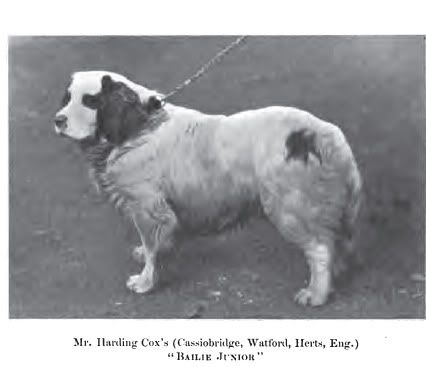
1901 Clumber spaniel.

1903 Clumber spaniel.

All that would have to be done is for the breed clubs to drop this nonsense about the V on the lower eyelid, and these dogs would be very similar to these dogs from over a century ago.

Now, it is true that when one peruses the images in Pai’s Photobucket album, there are some dogs with droopy eyelids.

I don’t know why these dogs were preferred over the ones with the tighter eyelids. It seems to me that is nothing more than the idiotic caprice of the fancy that picked upon this defective feature.

Dog showing has intentionally selected for an unhealthy feature in this breed, and it’s a good thing that the Kennel Club, the main registry in the Clumber’s country of origin, has decided to take this feature seriously.

The Dale Gribbles of the dog fancy continue to make up crap about this breed. They also are spreading easily falsified lies about the health of the dog that got disqualified at Crufts this year.

But it really doesn’t matter.

The facts are notoriously stubborn things.

Clumber spaniels didn’t always have ectropion as a breed feature.

And for the breed’s long-term health and welfare, its fanciers must embrace a back to the future breeding program that produces nice looking dogs with normal eyelids.

And if they don’t like it, then we can call them out for being obstructionist dinosaurs who don’t care about the welfare of their dogs.

I certainly am going to do just that.


Read Full Post »

« Newer Posts - Older Posts »

Follow