
Lycaon pictus. It is commonly called the African wild dog or Cape hunting dog. Such a name suggests a feral domestic dog, which it most definitely is not. It definitely needs a name change if it is going to survive.
Lycaon pictus has an image problem.
But most of it seems to be in the name.
I remember hearing these animals called “Cape hunting dogs,” and some old nature documentaries treated them as if they were some sort of feral dog.
In colonial texts, I always see them referenced in this fashion. I remember reading The Man-eaters of Tsavo by Col. Patterson, and his discussion of the species is that they are something like a dingo. I also remember reading texts that discuss Rhodesian [sic] Ridgeback histories, and the “Cape hunting dog” is listed as an ancestor. (I think they mean something else, but the terms are so nebulous that people often wind up mixing up African feral dogs with “African wild dogs.” It’s enough to confuse modern researchers.)
Because these animals have a range that extends beyond southern Africa, it became common to call these animals “African wild dogs.”
Another bad name.
Not only are there lots of other real African wild dogs (three species of jackal, the Ethiopian wolf, and several foxes), these animals are not related to any of the feral dogs. One of my biggest complaints in Stanley Coren’s Intelligence of Dogs is that he thought this species could have contributed to several domestic dog breeds. The name is both generic and misleading at the same time.
You see, Lycaon pictus is a relative of the interbreeding and interfertile species in the genus canis, but it’s not that closely related to them. It is more closely related to those interfertile species than the two species of “Africa-only” jackals (the black-backed and the side-striped).
Here’s the dog family phylogenetic tree:
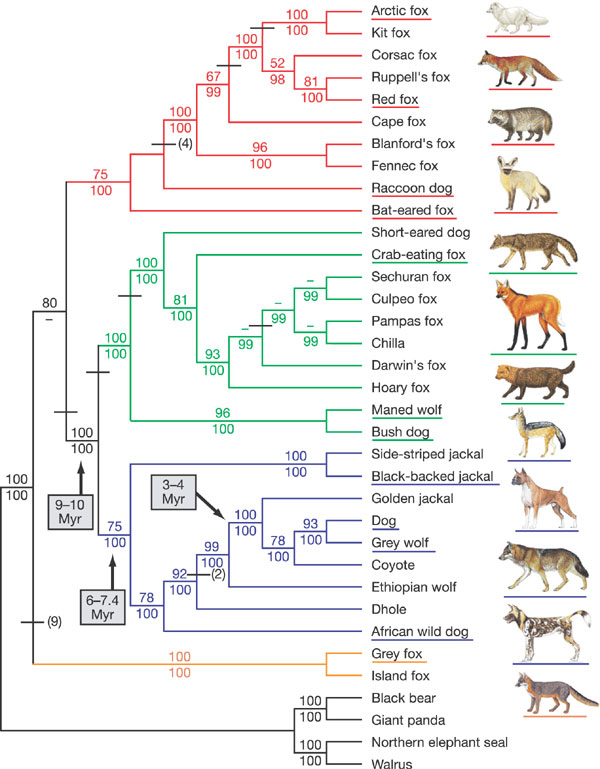
Ethiopian wolves and golden jackals are the most distant relatives to Canis lupus (which include dogs, New Guinea singing dogs, dingoes, and wolves) with which it can interbreed and produce fertile offspring.
See where “African wild dogs” are on that tree?
They are too distantly related to interbreed with domestic dogs or wolves.
But calling them “African wild dogs” suggests that they are related to dogs. It even suggests, if one gets sloppy enough, that these animalss represent a form of feral African dog.
It wouldn’t be so bad, but Lycaon pictus is an endangered species. The IUCN lists them as endangered, and the populations that do exist are fragmented. The land they live on is needed for people to raise crops and graze livestock.
When people encroach on Lycaon pictus’s habitat they unleash several threats. One of these is domestic dogs, who are carriers of canine diseases.
People also shoot, trap, and poison them.
In the old days they were shot to protect game herds. The same rationale was used in the early days of the conservation movement to kill off wolves in America’s nation parks. Kill of the predators to save wildlife.
Today they are shot to protect livestock.
And if we believe that African wild dogs are just feral dogs, then what is to stop people from killing them?
To make things worse, Lycaon pictus requires vast expanses of territory. They need lots and lots of room to be able to hunt enough prey to survive.
Most African national parks and private game preserves are too small for them.
And then those preserves are much more interested in promoting “sexy” animals. They do a lot to promote lions and hyenas, which are major predators and competitors of Lycaon pictus.
And if the park managers believe that Lycaon pictus is some kind of feral animal, they aren’t going to do much to promote their conservation to either their investors or their governments.
So to solve this problem, one conservation has decided that a name change is necessary to save the species.
In the New York Times, Nicholas Kristoff writes about the efforts of conservationist Greg Rasmussen in Hwange National Park, Zimbabwe:
We humans are suckers for certain kinds of wildlife, from lions to elephants. I hadn’t known I was a zebra fan until I drove my rented car into a traffic jam of zebras here. My heart fluttered.
As for rhinos, they’re so magnificent that they attract foreign aid. Women here in rural Zimbabwe routinely die in childbirth for lack of ambulances or other transport to hospitals, and they get no help. But rhinos in this park get a helicopter to track their movements.
Then there are animals that don’t attract much empathy. Aardvarks. Newts. And, at the bottom tier, African wild dogs.
Wild dogs (which aren’t actually wild dogs, but never mind that for now) are a species that has become endangered without anyone raising an eyebrow. Until, that is, a globe-trotting adventurer named Greg Rasmussen began working with local villages to rebrand the dogs — and save them from extinction.
It’s a tale that offers some useful lessons for do-gooders around the world, in clever marketing and “branding,” and in giving local people a stake in conservation. For if it’s possible to rescue a despised species with a crummy name like “wild dogs,” any cause can have legs.
***
Wild dogs are not dogs, which split off from wolves only in the last 30,000 years. In contrast, wild dogs last shared a common ancestor with dogs or wolves about 6 million years ago. They are the size of German shepherds and look like dogs, but they don’t bark and have different teeth and toes. And although many have tried, they have not been domesticated.
“Chimpanzees and gorillas are closer to us humans than wolves are to painted dogs,” Mr. Rasmussen said.
Note that terminology: “painted dogs.” Central to Mr. Rasmussen’s effort to save the dogs has been a struggle to rename them, so that they sound exotic rather than feral.
Do-gooders usually have catastrophic marketing skills. Pepsi and Coke invest fortunes to promote their products over their rivals, while humanitarians aren’t nearly as savvy about marketing causes with far higher stakes — famine, disease, mass murder.
Mr. Rasmussen is an exception, and his effort to rebrand the species as “painted dogs” caught on. The name works because the animals’ spotted coats suggest that they ran through an artist’s studio.
Mr. Rasmussen runs the Painted Dog Conservation, a center that offers the animals a refuge from poachers and rehabilitation when they are injured. But most of all, he works with impoverished local villagers so that they feel a stake in preserving painted dogs.
Conservation efforts around the world often involve tensions with local people. But you can’t save rainforests if their advocates are 5,000 miles away, and conservationists increasingly are realizing that they can succeed only if they partner with local people.
Painted Dog Conservation does a lot of work with local people who live near these animals. Rasmussen understands that the people aren’t as into conserving this animal because it’s not believed to be something unique.
It’s just a dog.
But if it’s a “painted dog,” it might be worth protecting.
***
You may note on this blog, I’ve usually called them by their scientific name or the direct English translation of that name. Lycaon pictus means “painted wolf.” Lycaon means wolf in Greek. Pictus means painted in Latin.
I think this is actually a better name than “Painted Dog.”
Why?
Well, I know they aren’t wolves as we understand them.
But neither is the South American maned wolf.
And what about the extinct the Tasmanian wolf?
Or the hyena the Namibians and South Africans call a Strandwolf?
Or the the little termite eating hyena called the aardwolf?
It seems to me that there are lots of things we call wolves but really aren’t.
The maned wolf is more distantly related to the real wolves than the Lycaon pictus is.
And the maned wolf does not have the same social structure that characterizes both Lycaon pictus and real wolves.
It seems to me that we could get away with calling this animal the “painted wolf” far more easily than we could by calling a marsupial carnivore a “Tasmanian wolf.”
And there is another thing:
North Americans and most Europeans view wolves rather strangely.
Where we once believed them to be the epitome of all evil in the wilderness, we now believe them to be the symbols of our wild heritage.
Calling Lycaon pictus a “painted wolf” would at least get people thinking about it in those terms.
Just look what has happened to the animal formerly referred to as the Simien jackal. DNA studies told us that it was actually closely related to the wolf and coyote, and its name was changed to “Ethiopian wolf.”
People now care about it because they think of it as a wolf.
It doesn’t matter than more recent studies have found that the golden jackal is more closely related to the wolf and coyote line than the Ethiopian wolf is.
People want to conserve wolves.
They don’t want to save the jackals or the feral dogs.
It’s unfortunate, I know.
But words have power.
And so do symbols.
The wolf of Eurasia and North America has been saved largely because the symbols it represents have changed in the public imagination.
I don’t see why the symbolism of the wolf can’t be used to save Lycaon pictus.
Calling them painted wolves would certainly elevate their status in the developed countries, and it might even help generate revenue (in the form of ecotourism and various foundations) that might be used to save this species.
Whatever we call it, Lycaon pictus needs some rebranding.
But maybe not.
There are Australians who are trying to save the dingo, which is a feral breed of domestic dog!
But Australia is a much more affluent place than many African countries, and it might be easier to get people excited about something like this if their bellies are full and they have money to spend.
So a rebrand is necessary.
***
Before the dingo people assail me:
I am classifying the dingo with the domestic dogs for a very simple reason.
They all descend from domestic Asian dogs, not wolves. All dogs, including the dingo, descend from wolves, but their direct ancestors were domestic dogs.
I do not deny that they are pretty wild animals and are not typically suitable as pets.
However, dingos are currently listed as Canis lupus dingo. I have some issues with this classification.
I believe there are two main reasons for its subspecies status– to keep people from owning them and to ensure that governments and individuals will do all they can to preserve them as native Australian wildlife.
I certainly don’t disagree with those objectives.
But I think we need to be careful about assigning it a subspecies status.
Where does it stop?
Couldn’t we say golden retrievers a unique subspecies of C. lupus?
I guess it’s just the taxonomic lumper in me coming out.
***
You note that I don’t use the name Canis familiaris for domestic dogs.
I think it’s a pretty stupid name.
We call domestic pigs Sus scrofa domestica because it’s derived from the Eurasian wild boar (Sus scrofa).
We call the domestic horse Equus ferus caballus because it’s derived from the Eurasian wild horse (Equus ferus).
Because most domestic ducks (save the Muscovies) are derived mallards, we call them Anas platyrhynchos (no subspecies given).
I don’t get why there is so much resistance to calling domestic dogs Canis lupus familiaris.
I think it may have to do with the long held belief that domestic dogs couldn’t possibly be wolves because wolves are evil.
I am sure this thinking has tinctured a lot of discussion about dogs and their origins.
And Darwin didn’t help.
Darwin believed just about every wild dog played a role in developing the domestic dog.
It’s not true, of course.
Then Konrad Lorenz posited the theory that some dogs were derived from wolves and others were derived from golden jackals.
So far, we know of only one dog that has direct ancestry from jackals: the Sulimov dog.
Now, there are differences between dogs and wolves, but wolves themselves are pretty diverse animals.
In their wild forms, they have come in so many different forms and ecological niches throughout their natural history.
In their domestic forms, these differences can become even more greatly magnified.
The cognitive adaptations that dogs have to live with people are interesting and worth noting, but how are these different from the Arctic wolf’s white pelt or the Arabian wolf’s large ears?
Why can’t we just accept that C. lupus is a very magnificently diverse species and domestic dogs are part of it?




“It’s just a dog.
But if it’s a “painted dog,” it might be worth protecting.”
Change the dog part. People in Africa are not so into dogs. Why call it a dog at all? Especially since it isn’t one.
We need a word like Dhole.
But all of the African names I’ve found don’t fit nicely in the English language.
We need something. I’m not talking just about indigenous Africans.
I’m talking about those of European decent who still don’t know what these things are.
These things need rebranding, badly.
I’ve always thought African Wild Dogs were beautiful and interesting. I don’t get why other people don’t? Is it because they resemble Hyenas (which I also love, but I guess many people don’t)?
Painted wolf seems pretty good. They’ve been called that before.
Yes.
I didn’t invent the term!
Jeff Corwin calls them that.
i don;t see dogs as domesticated wolves, either. ;–)
wolves + dom-dogs last had matrilineal common ancestry NOT a mere 30k ago, but between 65k and 100k years back.
thats from estimating the mutation rate of mitochondrial-DNA in wild wolves + domestic dogs.
dogs have TWO estrus periods per year; wolves, dingoes + NG-Singers, only One.
(that may apply to Basenji, too – i am not sure.)
dom-dogs form no pair-bond; wolves, pinctus, dingoes, jackals, foxes… all do.
dom-dogs are promiscuous; wolves are not, etc.
dom-dogs do not hunt LARGE GAME co-operatively; wolves + spotted-hyena + pinctus do.
foxes, maned-wolf, jackals, western-coyote, etc, generally hunt solo, and eat small game or scavenge for leftovers.
there are plenty of differences between dom-dogs + wolves; continuing the traditional romance of the wolf on the hearth-rug does a distinct disservice to both wild-wolves AND dom-dogs, IMO.
IMO + so far, IME, as long as this image of dom-dogs as wolves in disguise is peddled by biologists or ethologists, APOs / pet-owners will continue to think that Nature red in tooth and claw must rule…
and dominance, pack-theory hogwash, escalated punishment and harsh-handling will continue to hold glamour + be fervently practiced on hapless pet-dogs.
the day that NO * MORE dogs are pinned, choked, rolled, poked, hung, zapped, and otherwise abused in the putative name of *training* will be a day for dogdom and humanity to celebrate! DoG speed the enlightenment – it cannot come soon enough for me.
all my best,
— terry
terry pride, APDT-Aus, apdt#1827, CVA, TDF
Now, you know what I think of dominance theory.
I do see dogs as wolves.
The original study from Wayne that said dogs were over 100,000 years old has been modified.
It’s now more likely 30,000-40,000 years.
And there have been significant gene exchanges between dogs and wolves– enough that they are almost impossible to tell apart.
Dogs do pair bond if given the opportunity to do so. Elizabeth Marshall Thomas had a husky who did. And I know two JRT’s who did.
Dogs are just more flexible than wolves are in their social behavior.
Dogs have a very truncated social behavior. The purpose of a ‘pack’ or group, and pair-bonding, is to raise pups (hunting of large animals is secondary.) Feral dog populations have a very poor pup survival rate and are dependent on previously owned dogs to keep their numbers up, because the male does not care for the bitch during pregnancy, and does not help the bitch with the pups after they are born. Serpell covers this in one of his books, IIRC the studies were done in Italy.
I do have male dogs that will regurgitate food for ‘family’ pups. Since my un-related litter actually turned into a ‘family’ litter after Kali took over raising the pups, I still don’t know if my males will yak to feed non-family pups. My bitches will not only cooperatively raise pups, but they do ‘babysit’ when the real mom leaves.
Terry-many breeds that have a country of origin population have a single heat per year: Azawakh, Basenji, Saluki, Tazi, Taigan, etc. These are animals raised mostly outside in a resource poor environment.
I think it is the Ethiopian wolf that leaves her pack to screw around with neighbor males. I know I saw that on tv but it’s been a while.
Yes. It’s the Ethiopian wolf.
BTW, I’m very uncomfortable calling dogs a separate species from wolves. Wolves are a very diverse species, and yes, there are/were very dog like wolves.
I have a post on it here:
https://retrieverman.wordpress.com/2009/09/29/are-dogs-wolves/
That said, I think dominance theory is bunk.
But some of this stuff that is said about dogs not being wolves is also bunk.
Dogs are wolves, but they are just a different subspecies with some unique adaptations.
My critique of Cesar is that he thinks dogs are like what the classical studies on wolf packs say they are. This isn’t true.
And captive wolf packs aren’t like man made ones, which includes all of the captive ones and the Yellowstone megapacks, which have lots and lots of aggression them.
I’ve known too many well-fed free roaming owned dogs that were capable of forming pair bonds and paternal care.
I think people who say this are trying to throw the baby out with the bath water.
Yes, the idiots misuse the notion that dogs are wolves. That’s because they don’t understand that dogs are more flexible than wolves and dogs have cognitive abilities beyond wolves. Those need to be our focus.
Keep in mind that man created dogs and man created modern wolves. Modern wolves are the result of selective pressures that selected for only the most neurotic and reactive animals. Dogs are the result of selective process that produced the most socially tolerant animals (until we discovered dog fighting and how to use them for war).
I know that I’m a heretic, but no one has convinced me that C. familiaris isn’t anything but a bullshit scientific name.
It’s C. lupus familiaris.
A very friendly very dog-like wolf: http://books.google.com/books?id=_jrDrKS4o-IC&pg=PA45&lpg=PA45&dq=wags+wolf+murie&source=bl&ots=DXxFrlUzfX&sig=oWTGspyQ8DWHPrJKmBIpnvJH2RI&hl=en&ei=Q0POS9HJJMT68AbtjI1q&sa=X&oi=book_result&ct=result&resnum=3&ved=0CA0Q6AEwAg#v=onepage&q&f=false
>> Dogs do pair bond if given the opportunity to do so. Elizabeth Marshall Thomas had a husky who did. And I know two JRT’s who did. << – retrieverman
——————————–
did the M-dogs hang around of their own free choice after the Fs were in whelp?
did they feed the bitch while she was tending neonates?
did they regurgitate for their pups?
did they mind pups while the dam got a drink, stretched her legs. went to void?
did they largely ESCHEW all other opps to mate with other Fs who came into estrus?
what most humans refer to as *pair-bonding* in dogs is bitch preferences for a particular M or type of M – one drop-eared un-papered Spaniel in my youth would beat the living tar out of every M-dog with her type, but would flirt + mate with prick-eared dogs…
twice escaping to do so.
bitch-preference for an individual M-dog is an extremely truncated form of limitation; the M-dog has no commitment that i have yet observed in these so-called pairs, which are really all about F-choices, and ONLY apply in estrus.
in Dunbars long-running studies of a freely associating dog group, one F consistently chose a particular M as her buddy, 48 to 50 weeks of the year…
but she NEVER mated with him, not once.
she would mate with another M, then after estrus ceased, come back + take up their non-sexual relationship with just a few mildly apologetic appeasement displays.
so whats a pair-bond in dom-dogs?
the buddy she sticks to thru thick + thin, shares naps with, grooms, hangs out with, shares food now and then?
or a sex-partner who is attached to her for 20-mins 2 or 3 times a year?
many Fs who have preferences in mating are willing to mate with other dogs *similar* to their favorite consort; one GSD bitch i knew would mate with almost any Siberian, but ripped into 4 GSD males over 2 years and 3 heats; her owner gave up and spayed her (this was before AI in dogs).
simple Female-preference vs sexual exclusivity, shared rearing of a litter, etc, is a really thin shadow of what i think of as a Pair-Bond – which is at least 6-mos to a year of fidelity and shared territorial defense, pup-rearing, etc.
10 to 12 days of estrus is a drop in the proverbial bucket, by comparison to a 6 to 12-month pair duration.
what sort of pair-bond are U thinking of, in dom-dogs?
curious,
— terry
terry pride, APDT-Aus, apdt#1827, CVA, TDF
Yes. To all of those things.
Please read her book. The male husky vomits food for his puppies, and everyone goes nuts. Nobody knows why he did that!
I also have a study in which pariah dogs in India had pair bonds. The male dog actually vomited food for his puppies.
This is one of those things I deeply, deeply believe is nonsense in dogs.
Dogs can do wolfish things.
They can pair bond exactly like wolves do, but they rarely get the opportunity to do so.
Barbara Woodhouse had a GSD that dug a den for his mate and vomited food for his puppies.
I had a golden retriever that would vomit food for her puppies.
And one of the farm collies I grew up with formed a pair bond with another dog. They had a litter, and he vomited for them, too.
This is one of these things that is totally wrong about some of the stuff in dog science.
Raymond Coppinger is wrong.
I don’t agree with dominance theory, if you dig through it.
I’ve read both her dog books and found them to be kind of wanting; I remember disagreeing with a lot of her conclusions in the first book.
The second one I really didn’t like. She threw in some psychic stuff.
Which conclusions did you disagree with?
I think she was still operating in a dominance paradigm.
And that dogs just need other dogs.
But her huskies did pair bond, and the male did vomit for his offspring.
It’s been a while since I read it, I really don’t remember. I will have to see if I can find it and read it again.
The sires of my litters have never regurged for the pups, even though they have had plenty of opportunities to do so. Uncles and older brothers from previous litters, yes. The bitch line in my halfghans produces exceptional mothers, so it doesn’t surprise me the males will also feed the pups.
I’ve never had a dog of either sex attempt to bring food to a bitch that’s just given birth, though.
I have.
Our farm collie vomited for his English shepherd mate, when she had puppies.
The part I liked about her book was when she described two different mating systems.
Her huskies had a pair bond. She would only mate with him.
But when the male husky was gone, all her bitches turned into typical “slutty” bitches, except her dingo. The others tried to repress her heat, but she got mated by a springer spaniel. Then the dingo had puppies, and one of the huskies that also had a litter came in and killed all the puppies but one.
She also discusses street dogs in Puerto Rico doing everything to get bred by packs of free-roaming males, who did form cohesive social units.
The fact that you have a lot of different systems in dogs is why I discount the traditional dominance theory.
Well, it’s one of the reasons.
Coppinger wrote his book in part because he hates dominance based training methods. Hey, that’s fine. I hate it, too, but that doesn’t mean that dogs aren’t wolves.
I answer that question yes and no.
It’s very complex.
Paternal care by a golden retriever male (3 mins in):
He’s licking the puppies as they are born.
I hope you like Iron Maiden.
I like Iron Maiden just fine, though I prefer Judas Priest. Can’t watch the video, it’s too long and the wrong time of day.
The type of social system that wolves have has very high next generation survival value. Western dogs don’t really have that problem, not in the last hundred fifty years or so. They haven’t necessarily been selected for high puppy survival behaviors.
These behaviors are interesting, but they are remnant behaviors, and not always typical.
Most domestic dogs are not allowed or encouraged to pair bond.
But they are definitely capable of doing so.
But those studies of street dogs in India show that male dogs do provide some investment in puppies. (That’s the story behind the study I posted earlier)
http://indianpariahdog.blogspot.com/2010/01/dr-sunil-pal-and-study-of-free-ranging.html.
Okay then …is there any explanation for why a Female dog would vomit for a newly introduced 8 week old pup? And the Female has been about 2 months out from whelping her own pups already.
Very strong maternal instincts.
Captive wolves will vomit for puppies who aren’t their own.
I also have known a spayed female dog to lactate (not very much) when another female dog had puppies.
I have a bitch that will still occasionally regurg for her own pups, her sisters pups, and her ‘adopted’ pups (she simply took over the rearing of a completely unrelated litter when they were five weeks old.) Those ‘pups’ are, respectively, four years old, fifteen months old, and eight months old.
The last time I had two litters at once, ten days apart, the bitches combined pups and they had three ‘mothers’, the two real ones and an aunt. The aunt has nursed three different litters, none of them her own.
Good bitches.
what makes this paternal?
is he actually the sire of the litter?
my GSD-X would help to clean-off newborn lambs, especially the 2nd-born of twins, as the ewe might still be cleaning #1 under her nose, as #2 fell to the straw or pasture behind her;
but that did not make him the father-figure of the lambs, he was taking advantage of the tasty birth-fluids and also helping the lamb stay warm / prevent chilling, but i doubt he THOUGHT about that.
he also adored hoof-trimmings when the farrier came, but that did not mean he was compulsively neat, LOL – dogs seem to think they taste great.
how do i know? (shrug)
maybe they do – but i;m not gonna sample them, LOL.
dogs do things for dog-reasons – yummy is a perfectly-good dog-reason; yes, he COULD be a deeply-devoted dog with strong parenting instincts, too –
but my GSD-x cleaned bunnies, chicks, ducklings, and lambs with equal gusto.
he did not clean kittens at birth because
A, the queens never let him find the kits, and B, if he had, he would have known that they would rip his face off for trying…
when the kits hit 6 to 8-WO, the queens would cheerfully ** leave the litter ** under his eyes, and often between his legs as he lay there, looking up and away in embarrassment –
but he WOULD mind them, keep them from wandering off, watch where they were, carry a straggler back in his teeth…
he even ignored it when they nursed his long-hair + kneaded his chest + belly painfully with their thorny paws.
but i am *positive* he never sired any kittens, LOL.
cross-species fostering of neonates + juvies is not rare;
theres a M JRT in Africa who reared multiple big-cats in a sanctuary – leopard, cheetah, etc.
— terry
Honestly, I’m done with this argument.
You are going to focus on the differences.
But you’re not looking at the big picture.
Have you looked at black-backed jackal mtDNA studies? Compare them with how different dogs and wolves are in their nuclear DNA and tell me that Canis familiaris is a valid species. Different populations– and even the same population– can vary in their mtDNA by as much as 8 percent. But no one suggests that we divide black backed jackals into two species.
They have different behavior– one population howls and the other doesn’t.
Dogs and wolves vary at most by 0.2 percent.
Their differences and similarities are so nuanced that no rational person can say dogs do this but wolves can’t or vice versa. You say this, but then someone will find some exceptions.
I’m no fan of dominance theory to explain dog behavior, but I am no fan of denying that dogs are part of C. lupus.
If they aren’t, then we have a bunch of different species of black-backed jackal. Maybe two. Maybe as many as four.
http://www.pnas.org/content/87/5/1772.abstract
Domestic graylag geese, captive bred colonies of bobwhite, and budgerigars all exhibit deviations from their ancestral breeding behavior (which is monogamy).
Budgies can be bred successfully at a ratio of one cock to two hens. Bobwhites– one cock to three hens. And graylag geese can easily be induced into breeding with multiple partners.
Does that make the domestic versions of these birds separate species?
Because that’s the argument you are making with dogs.
And to be honest.
It’s pretty silly.
i did read ** The Secret Life of Dogs ** back when it was 1st-published; i was frankly appalled at *elizabeth* and so were many of her neighbors —
where i grew-up in a rural dairy-county, roaming dogs were not welcome, and owners who persisted got a serious talk from the sheriff, county-ACO, state-game warden, or the dog got B+B – bullet + bury.
allowing ones dogs to roam in an urban suburban area is about as irresponsible as it gets; calling it RESEARCH is IMO simply re-labeling ones irresponsibility to make it more palatable.
i still think *marshall-thomas* is a lousy role-model for anybody –
building a pen for her Nordic-mixes in a humid, sticky, hot, rural area, where heartworm is endemic, mosquitoes and fleas are year-round, and letting them dig dens to whelp?
color me un-enthused.
heat, humidity, ground-nesting hornets, constant biting insects…
what a wonderful (hellish) environment for Nordic-mixes, where hotspots and other major skin-issues are virtually assured in outdoor-housed Nordics, with their thick hairs-per-sq-inch double-coats.
Tidewater-crud is a secondary bacterial infection that moves-in on chronically irritated skin and creates hyperpigmented NAKED rumps –
which may be a ring at the base of the tail,
or a bare slab that starts at the end of the ribcage and runs halfway down each rear-leg, possibly decorated with crusted sores in high-summer, when humidity and heat are worst.
going out when the weather is nice to sit on a log in the dog-pen and watch the dogs lay around?
big whoop – what about pouring rain, soggy heat, thunderstorms, intense rainless weeks of sun, pollen season…
would SHE live out there, 365 days a year?
i doubt that.
E-M-T has a lot to answer for, : lol :
— terry
I think Dunbar is wrong here.
He was looking at only urban dogs.
Rural dogs are much more likely to behave as wolves do.
Urban dogs are more likely to be like the dogs in Coppinger’s Pemba theory.
Dunbar was studying dogs who were kept as a 24/7 group in a laboratory, with CC-TV recordings of who did what when, and with whom – eat, drink, sleep, play, mate, fight, push, intimidate, appease, etc.
unfortunately, funding cuts eliminated the study lab, and the dogs. :—(
— terry
And Laboratories are the best place to get generalizable data that can be applied to every single dog group in the world.
Dogs are not encouraged to form pair bonds, and males are not encouraged to help rearing the offspring (in most cases).
I think we should admit that dogs are very flexible in their social behavior, and they do have the ability to rear their offspring in many different ways.
I don’t think C. familiaris is a valid species.
If that’s a valid species, then we’re going to have to chop up a bunch of species.
Orcas vary in behavior from population to population in the same way that C. lupus does.
Keep in mind that all the studies I’ve read on wolves involve big game hunting wolves from Northern Eurasia or North America.
I’ve never seen one that involves the Arabian wolves or Indian wolves or even Mexican wolves.
From what I’ve read, Arabian wolves are quite a bit different from those big game hunting wolves in terms of behavior and phenotype.
Yet no one calls them a separate species.
The better way to think of C. lupus is as a very diverse species in terms of behavior and looks that was once even more varied than it is now (see the Goyet Cave “dog” study for a discussion on this: http://anthropology.net/2008/10/18/a-possible-domestication-of-dogs-during-the-aurignacian-31700-years-ago/)
It’s hard for us to get our heads around this.
We’re not that diverse as a species.
But that doesn’t mean that others aren’t.
If people are using the dogs as wolves thing for their crappy training theories, well, I disagree with that. I’m not a dominance-based person.
But I’m not so sure it’s wise to take this beyond that discussion and say dogs are separate species.
Golden jackals are separate species, as are Ethiopian wolves and coyotes. But dogs and wolves aren’t even remotely reproductively isolated. If you take a bitch in heat and put it near a wild wolf, he’ll mate with her. And if a dog spells a bitch wolf in heat, he’ll go for her (and probably will die because the other wolves will kill him).
Now, Dunbar is correct about dominance based and confrontational dog training methods. In fact, he was way ahead of his time.
It’s just that dogs are variable in this.
My experiences with farm dogs that were allowed to roam show that male and female dogs do pair bond.
The difference between dog and wolf is a continuum. There are doggish wolves (like Romeo: https://retrieverman.wordpress.com/2010/01/27/romeo-the-friendly-wolf-is-missing/) and wolfish dogs.
http://www.thebark.com/content/wolf-who-stayed
Here’s the study:
http://www.sciencedirect.com/science?_ob=ArticleURL&_udi=B6T48-4DJBSHP-2&_user=10&_coverDate=01%2F01%2F2005&_rdoc=1&_fmt=high&_orig=search&_sort=d&_docanchor=&view=c&_acct=C000050221&_version=1&_urlVersion=0&_userid=10&md5=d38f804da160488916b9ffe07e916b53
>> Parental care in free-ranging dogs was investigated in Katwa town, India. Six lactating bitches, 4 were monogamous. …
(63%) of pups [died] by the age of 3-mos.
Mothers were in contact with the litters for 13 weeks of the litters’ life.
…negative correlation between the duration of mother–litter contact in any observation session and the age of the pups. Milk feeding… continued for 10–11 weeks of the litters’ life. The duration of milk feeding in any 30-min observation session reached a max/ 27.54 min during the 1st week and a min/ 2.22 min during the 11th week (of age).
** All the mothers in this study were observed to feed the pups by regurgitation. **
For the first 2 weeks (post-whelp, the dams) were observed to be more aggressive to protect the pups.
The four males (male parents) were in contact with the litters as ‘guard’ dogs for the first 6–8 weeks of litters’ life. In absence of the mothers, they were observed to prevent the approach of strangers by vocalizations or even by physical attacks.
Moreover, **one male ** fed the litter by regurgitation showing the existence of paternal care in free-roaming domestic dogs. <<
6 dams, 4 *monogamous* (does that mean they mated with only one M?)
4 male-parents hung around for 6 to 8-wks post-whelp, and barked at intruders; ONE regurged –
how many times did he puke to feed the pups?
once? how old were they at the time?
if the pups were weaned and the dam had died, would his regurgitating have saved the litter – or fed them a meal or 3?
its not exactly a ringing endorsement –
1 in 4 of the males did any regurgitation at all.
the pups were on their own at a bit over 12-wks age.
no doggone wonder so many died; i doubt one in 10 would be alive at 12-mos age.
pariah-dogs are not welcome, well-regarded or cared for – they live short, desperate, skinny lives, and the bitches have the worst of it.
thank heaven they are not as incessant breeders as dom-CATS – queens live a life of endless, wearing fecundity; its possible to have a litter at heel, another nursing in the nest, and a 3rd growing in her belly.
— terry
Have you seen the Frogdog blog?
Lots of paternal in those dogs.
http://bullmarketfrogs.com/blog/
The bitches nurse each other’s puppies.
The dogs are interested in the puppies.
I actually think this is more common in feral dogs, but for some reason, it doesn’t work its way into datasets.
The urban dogs and the rural – a big difference, yes.
Urban dogs are allowed to pair-bond only with their owners. Other bondings are just “No!”.
Oh the dull life of the city dogs. Spending 22 hours a day inside a home, they are doomed to degenerate in a way – and another. Then, we’ll have the real Canis familiaris.
Canis neuroticus is more likely what you’d have.
U must know some p*ss-poor owners, LOL – not that those are rare, sadly.
i know rural dogs who live in 6 x 10 concrete-floored kennel I/O runs with 4 x 6 indoor pens for each dog – whoopee. if they are hounds, they may be shown in conformation, which can be enriching as stimulus, but high stress, too.
if they are hunted, they might be used a couple of weekends or a few weeks total a year.
i also know rural dogs who spend their entire lives in concrete or dirt floored pens, or on pea gravel –
or on 6-ft lengths of CALF * CHAIN from puppy-hood to death.
i know rural dogs who are allowed to roam at large, run deer and are shot dead; chase stock and are picked-up by the sheriff and euthed by ACC; eat bait from coyote-gitters and die horrifically; eat wildlife or dead salmon, and get incredibly sick; live beside dumps and scavenge; get hit by cars; get shot by hunters for target-practice (just like roaming cats) even tho they are doing NOTHING to deserve killing…
i know rural dogs who work stock, who hunt + train, who live INdoors with their family, who sleep in the barn and rat or varmint hunt, who buddy-up with the cats + horses, who have a great life.
i know urban dogs + suburban dogs who train, play, have a bigger social calendar than i ever will, who compete + love it, who do freestyle + flyball + agility + 4H obedience + the dog-park and the beach, they go boating + swimming + surfing + jog with bikes + ski-jor and vacation with the family and go to DOG * TRAINING * SEMINARS and DOG * HIKES and adventures unimaginable when i was a kid and through my 30s.
things have changed SO * MUCH for whats available for dogs and their owners –
dog-friendly cafes – patio restaurants; dog day-care + puppy playgroups!
meet-ups with other owners –
BREED * SPECIFIC meet-ups, dog-reactive dog-walking groups…
self-help owners groups.
BOOK * CLUBS for dog-owners who read + discuss dog books – training, behavior, breeding, memoirs, genetics, U name it, its out there.
urban dogs, rural dogs, suburban dogs can have DREAM lives – or live nightmares. it all comes down to the owners and what they want, and where they are –
sledding with a Siberian in Virginia Beach, VA, is not a happening thing, LOL – it can be 90-degrees F in 8-mos of the 12, and over-75% humidity most of the time, yecch.
but U can wt-pull, ski-jor, skate-jor, bike-jog, disc-dog, hike, back-pack with the DOG packing, camp, canoe, rent a beach cottage,…
what do U want to do with Ur dog?
fill in the blank. :–)
— terry
terry pride, APDT-Aus, apdt#1827, CVA, TDF
This is how we keep dogs.
We are far from the main roads, so dogs are allowed to freely roam.
No one cares.
This is rural America.
Keeping dogs shut up all the time ruins them, IMHO.
I keep my dogs like Ted Kerasote keeps his.
we were 2.5-miles off a paved-road in the village, on a dirt-road;
we had between 35 + 40-acres split in a big T by road-frontage, but all dirt township-road, 1.5 cars wide; U had to pull well-over into the ditch, to let an oncoming car by, and roll-up all the windows, too, or choke on red-orange dust.
my GSD x Keeshound was *my dog* —
he was free from his arrival as a dumped-puppy at approx 8-WO until for the first time, when he was 8-YO, he went to the 4-star restaurant 4-miles away to fight over a bitch in estrus.
he was inside or leashed for 3-weeks, and not markedly un-happy about it…
this was the dog i took thru 4-H obedience, and he would get up on his hind-legs, TAKE * DOWN his leash, and come find me, dragging it hopefully, wherever i was, LOL.
he was chained for 3-days when he was 11-YO;
his vet had told me he had rheumatoid-arthritis in his hips, which made No Sense, he had been swimming in the quarry for a 1/4-mile just 2-weeks before!
but he was dragging himself under the chicken-coop to lie on the cool damp earth for comfort; then he would stiffen, and be unable to get out. :—(
after dragging his 85# laboriously backward TWICE under the wasp-nests to the light, i chained him at the back-door on the soft bark-chip floor of the woodshed in the shade, with the bright door to look out;
my mother was on vacation, and i did not want to kill the dog before she came home; he was in my bedroom at night, and in the living-room in the evening.
the day she returned, he could no longer rise to void; it was time, and past time.
BTW – the VET was wrong; he had Lyme disease.
>:—(
our nearest-neighbor was a 1/4-mile away; he left HIS dogs roam;
over the years, they killed my 8-MO 7# kitten by ripping her hind-leg off 10-feet off our porch, in deep-snow, while i watched in shock;
they killed a Himalayan kitten who was sunning ** on the downstairs porch, 5-ft from the door, before she even got off her chair*…
they ran our sheep a couple of times when they found a gap where fence had sagged, and we had 4 lambs slip / miscarry and die; and one ewe had torn fleece and was shocky for 24-hours, but recovered;
they ran a DAIRY farmers dry-heifers around the paddock after dark, 4.5 miles away!…
they ran deer,
they bred other folks bitches by jumping fences and finding their way into barns or sheds, once breaking thru a tack-room window to breed a terrified 6-MO BC…
think they made a good impression?
think again – ROAMING dogs do not good neighbors make.
dog-sh*t in our strawberry bed was not endearing –
that was 10-ft from the porch in front of the house.
whether they are off-leash or on-leash, *responsible owners* keep their dogs on their own premises – my dog only broke the bounds once in his 11 years.
*kerasote* does not and did not make a habit of free-roaming dogs, to the best of my knowledge;
Merle got a door because he was mature-enuf + polite-enuf to merit it.
dogs who start fights,
chase game,
harass stock,
rip-into garbage,
kill poultry, etc,
should be (and often are) picked-up if possible, and the OWNERs should be fined;
if they refuse thereafter to keep the dogs on their own land, then confiscating the dogs + re-homing or euthanizing them have also been verdicts; so has the ever popular Shoot-em and Shut-up.
i sure hope Ur dogs are not predatory or otherwise problematic.
keeping dogs indoors at night, and on home-property always, is my preference – unless of course, they accompany someone.
my dog learned to generalize HEEL to the horses shoulder when i rode, and would walk on either side on cue, to keep on the verge.
loose-dogs off their home-turf on their own, often get into trouble – mild or serious – IME.
good fences make good neighbors? yes…
— terry
Terry,
Vets are wrong many times.
How did you find out your dog had Lyme?
Some vets say dogs are immune to that, some say they aren’t.
BTW, those small animals causing Lyme are here again! I found 5 in my dog’s hair (not skin tho’) yesterday.
hey, bridget –
ironically, in a journal article in another vets waiting room…
ALL his bizarre symptoms were there – the sudden onset, the cardiac arrhythmias, the nocturnal come and go fever, night-time anxiety (never exhibited under any circs before) which was associated with the heart-racing, the joint pain in a dog with no history of any hindquarter injury or structural problems.
my dog was stricken in late-June, 1977 in Bucks Co, PA.
on the advice of my vet, i put him down in August.
he was never radiographed, blood-tested, diagnosed or treated.
at the time, my vet was the *only* small-animal vet in the area; the next-nearest was 2-hours away, one way.
i have never heard a vet claim dogs are *immune* to Lyme –
a friend + fellow-trainer is a vet-tech in a multi-vet practice in New England, and they get dogs referred to them by other vets – they have an excellent record for Dx, Rx + Px, and many performance + working dogs as well as pets, go there to be Dxed + treated.
all my best,
— terry
People who live nearer the major roads keep them tethered all the time.
Now, that really ruins a dog.
This is a complete picture.
oops! hit the WRONG reply, sorry!
:—(
the post under C-neuroticus was meant for U, bridget –
i apologize for the mistake.
sorry for the confusion, theres no edit function,
— terry
How I love African Wild Dogs!(er whatever you decide to call them–I think some Native African name might be a good, exotic choice in “renaming” them)–I got to take care of some at my zoo(don’t EVEN believe the myths that they CAN’T BE TRAINED and are totally intractable! They are most certainly trainable!), and I have a friend in South Africa who has been working on a Wild Dog study for some time that I get to hear reports from. One of their great problems, even with radio-collared dogs, is FINDING them! They cover such vast distances, and frustratingly range into developed areas and kill livestock, which gets them into trouble, of course. The cultural view towards them is extremely negative–many get shot regularly, alas. Reading many old “white hunter” accounts over the years, I am always apalled at how villified this species has been, and how undeservedley. But like many cultural traditions, these views just get parroted over and over(like these canids’ supposeded untrainability), and no one bothers to look beyond the myths, to the detriment of a marvelous, unique wild animal. I have always been perplexed at WHY almost no one has bothered to try and keep and raise these guys in captivity, even just as interesting exotic pets, like so many other much more difficult species–I think it relates directly to such cultural traditions in that people have convinced themselves it CAN’T be done. Or perhaps with domestic dogs everywhere, peoples’ expectations for performance and behaviour are too high(the same as with wolves) in such a similar animal, unlike what people expect and demand from a lion or leopard, say. But at the rate things are going in Africa with development, and canid diseases, and negative attitudes towards them, before too long, these nomadic wanderers may soon be extinct in the wild………
….And I am one of the tribe that thinks wolves and dogs are VERY much alike–however, Terry, there is NO DOUBT that thousands of years of domestication has changed many things–especially regarding temperment! But having been around quite a few wolves(in captivity), coyotes, African Wild Dogs, foxes, and a variety of domestic(and NOT so domestic!) dogs, as well as keeping wolf hybrids myself along with domestic breeds in the same pack, I can assure you that wolves and dogs certainly recognize each other as alike, and display and share the same “language”! But then, domestication changes most animals at least to some degree from their wild ancestors–it has changed us, as well! After temperment(mainly in the sense of a willingness to put up with all manner of crazy stuff we expect our dogs to comply with! Although certain independent-type dogs will beg to differ on that score sometimes, too!), I think, indeed, the promiscous nature of dogs in breeding, and general lack of paternal care exhibited are the most glaring differences–although wolves raised in captivity can “learn” to be promiscuous, too, which many wolf hybrid breeders have discovered. But this is true of many domestic animals, where humans are doing the selecting–having animals in captivity that are difficult to breed is awkward, to say the least! Some dogs do show occaisional paternal behaviour in “throwbacks”-and it may also depend on how they are raised and getting the opportunity to do so–most pets do not. I did keep tabs on a pack of truly feral dogs when I was growing up–many of these dogs were born in dens and raised with no human contact, and were completely wild. In observing pups around a den, I never saw a male helping tend them, it seems the bitches were on their own. As for dogs not hunting large game in a pack? In these circumstances, they certainly did! Not even full grown cattle were safe from these guys, and there are plenty of accounts of packs of feral dogs(or people’s neighborhood pets out for some “sport”!) pulling down deer, etc. They behave just like a pack of wolves when they hunt this way, too(perhaps not as skilled, and it depends on the sizes of the dogs, too–they need to be fairly large themselves to tackle large game, of course). I think it is unfortunate, and very inaccurate, how the whole “dominance” thing has become associated ONLY with negative training in humans(seems to confuse “dominance” with “domineering” to me…..)–no scientists seem to have a problem with the proper use of the term–wolves, dogs in a pack, and virtually ALL social animals have SOME sort of dominance hierarchy–to deny that is to deny the obvious. Whether it is useful in TRAINING should be the only question! And it is questionable, certainly, and most people really don’t know how to apply it properly. Just remember, you CAN be benevolently dominant without abusing your dog(s), just don’t be so domineering!!
I’ll note that at least within my own Belgian Sheepdogs, I’ve seen the following:
1. male providing for the bitch and pups — including dogs OTHER than the stud like an uncle.
2. Babysitter dogs — males playing with pups. The worst behavior I’ve ever seen towards pups with my adult male dogs has been “AKKK! cooties!!!!” avoidance.
3. cooperative work. Of course in many herding breeds like my own, this is used in Herding work where the dogs are managing a very large flock/herd and one dog takes one side while the other dog works opposite. The vast majority of dogs I’ve worked do this naturally. You put it on cue later.
4. group behavior in the face of any threat.
Now I’ll also note that my bitches tend to be very intolerant of any OTHER bitch once the other “dares” to have a litter. And some of them have been pretty intolerant once the other has become fully mature (2 – 3 years old).
In most cases, dogs aren’t given the opportunity to establish a full pack “ala wolves”. Most human children wouldn’t manage to restablish a Cro Magnon lifestyle either. Much of it was cultural and taught. To find out if dogs could /would set up “ala wolves”, it would be necessary to try them with wild wolf foster parents. As for sexual behaviors, I expect that you would find that, given time and a climate/environment demanding it, dogs would re-establish back to an annual season. Lots of dogs (including many Belgians) only have one/year cycles or 9 months, etc. But short of a SEVERAL generation test, we’ll never really know.
Dominance is something that is badly abused as an excuse for a lot of things. It doesn’t mean that there isn’t a leader and subordinates. The more varied the roles, the less likely ONE individual is going to be “leader” in everything. No one asserts this rigid structure for lions, hyenas , dholes or “painted wolves”. Mostly the concepts of rigid structure came from a Victorian “see what you want to see” cursory glance at other animals + some wishful thinking regarding human households and “head of the house”. And pecking order came, as it name implies, from looking at chickens, not mammals (and even there it’s overly simplistic).
Vr, Peggy Richter
I wouldn’t say Victorian.
I’d say more like Romantic German nationalists.
The blog was one of the bests and the thred the most interesting.
I think ignoring the parential insticts in breeding is another mistake breeders do. Think how common the artficial breeding techinics are. I think all that may benefit the neurotic and unhealthy dogs, in the long run.
The same goes for all the behaviors.
People dont’t back up the wolfish behaviors in their dogs.
I think it is quite like pissing in pants to keep warm.
I BARF-feed my dog. The vet once said to me dogs are too domesticated to be fed that way. I changed the vet.
If my dog dies for a sharp bone in his throat or tummy, it is allright for me.
Better than to die for sugar, salt and all conservatives.
Bridget,
I’m fine with feeding conservatives to dogs.
http://en.wikipedia.org/wiki/Preservative
http://en.wikipedia.org/wiki/Conservative_Party_%28UK%29
Just so you get the joke.
Heh heh!!!
Some say that free radicals are even much worse…
LOL
[…] that the name ‘wild dog’ evokes sentiments of rabid or feral dogs. Popular blogger retrieverman gives some thorough insight into this issue on his blog and argues that the name of this […]
[…] 20, 2010 at 6:00 PM The Bark has been good to us both lately! .-= retrieverman´s last blog ..Will rebranding Lycaon pictus save it? […]
I’m shifted incidentally an individual dealt with this particular topic. It’s not at all often I knowledge an internet site with getting articles or blog posts like yours. I will write down your own feed to remain up to date along with future updates. Merely striking along with do carry on in the solid work.
This is a really cool blog. I agree that Lycaon pictus needs rebranding, and I think “painted wolf” makes a great common name for them. Having said that, rebranding alone will not save them. People all over the world persecute predators in the name of protecting their livestock. This happens to gray wolves in North America and Eurasia, and it happens to painted wolves in Africa. I think the real differences will come from persuading people to keep livestock in shelter, to have guardian dogs, and to shoot individual predators if need be, rather than condoning a war-like policy in which carnivores are trapped and poisoned as a matter of course.
As for whether to consider dogs as domestic wolves, from a phylogenetic standpoint, that’s exactly what they are, just as house cats are domestic wildcats, cattle are domestic aurochs, sheep are domestic mouflon, and so on. At this point, it does appear that humans and wolves first started living together 30,000-40,000 years ago, which is far longer than any other animal. Thus, there are some important differences between wolves and dogs, as mentioned above. Among these are the ability of dogs to read human body language better than any other animal, including our own closest relatives, the chimps. That’s a big deal. So, I’m certainly not denying that dogs and wolves are different. Nevertheless, from a genetic and interfertility standpoint, dogs are domestic wolves.
Finally, your comments on interfertility are great, but need amendment. It is true that species in the clade that includes wolves (and dogs), coyotes, golden jackals, and Ethiopan wolves can interbreed. However, outside of their own species, they experience reduced fertility. Wolves and dogs have no reduced fertility because they are in the same species. However, when wolves and dogs hybridize with coyotes (their next closest relative), the offspring may produce fewer sperm or eggs. If hybridizing continues for generations, then full sterility arises. Red wolves and eastern coyotes are of hybrid origin, but they remained fertile because the hybridization events were relatively infrequent. When you cross dogs with golden jackals, male offspring are always sterile, and female offspring are often but not always sterile (Haldane’s Rule). The Sulimov dog (a Russian breed used for sniffing out bombs and drugs in airports) was created by experimenting with hybridization between Siberian huskies and golden jackals. As for the Simian wolf, hybrids with dogs have been observed (and neutered) in the Bale Mountains. They were visibly more robust than pure Simian wolves. I guess we’ll never know whether they had any fertility prior to neutering. If male, probably not. If female, then maybe.
One more word on the wolfishness of dogs. Obviously, highly derived breeds have lost many of the behaviors of their wolf ancestors, but more primitive breeds still retain many of them. Stray dogs come in a few shapes and sizes, but when dogs go truly feral and form successful packs, they inevitably revert back to a more wolf- or dingo-like appearance over a few generations. These feral dogs can live in a family setting, like other wild canids. Such dogs are also formidable predators, capable of bringing down big game like deer. Of course, they can also bring down livestock, which makes them loathed pests which people should not have to put up with.
Dingos also used to be persecuted in Australia, just like gray and painted wolves elsewhere. Like other parts of the world, Australia has become more conservation oriented, which is why dingos are now more protected. Due to Australia’s ecology (dry environments with erratic seasons), dingos and their extinct predecessors the thylacines are about as large a mammalian predator as Australia can support. The extinct marsupial lion was about the size of a jaguar. In contrast, other continents have much larger carnivores, i.e. big cats and bears. So yes, it is weird that Australia is protecting its dingos, while Africa is not doing much for its painted wolves. However, with the thylacine gone, dingos have been the apex predator for the past 5,000 years. This doesn’t mean painted wolves don’t deserve protection. However, they are part of Africa’s large predator guild, while dingos are the only large land predator Australia has left.
Gabby,
wonderful comments, i’m glad U came by –
would U mind if i quoted the paragraph on “interfertility”?
[dogs re wolves, coyote, jackal, etc, & mixed species progeny].
I’d very much appreciate being able to share that info on a Linked-IN
forum, but would only do so with prior permission.
Welcome to the blog,
– terry
Addendum –
if i am allowed to share the post, is there a more-formal name that
U’d prefer i use as a signature, or is “Gabby” & a link to this blog
post a sufficient I.D.?
– t
Feel free, Gabby,
to contact me directly if U’d prefer – ‘thistlepurple AT yahoo DOT com’
Painted Dog, Painted Wolf, or Painted Dhole?
All wrong but all okay. Better than any of the longer labels.