
This famous depiction of two early wavy-coated retrievers appeared in The Dogs of the British Islands by John Henry Walsh (“Stonehenge”). This particular image appears in many books on golden, Labrador, and flat-coated retrievers to show what the original wavy-coated retrievers once looked like. The two dogs show the two distinct types of wavy-coated retriever that existed in Britain in the 1870’s. Paris shows the “Newfoundland” extraction, and Melody shows definite setter characteristics.
As I noted earlier, these two dogs represent the continuum of type that existed in the old wavy-coated retriever, but I did not include Stonehenge’s analysis on these two types.
Stonehenge was writing at time in the early days of the wavy-coated retriever. It was not then a distinct breed. It was more or less a type. Distinctions between breeds were not as clear as they are today, and dogs from the same ancestry could be registered as the same breed.
In the early days of the wavy-coated retriever, the show ring tended to reward dogs that showed more of a St. John’s water dog (“Labrador” or “Newfoundland”) influence:
In the early shows up to 1864, the classes for retrievers were open to all, and it was not till after the second and third held at Birmingham that any decided opinions began to be expressed. In 1860 the celebrated Wyndham was brought out by Mr. R. Brailsford with success, and he was at once accepted as the type of the wavy-coated strain, being apparently nearly or quite pure Labrador [St. John’s water dog]….The two Wyndhams were much of the same type, nearly or quite pure Labrador, and were about equally successful on the show bench. For some years Mr. Gorse carried all before him in the curly-coated classes of the various shows with Jet and his son Jet II.; but in 1872 Mr. Morris, of Rochdale, brought out True, a magnificent specimen of the breed, with which he has since that time swept the board in the champion classes, his grand bitch X L being almost equally successful in her own class. From the year 1870, when Meyrick’s Wyndham only took a third prize at Birmingham, Mr. Gorse, Mr. Shirley, and the various owners of Morley have shared the prizes in the smooth-coated classes, Major Allison’s Victor being their chief competitor. This dog shows more of the setter than is approved of by Dr. Bond Moore, who takes the lead as a retriever judge, and who has apparently influenced his coadjutor, whether Mr. Lort or Mr. Shirley, in the case of Victor; but has nevertheless, in conjunction with those gentlemen respectively, at the Alexandra Palace and Birmingham Shows of 1874, and more recently at the Islington Show of 1877, awarded a first prize to Melody, a bitch showing even more of the setter than Victor, according to my judgment. In each case the class was a large one, and that at Birmingham was noted by the judges as ” extraordinarily good.” With such conflicting fiats, it is difficult to arrive at any definite opinion of the strain considered by the cognoscenti to be the proper type of the smooth-coated retriever, and I have therefore selected one of each kind, my own impression being decidedly in favour of the setter cross, as likely to possess the best nose. Melody is a beautiful bitch, no doubt, but she has no pretensions to superiority in any respect over Victor, and hence the above-mentioned decisions are the more incompatible. Both Paris and Morley are said to be pure Labradors, the former being by Sir Henry Paulett’s imported Labrador Lion, out of Bess, an imported Labrador bitch. Paris has won repeatedly the champion prizes at the Crystal Palace and Dublin shows (pg. 105-106).
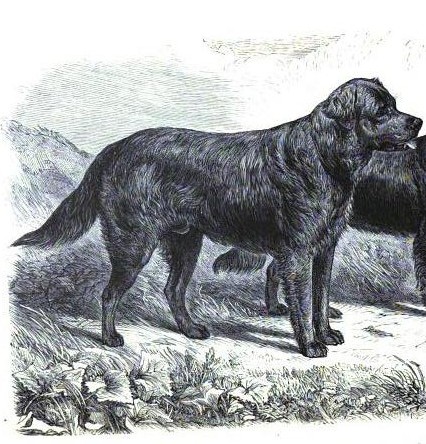
Stonehenge repeats that Paris is a “pure Labrador” several times in the text, concluding that “Mr G. Brewis’s Paris has been very successful on the show bench, and has a fine body and good coat, but I confess I neither like his head nor his short jaw. Nevertheless, it is impossible at present to find a better type of the pure Labrador.”
One should note the name of Paris’s sire. The name “Lion” strongly suggests that he was quite muscled and profusely coated. I imagine him possessing a particularly thick ruff, which gave him the appearance of having a lion’s mane.
So Paris was a long-haired St. John’s water dog, and the evidence is fairly conclusive. At least some of these water dogs from Newfoundland and St. Pierre and Miquelon were feathered. These animals probably were not preferred in their homeland, because dogs with lots of feathering tend to be less useful in climates that have a lot of snow and ice. Further, a dog with a more stream-lined coat is more useful in the water. For example, one never finds an otter or seal with long hair. Their fur is short and dense– just like the correct coat on a modern Labrador retriever or Chesapeake. Because the feathered coat is recessive to the short, dense coat, it was very likely that pups with feathering would pop up in water dog litters, and these dogs would have been the ones that the fishermen and settlers were likely to sell to British merchants, who brought them to the home country to sell as pets and working dogs.
If one takes a good look at Paris, he actually very closely resembles a modern English-type Labrador or contemporary smooth-coated St. John’s water dog. He has the same blocky head and dense bone. The only substantial difference is that he had long hair. To compare him to those dogs linked in this paragraph, it is best to look at Paris alone. When juxtaposed with gracile Melody, he appears quite coarse, but when one looks at him alone, the similarities between Paris and the short-haired St. John’s water dog and the modern English Labrador retriever become more obvious:
Stonehenge also makes an interesting comments on why these long-haired St. John’s water dogs were crossed with setters. Melody clearly shows a very strong setter influence, which Stonehenge seems to prefer over the “pure Labrador.” Stonehenge writes about why the setter blood was so important, and it had more to do with working ability than beauty:
It is generally supposed that this breed is a cross between the Labrador dog, or the small St. John’s, Newfoundland, and the setter; but in the present day the most successful on the show bench, as above remarked, have been apparently, and often admittedly, pure. In the belief that the nose of the pure Labrador is inferior to that of the setter, I certainly should advise the cross-bred dog for use; but to be successful on the show bench, under such judges as Dr. Bond Moore, Mr. Handley, and Mr. Lort, the competitor should display as little as possible of the setter. In all other respects Major Allison’s Victor was perfect, his symmetry being of the most beautiful order; but Dr. Bond Moore could not forgive his setter-like ears, and his fiat was against him (pg. 106-107).
The St. John’s water dog had retrieving instinct, love of water, and very high trainability, but it lacked the sense of smell that a working retriever in Britain needed to do its work. So it had to be crossed with setter.
When trialling retrievers became a popular use for the dogs, Rawdon Lee would write how the early trial enthusiasts wanted a dog that was large and more like what a “pure Labrador” resembled. They wanted a big dog that could carry a large hare a great distance, but it soon turned out that more lightly built dogs were more useful for trials. And the selection pressures of trials would have a major influence on the development of the wavy-coated retriever as it eventually became the golden and flat-coated retrievers we know today.
Today, the golden retriever essentially exists within a Paris and Melody continuum. Performance-bred dogs, especially those bred for agility trials, tend to lean towards the Melody type– sans the long setter ears. The conformation lines of golden retriever approach Paris’s type, although one might be more accurate if one compared these dogs to Zelstone, another dog of this “pure Labrador” sort.
It is very interesting how history has repeated itself in the golden retriever. The original wavy-coats were preferred to have the more “pure Labrador” appearance in the ring. This type fell from favor, and now it is quite common in conformation lines of golden retriever.
And the only reason for that, as far as I can tell, is that original yellow retrievers at Guisachan looked more like “the pure Labrador” type than flat-coated retrievers did when golden retrievers became a separate breed. After all, the yellow retrievers at Guisachan were part of the wavy-coated breed at this time, and it would make sense that they looked more like Zelstone or Paris than Melody or a twentieth century flat-coat.
It is important to understand that conformation often tracks both the style at the time and the selection pressures that exist in either showing or trials. These selection pressures can change very rapidly– even with the most carefully written and “Darwinian” breed standards.
Selection pressures for domestic animals change just as human societies do. It seems to be the only constant. This continuously changing conformation in retrievers is but one example.




It may be a bit heretical, but I imagine “Seaman,” the Newfoundland who accompanied Lewis and Clark on the exploration of the American West to the Pacific Ocean, was actually a dog more similar to Paris than a modern Newfoundland or Landseer.
Totally OT but the comments on the PDE blog have been psychotic lately. I think I’m going to quit breeding entirely because so many other breeders are obviously not playing with a full deck. Saying “I breed dogs,” becomes the equivalent of “I’m not only crazy, but I have no knowledge of anatomy to boot!”
OT: looks like a long-coat Lab:
http://webpages.charter.net/lofgren/Fluffy.htm
Sorry, OnT: http://webpages.charter.net/lofgren/Fluffy.htm
That photo tells us that a golden retriever isn’t just a long-haired yellow Labrador…
I was expecting that powder keg… LOL.
[…] Paris was a long-haired St. John’s water dog […]