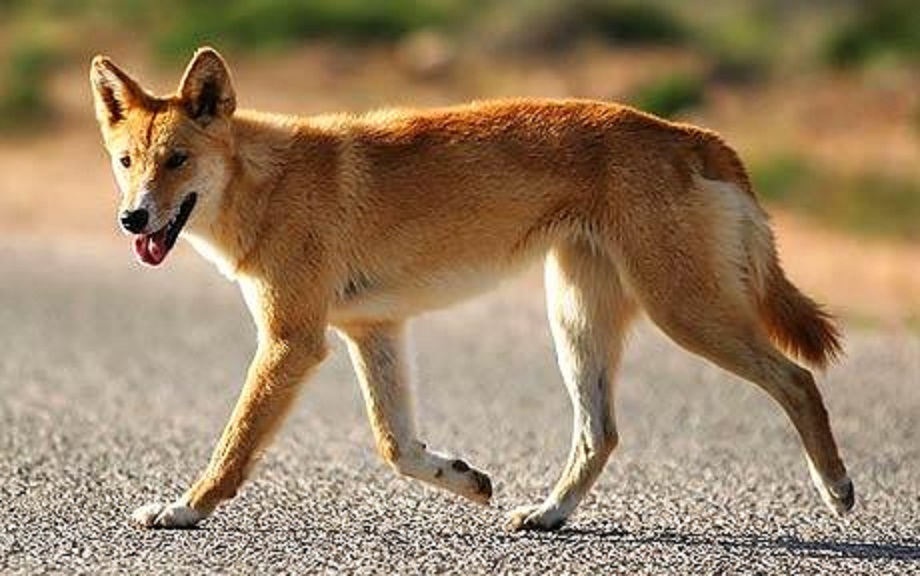
Dingoes are derived from domestic dogs that were brought to Australia between 4,000 and 6,500 years ago.
They are feral dogs.
In terms of classifying them through their phylogeny, they really shouldn’t be recognized as Canis lupus dingo but as Canis lupus familiaris.
However, the question of whether they should be considered native wildlife in Australia has been a bit of a debate over the years. At times, experts have aligned them with dholes, while others have considered them the ancestor of the domestic dog– which is, of course, putting the cart before the horse. Dingoes are derived from dogs, not the other way around. A dingo is more like a landrace of dogs that has evolved to live in the wilds of Australia.
Under normal circumstances, feral animals that derive from domestic species are not considered native wildlife. They usually don’t get protections from governments. If they get anything, it’s normally a bounty on them or the government hires its own people to exterminate them.
We have lots of issues with invasive species all over the world.
This is not an issue to be taken lightly.
However, when an invasive species has been in a place for thousands of years, can we still think of them as an invasive species?
Because dingoes were introduced by man so long ago, should they be considered invasives like feral cats and red foxes?
Well, the answer is much more complex.
And there are many ways to examine this question.
Perhaps the most novel is to examine how other species react to a predator that is an introduced species. It
Have they evolved behavioral mechanisms that keep them from falling prey?
This a study using this new methodology was recently published in PLoS One. It is entitled “When Does an Alien Become a Native Species? A Vulnerable Native Mammal Recognizes and Responds to Its Long-Term Alien Predator” by Alexandra J.R. Carthey and Peter J. Banks.
The authors examined the foraging behavior of long-nosed bandicoots on properties that were near national parks in the Sydney area.
They examined how often these bandicoots foraged in properties that contained dogs or cats. Cats are quite capable of killing one of these bandicoots, and if they had evolved an aversion to cats, it would be a major boon to their survival.
It turns out that the bandicoots tended to avoid properties with dogs on them. The tended to frequent those where cats were present.
The authors contend that the bandicoots have been able to evolve some natural aversion to Canis lupus through their thousands of years of predation from dingoes. Because of this aversion, they avoid domestic dogs are present, and because domestic dogs and dingoes are part of the same species, they had to have evolved this aversion in response to predation from dingoes.
Cats have been in Australia for only 150 years, and bandicoots have not evolved a similar aversion to them, which tells us that, at least when we’re dealing with long-nosed bandicoots, dingoes have the effect of a native predator upon them. But cats do not.
The arrival of the dingo was not without ecological consquence for Australia’s fauna. Three species are thought to have disappeared on the mainland as a result of predation and increased competion from dingoes. Thylacines and Tasmanian devils went extinct on the mainland within a very short time of the dingo’s arrival, and the Tasmanian native hen, a type of flightless rail, also disappeared– probably as the result of dingoes killing them. These species persisted into modern times in Tasmania– the only place in Australia where dingoes never colonized.
But these mainland extirpations happened thousands of years ago.
And in that time, the other animals on the Australian mainland that didn’t become extinct had time to adapt to the dingo.
The dingo filled the niche of top mammalian carnivore, a niche that would have been left vacant with the extinction of the thylacine.
Lots of native marsupials in Australia existed alongside predatory dingoes.
Their numbers collapsed only when Europeans arrived and brought in all sorts of different domestic species. And then introduced the European rabbit and the red fox for sport hunting purposes. The grazing species changed the Australian landscape, causing lots of erosion and overgrazing of ground cover, and the cat and the fox began killing the small marsupials that dingoes generally ignored.
In fact, when dingoes exist in large enough numbers, they keep the fox and cat numbers down, and the small native marsupial population is able to thrive.
So Australia’s wildlife has had time to adjust to dingoes and dogs. It has not had time to adjust to all the other introduced species.
This is something would would have expected, but it is interesting to use it in this particular methodology to see if dingoes are truly native or not.
***
My one little complaint with this study is that the authors state that they never asked the property owners if their cats killed bandicoots.
Although long-nosed bandicoots are in the size range that would make them vulnerable to cats, one really needs to know if the local cats actually consider them prey.
If the local cats don’t consider them prey, they aren’t likely to fear them.
And then you introduce a learned behavior variable into the study that isn’t entirely accounted for in the model.
The other problem with using this methodology to determine whether a species is native of nor is that invasive species usually affect ecosystems, not single species.
For example, one study that is often bandied about to defend the existence of feral cats in New Zealand found that feral cats kept down rats that preyed upon a certain species of seabird. When the cats were controlled, the rats took a heavy toll upon the colony.
That’s an interesting find, but if one were to look at how cats affect various species in New Zealand from a cost-benefit perspective, one would clearly find that cats are an ecological disaster there. They have been implicated in the extinction or near extinction of so many different birds that one could hardly say that their benefit to this seabird colony justifies their existence.
So we need to look at how dingoes affect the ecosystem before making these pronouncements.
However, to me, it’s pretty obvious that dingoes are the top mammalian predator in Australia, and they do play a beneficial role for most native species.




Thanks for defending the poor old dingo. Good to see science is on his side, too.
I love dingoes. they are perfection in doggy looks.
I agree. But a lot of people will argue that crossing them with European dogs is ok. No harm done. I think lots of harm is done. They are such a perfect dog.
There are dingos in Thailand. Do you know anything about them? I know you can’t save a landrace by rescuing a few of them: they’ll be suffering from inbreeding depression within minutes. But I wish somebody would bring some over here just to put out there in our general mongrel population, to maybe help with the genetic problems our dogs inherit from their purebred EU dog ancestors.
In Thailand they are captured and shipped to Viet Nam, where people eat them.
I think foxes & ferel cats do far more damage than dingos although some parts of australia are getting dingo x ferel dogs that are very very hard on many different animals both native, ferl & livestock.
I had a BC bitch in my late teens who escaped to mate with a dingo at our local wild life park. I did know where she went but recieved a ph call saying we have your dog come to Endevour Park to pick her up. I get there stunned to be told she had climbed into their Dingo enclosure. Yep she had 3 yellow pups, I kept 1 & the park kept the other 2. The park also fixed thier enclosure although they where amazed as had never had a problem before.
JO the BC went on to be a great dog but was never allowed off a chain or totally enclosed yard of a night ever again, lol. She was the smartest dog I have ever owned & toke it upon herself to find the perfect mate apparently.
Wanna the yellow pup was very much a 1 person dog but 1 of the best work dogs we ever had.
If I may borrow an AU expression: Good on you. Wasn’t the Kelpie derived from collie x dingo crosses?
I just want to clarrify I made an error in the above post saying I did know when it should say I did not know where she went.
Yes the kelpie has dingo blood & some people also say the red cattle dogs got their colouring from dingo blood.
Wanna was a damn good dog that I had to portect by registering her with my local council as a kelpie/bc x but it was pretty clear to see she was very much a dingo cross to anyone who knew what was what with dogs n dingos.
I never did get my pure breed litter out of Jo even after paying a big stud fee once, as she liked to choose her mates & therefore her only other litter was by a kelpie she choose.
1 of the pups the park keep was given to the keeper when he moved on to use in his dingo breeding programe. He allowed her to be mated to a pure dingo & as far as I know 3 pups (the best 3 out of 2 litters he breed from her with the dingo male)where also allowed into his breeding programe as he was having problems finding new genes at the time. He was honest about the pups being only 3/4 dingo though, as was the park about thier 1/2 dingo male they kept. I got to see a male out of the litter(the back crossed litter that is) when he was mature & the differences to a pure that I could see was he had a slightly heavier coat & his skull shape was slightly different plus he had 2 hind small socks & a very slight snip. I was told he threw a black pup in the first litter he breed, although it lightened with age to a dark wolf looking coat or very dark sandy colour apparently. The person who told me this did not know much about dogs or dingos & I can not be sure how accurate this discription was of the color & colour change.
I was surpriced the pups where not black though in my first cross litter being that black is so dominate but I put it down to the fact Jo’s sire was what I would call a wheaten or very very light tan n white dog & there where several liver & brown’s on her dams pedigree also. Out of the 3 yellow pups(2 bitches, 1 dog) 2 where just a slightly darker colour than most dingos & had very min white markings but the the bitch they breed from was very much dingo in colour although she had 2 hind socks & a partical white collar, a slight snip on her nose & tail tip the most white of any of the pups but her stucture was near spot on. The dog was a solider heavier boned dog & showed the most Collie imho although he had the least white markings with only a partical back sock & a tiny nose snip that all but dissapeared with age. The bitch I kept was very slight & athletic build & nearly as spot on as the parks/keepers bitch but she has a more BC shaped head on her plus more feathering on her tail & legs.
I have a mate who breeds dogs for pig & wild bull hunting in Ausralia’s top end & tropics, he has 2 high % dingos that are used mainly as finders & bailers whilst the big dogs go in to get a hold of the pig. 1 dog looks very much as the dingo photo posted her but his full sister & littermate is black n tan looking but has been DNA proven to be very high % dingo with some kelpie blood. They where DNA’d as a dingo breeders/conservastion centre where interested in using the yellow male mainly because my mate had gotten them from an Aboriganal comminuty that was on an island off shore from Cairns & they thought they might have interesting DNA & may offer some new blood. I will ask my mate for some pics of the dogs. He also has some Australian Kangaroo( a mixture of sight hounds) dogs you guys may find interesting.
it’s an interesting issue of when an “import” becomes a native. Lots of animals crossed the Bering land bridge during the ice age — and are now “native”. All of Hawaii’s animals are “imports” from one period or another (as are all island species). We tend to correlate “alien” when the animal is brought in by people and often enough of course, the introduction is disruptive. But is it simply because we see that disruption and it’s fairly recent in terms of time? If we waited a few thousand years would we find that the introduced species “had gone native”? Clearly because we are a globe trotting species, we need to take care that vulnerable species aren’t obliterated by new predators or competitors – or for that matter, new diseases like distemper (http://www.kcet.org/updaily/the_back_forty/commentary/desert-kit-fox-distemper-outbreak-may-have-come-in-a-bottle.html).