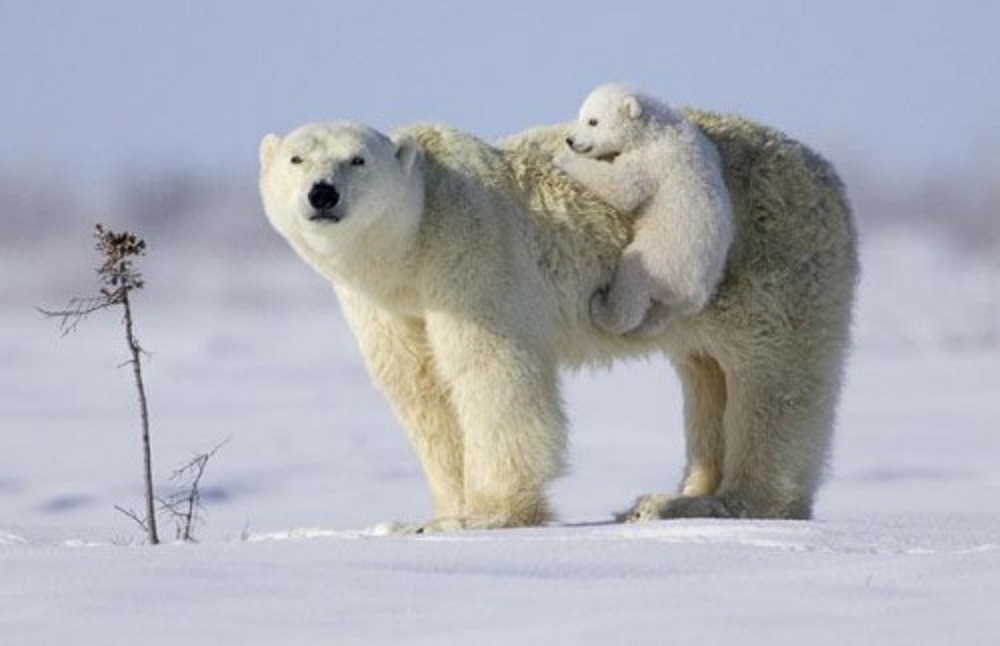
Right now there is a lot of talk about whether polar bears will go extinct as the climate changes.
The animal has become very much a symbol of demise of ice in the Arctic Ocean, where the bears prey on seals that that whelp on the ice.
The theory goes that if polar bears, they are automatically doomed to extinction.
I have always found this to be a very simplistic (and somewhat alarmist) proposition.
Please note that I do believe climate change is a major problem, and yes, we must do what we can to reduce greenhouse gases in the atmosphere.
What I don’t accept is that polar bears are automatically doomed by climate change.
There are two major reasons why:
The first is that polar bears are not stupid animals. They can learn to utilize new food sources fairly easily, and I don’t think for a minute that they are doomed because they can no longer hunt ice seals. The seals themselves might be doomed, because if they try to whelp on shore, they are going to be easy pickings for just about every predator. Climate change is happening too fast for these seals to evolve new reproductive strategies.
But polar bears themselves can learn to hunt other things. I see a future in which polar bears become the ultimate scavengers, competing with wolf packs that have brought down moose. Wolves will have a very hard time protecting their kills from such behemoth scavengers, and this certainly will put a new selection pressure on wolves in northern Canada and Alaska, who have had to worry only about about more omnivorous and generally smaller brown bear subspecies scavenging their kills.
Also, for those of you who are not aware, the short arctic summer brings about some of the most productive avifaunal events in the world. There are hundreds of birds that fly north to the arctic each spring to lay their eggs.
Why do they do this?
Well, during the summer, the sun is beating down almost 24 hours a day. That’s very good for plants, and it’s also good for insects that eat the plants, which are very good for certain birds to eat.
So if you’re a small insectivorous bird, and you want to raise your chicks in a productive environment, you go to the arctic to raise your young. There are hundreds of species that have evolved to do just that.
And then there are other birds that fly up there to hunt those little birds, and there are others, such as snow geese, that fly up there to raise their offspring in vast green meadows that erupt each summer.
There is already evidence that polar bears are taking advantage of the arctic’s annual avifaunal glut.
Polar bears are eating now eating snow goose eggs, which are quite high in fat. The geese produce enough eggs every year to sustain a healthy population of polar bears, and if polar bears began to capitalize on birds, they would be able to survive a warming climate, where ice seals are either extinct or whelping elsewhere.
The other thing is that polar bears have survived warming periods before.
And how do we know this?
Well, it turns out that brown and polar bears are very close relatives. The two species can interbreed and produce fertile offspring, which has caused quite a bit of confusion about the age of the polar bear species.
Early mitochondrial DNA studies have suggested that polar bears are a recent offshoot of the brown bear lineage. If this were true, it would mean that the polar bear rapidly evolved to fit its niche within the past 150,000 years, which would almost make them a subspecies of the brown bear. Later genome-wide analysis revealed that the polar bear actually an older species. It evolved some 600,000 years ago from the brown bear lineage. Even more extensive genome-wide analysis found that polar bears were more likely in the 4 to 5 million year old range.
This discovery highlighted the perils of constructing phylogeny and taxonomy using only mtDNA data.
But it actually showed that polar bears have survived warming periods before, and they very likely will survive this one. If polar bears were a very recent offshoot of brown bears that had become specialized to arctic sea ice, their chances of survival would be much lower than they are now, but it now turns out that they aren’t as specialized to sea ice as we may have originally believed.
The other way we know polar bears have survived warming periods is through the evidence of hybridization in brown bear populations.
We actually now have two very good examples of this hybridization.
The first of these was the discovery that extinct Irish brown bears had almost the same mitochondrial DNA as polar bears.
And back when we believed polar bears were fairly recent species, it was suggested that all polar bears evolved from those Irish brown bears.
There was also another population of brown bears that had similar mtDNA to polar bears. The brown bears of Alaska’s Admiralty, Baranof, and Chichagof (“ABC” ) Islands, also share an mtDNA sequence that is similar to that of polar bears. For a very long time, it was believed that polar bears evolved from these brown bears.
But the separation was even more recent– only 14,000 years ago. If this were true, then polar bears would be a species younger than the domestic dog.
Of course, that notion was destroyed through the genomic analysis. Mitochondrial DNA is only a tiny piece of the genome, and it is inherited only via the female ancestors. Studies that use only this data simply do not get the full picture, and there are many, many revisions in the literature that have come from errors in mtDNA analysis.
So I was quite pleased to see a recent study on the ABC Islands’ brown bear population. It was a genomic study, and it found that these bears are actually derived from polar bears, not the other way around.
The researchers conclude that at some point during a warming period, a population of polar got stranded on these islands. They remained on those islands, feeding on a wide variety of food sources for male brown bears to reach them.
This study also suggested that initial finding that polar bears were derived from Irish brown bears was also in error. Instead, something similar had happened. Female polar bears became stranded in Ireland and then mated with native Irish brown bears. Over time, the main mtDNA lineage of Irish brown bears was replace by that of those bears that were derived from those polar bears– perhaps the polar bear blood infusion was a bit of genetic rescue or provided some other competitive advantage.
These genetic studies show that polar bears are not bound to the sea ice.
As intelligent, opportunistic predators, they have been able to survive warming periods, and they have been able to survive through hybridization with their closest relative.
If I were going to bet on the future of the polar bear, I would have to bet that it will survive the current warming period.
I’m not so sure about the ice seals, and I think they are a more appropriate icon for the movement to reduce greenhouse gas emissions.
When it comes to adapting to change, one would not be wise to bet against any species of bear, unless we’re talking the giant panda.
The panda is pretty much screwed.
No arguments there.
But I think the future for the polar bear in this warming world is much better than many people are forecasting.
This isn’t an overly specialized animal in the same way a giant panda is.
It can adapt. It can learn.
It’s not as bound to the ice as people think.
It’s evolutionary history clearly reveals this fact.
***
Now, before commenting on this post. Please read it in its entirety.
I am not denying climate change. Nowhere in that post do you see the words “Global warming is a hoax.” (except right here!)




Very interesting, hopefully humans will not interfere with hybrids in the same way they are doing with the Ethiopia wolf. As it seems to me that the Ethiopia wolf is in a similar position, e;g habitat lose and finding away round that by breeding with dogs.
Adam
Perhaps before this current warming period is reversed (reverses itself, or whatever term best fits), polar bears will become assimilated into a brown bear/polar bear hybrid population, and the polar bear genes will just lay in wait until they can assert themselves again in certain bear populations as ice once again covers the arctic. Much as geneticists now claim all of us of European descent have a little Neanderthal in our DNA (I believe I have a little more than average. There has always seemed to been something “different” about me), the brown bear species will carry the polar bear into the future in their DNA.
It may get confusing when trying to label a polar bear a polar bear in the near future. Would a bear with polar bear phenotype but colored like a blond grizzly and eating goose eggs and driving wolves off their kills still be considered a polar bear? Or how about a brown bear that inherited a mostly white coat but kept the dished faced, shoulder humped phenotype of a grizzly?
We may put too much emphasis on physical features when we decide just what makes a species, and let visible phenotype lead us to think certain creatures are much more different from their closest relatives than they actually are. This was exemplified by the first naturalists to roam North America and name every wolf pack they came across that had the majority of individuals of a different color or size as a different subspecies until they had named a total of 24 that in most cases blended into each other where their territories overlapped.
Perhaps in the (not too far?) distant future, after we humans have practically destroyed ourselves, and we’re back to beating each other’s brains out with clubs rather than using high tech weapons of mass destruction, the little Neanderthal DNA in some of us will rise to the surface in the appropriate environments, and Neanderthal will once again walk the borders of an ice age north, and polar bears will rise from populations of brown bears that still carry their DNA to hunt the arctic ice. We know the earth is much older than most of us can comprehend (which I believe is why so many people have trouble comprehending and perhaps even believing in evolution), and every species that ever lived either went extinct or evolved into another species, or is in the (sometimes excruciatingly slow) process of doing so now. Expecting things to stay the same, for species to remain stagnant and hold their place in the natural world is just something we humans seem to have come up with and expect.
DAC
This was a brilliant BBC documentary, The Polar Bear Family & Me. Follow the link for some video clips. http://www.bbc.co.uk/programmes/p012zc93 There is talk of them being prosecuted for this stunt because you’re not supposed to cause the bears any distress. Yeah, poor hungry bear was looking forward to a nice fresh meal and never got to unwrap the her present.
Anyway, I digress. The only difference to this warming period is encroaching civilization, thus competition for food and space from homo sapiens with more effective ways to kill them than in the past. That might cramp their freedom to forage far enough to survive in the numbers of the last warming period. But as already mentioned, bears of most species are intelligent and resourceful enough to adapt quickly given a fair chance. Times are hard for polar bears right now. But this pressure on a species is what drives evolution. Who knows, the future of polar bears and the most northern grizzlies might well be very much grolar. Or even evolving into subspecies like a smaller, more landbound arctic bear that indeed takes advantage of the glut of geese chicks/eggs and evolves to be blonde rather than white for camouflage, or even seasonally changes colour like an arctic fox. Or a bear with an even more powerful head or larger size that prey on walrus if the seals aren’t there to eat. Or maybe an even a more aquatic species than they are already – they might evolve into a seal like creature themselves given enough time. Maybe all three of these or more? Evolution will come up with far better survival modifications for bears than I can.
Like Eastern wolves and coyotes: life finds a way.
suspect the seals will react by changing tactics — breeding on small islands or even mud banks that don’t give a bear much access. The European Beaver that lives in rivers doesn’t do as much of the kind of dam building seen in the American Beaver and other animals have changed tactics. Other seals seem to be able to manage to pup despite some significant predators, so the ice cave may not be as necessary as thought. (Harbor seals have rookeries on the CA mainland, where there were originally coyotes, wolves and bears. Harbor seals also live in Alaska).
Confused. I thought that the species boundary between the polar and grizzly bears was quite weak and that hybrids between the two were being seen in the wild as climate change brought the two ‘species’ into greater contact. I think i remember someone questioning whether the polar bear was a distinct specie, or just a white version of the grizzly. What’s this about brown bears?
I think it’s safe to predict that pure white bears will become less common as the areas blanketed by ice shrink, and the areas of interrupted snowfields grow. Bears will go on, but the polar bear as we know it is likely to retreat.
It’s actually not clear at all.
Grizzlies are brown bears. They are exactly the same species from North America to across Eurasia. They just vary a little according to habitat.
I don’t use the term grizzly bear unless I’m actually talking about that subspecies. It’s really weird, because all those subspecies are quite different. Kodiak and Alaskan coastal brown bears are quite large but are far less aggressive than grizzlies, which aren’t much larger than European brown bears, which actually aren’t that aggressive at all. Grizzlies evolved out in the open, so they are always on the defensive.
Sorry, I don’t agree with this whole premise that polar bears will evolve. They won’t be able to, unless you believe in Darwin’s contemporary (whose name I am forgetting), who had propounded the theory that all wild animals adapt to changing environment. Unfortunately, his theory lost to Darwin’s that those animals who are able to adapt live and those that didn’t disappeared.
Even that is not a possibility for the climate change is too fast for polar bears to adapt. It is more like dinosaurs, who died enmass due to a calamity that changed the rules of the game too rapidly for them to survive.
The reason why people are so hesitant to be skeptical about the claims about polar bears is because that is the global warming symbol. I accept climate science. I’m not arguing that. I am arguing about polar bear extinctions due to it.
Here’s a good piece on the actual science about polar bears and global warming:
http://www.psmag.com/environment/endangered-polar-bear-global-warming-climate-change-arctic-sea-ice-50450/
The science on whether polar bears and global warming simply isn’t clear.
My guess is that as bears, they’ll adapt. That’s what all bears, save pandas, can do.
I don’t think they are as bound to ice as they are claimed to be, for we have colonial accounts of polar bears living in the Maritimes and the Gulf of St. Lawrence and Newfoundland all year round, which isn’t in the arctic.
I understand what you’re saying, but I’m thinking of the extinction of polar bears more along the lines of what’s been happening to the Florida panther. They’re going extinct, but it’s the loss of a subspecies of a larger population rather than the mass extinction of the species as a whole. The dinosaurs were lost over a very short period of time due to an instantaneous catastrophe like a meteor striking the earth and wiping them out; and not just one species of dinosaur either, but more species than I’ll ever know.
But what if part of the population of one species of dinosaur went extinct due to global weather change; could there be the chance of that subspecies of dinosaur evolving again from the rest of that species still living if the subspecies had interbred with them before “going extinct”? As an example: if all T-Rexs in the world had a skin (“or feathers, if they had feathers) of various shades of brown, but one subspecies of T-Rex evolved a green skin (“whatever the outer coating was”) due to a certain environmental factors where that population lived (and they were considered to be a different species because of that difference). But then the environment favoring the green subspecies begins to disappear over a period of twenty or so years because of global warming, but during that time the greens are forced to move into more unfavorable areas, and interbreed with the browns living there, so that once all green T-Rexs are gone, and all the T-Rex in the world are brown, some browns still carried the green DNA.
Then once an environment favoring the green coloring came back X number of thousands later, green T-Rexs began appearing again, and soon there was a thriving population of green T-Rex living under the conditions they once lived under. Did they ever really go extinct?
If eventually all Florida panthers are genetically 7/8 West Texas cougars (mountain lions, pumas or whatever they call Puma concolor in West Texas), are they still Florida panthers?
If polar bears do disappear, but in 10,000 years or so another ice age starts freezing the arctic waters and surviving populations of brown bears (with a little of the old polar bear DNA still in them) start hunting the ice and producing cubs with lighter and lighter coats, and longer and longer necks until there are once again white bears roaming the arctic ice, are these white bears polar bears?
I guess it all comes down to semantics, or what you actually consider a “Polar Bear”. But one thing is certain, once all species of bears are gone, once all species and subspecies of brown/grizzly/Kodiak/polar bears are gone, then they are truly extinct.
DAC
This is a subject on which I’ve pondered long and hard.
Let me start by saying that I hate the idea of an anthropogenic extinction event. But, life on earth has gone through more travails than those visited on it by Homo sap–its extremely resilient.
Purists will say that a FL panther that is mostly western P. concolor, is not a FL panther. But one has to ask, do the environmental factors in FL that generated the smaller sub-species in the first place still apply? If the answer is yes, then I suspect that natural selection and relict FL panther genes will eventually produce an animal virtually indistinguishable from the original. Would it have the same genotype as the original critter? No, but the phenotype, the behavior and the niche being filled would continue to be the same. I would go even further and say that where one has a highly diminished species (or subspecies)–say the Sumatran Tiger–(s)he could, through a carefully thought-out breeding strategy, recreate the original species–YDNA, mtDNA, atDNA and all.
But even if all representatives of a given genus are lost, given time and an equivalent climate/ecosystem, convergent evolution will produce a reasonable facsimile thereof.
One final, related thought: A year or so ago, I was mildly ridiculed for opining that I hoped to one day see the recreation of the Passenger Pigeon and other contemporaneously extinct species. I would not so modestly now refer those who scoffed to the most recent issue of National Geographic, in an article entitled “Bringing them Back to Life”, on pages 30-41. The buzzword coined for the concept is “de-extinction.”
Massugu, you’re right, the one thing I overlooked in my assessment above (that once all bears are gone they are truly extinct) was cloning. I guess that way of thinking about extinction has become obsolete. It’s now probable that all species that have gone extinct, but left behind sufficient DNA in one form of preservation or another (be it frozen in the Siberian tundra or hanging on the wall in some hunters game room) can soon be brought out of extinction. I have long told my children that they would see a living woolly mammoth in their lifetimes. Cloning polar bears from well preserved DNA and impregnating brown bears with the cloned ovum will be a snap in the future. Now if we can only save our own species so there will be someone around to do the cloning.
DAC
The breeding strategy I mentioned wouldn’t even have to depend on cloning–just good solid animal husbandry techniques and a little knowledge about heritability.
I also suspect that as more and more species–extant and extinct–have their genomes sequenced, scientists will be able to mix and match gene sets and pluripotent stem cells in such a way as to “de-extinct” critters from scratch, instead of cloning them. (Think genetic Leggos.)
We’re already seeing the creation of new critters such as the “Frankenstein Fish” super salmon (yecch!) No matter how much we may dislike the technology for how its being used, the question remains, how hard would it be to extend it to revivie extinct species (or very close facsimiles of same?)
Here’s another one for you DAC…
http://grist.org/list/baby-chicken-whose-father-is-a-duck-is-either-a-new-hope-for-extinct-species-or-a-sign-of-the-end-times/?utm_source=facebook&utm_medium=update&utm_campaign=socialflow
Now that’s a *ucked up duck!
DAC
[…] More evidence that polar bears and brown bears have exchanged genes in the past (retrieverman.net) […]