PET ME!!!!!!!!!
Posted in wild dogs, wildlife, wolves, tagged Wolf on March 23, 2013 | 11 Comments »
Posted in golden retriever, Miley, tagged golden retriever on March 23, 2013 | 17 Comments »
March is gray, and snow is coming— again.

Posted in West Virginia, wild dogs, tagged coyote, Eastern coyote, West Virginia coyote on March 19, 2013 | 80 Comments »

From The State Journal:
Agriculture Commissioner Walt Helmick believes he has the solution to West Virginia’s coyote problem.
Helmick is looking at establishing a bounty to encourage hunters to kill the critters.
He said coyotes are the state’s biggest predator problem. They are in all 55 counties and pose a threat to both farm animals and domestic pets.
“More of them are being born than we’re removing. They’re winning the battle,” Helmick told The Register-Herald of Beckley.
“We spend a significant amount of money on predator control. About half a million dollars. The feds helped us out a few years ago but aren’t doing anything at all now. We’ve lost the federal support.”
Under Helmick’s plan, coyotes would be trapped and their ears would be marked with an identifying number. They would then be released in a different area. Hunters who kill a coyote marked with a number would receive a bounty.
“Hunters will be out there all the time, looking for this type of opportunity, and will probably kill another 25 trying to get to that one, or maybe even kill 100 of them,” he said.
Details of the plan, such as the bounty amount, are still being worked out.
Helmick wants to expand the state’s sheep industry. But he said that will be difficult unless the coyote population is reduced.
“I know we have a problem with the sheep industry,” he said.
“And the coyote is not all the problem, but it’s a significant part. For the rebirth or growth of the sheep industry, it would be almost impossible with the amount of coyotes we now have on the loose.”
If this plan is implemented, West Virginia will learn the hard way what a waste of money a bounty system for coyotes actually is.
For some perspective, the coyotes that live in West Virginia are derived from ancestors that first encountered Europeans on the Great Plains.
Those settlers then spent a hundred years trapping and poisoning coyotes left and right all the way to the Pacific Ocean.
The results?
Coyotes are now found in every province in Canada and every state in the US except Hawaii. If they were better swimmers, they would do fine in Hawaii.
Their range now runs from Alaska to Panama.
And all those millions and millions of dollars spent on killing them has only resulted in them expanding them.
I have no problem with hunting coyotes, but we are kidding ourselves if we think we can significantly reduce their numbers through a trapping and hunting bounty lottery.
If we couldn’t reduce their numbers on the Great Plains, where it’s very open, you can forget about reducing their numbers in dense, brushy places like West Virginia.
Coyotes are here, and they are going to stay.
You can hunt them and trap them, but we’re always going to have them.
Furthermore, Helmick’s understanding of trapping is pretty weak.
If you trap a dog in a fox trap and then let it go, that dog will never be caught in the same kind of trap again. Dogs are not stupid animals, and many old trappers trained their dogs to stay out of their traps by setting some to catch the dogs.
Once caught, the dogs become trap-wise.
This plan, which involves catching a coyote and then turning it loose in the hopes that it will be caught again, is really quite stupid.
A coyote has far more sense than any dog, and the chances of a trapper ever being able to catch one of those marked coyotes are really quite low, and we would have to pay trappers to catch the coyotes in the first place.
There really isn’t that much of a sheep industry in West Virginia. You can drive all over the state and go 50 or 6o miles without seeing a single sheep. So this policy really isn’t helping a major industry in the state. It’s just giving a few select sheep producers so assurance that the state is doing something.
A much better use of taxpayer money would be to encourage sheep farmers to keep a donkey among their flocks.
Donkeys hate anything that looks like a dog, and they will also bond very strongly to whatever animals are in their pasture.
So a donkey is the ideal weapon against coyote predation upon flocks.
But politicians like to look like they’re doing something.
This coyote bounty lottery scheme will not reduce coyote numbers. It will cost the taxpayer money.
It will look like we’re doing something.
But we’re just wasting more government funds.
But I guess that only matters when Obama does it.
Posted in wildlife, working dogs, working retrievers, tagged duck hunting, wildfowling on March 19, 2013 | 2 Comments »
Wildfowling is English for duck and goose hunting:
Posted in Carnivorans, wildlife, tagged brown bear, polar bear, polar bear evolution on March 19, 2013 | 18 Comments »
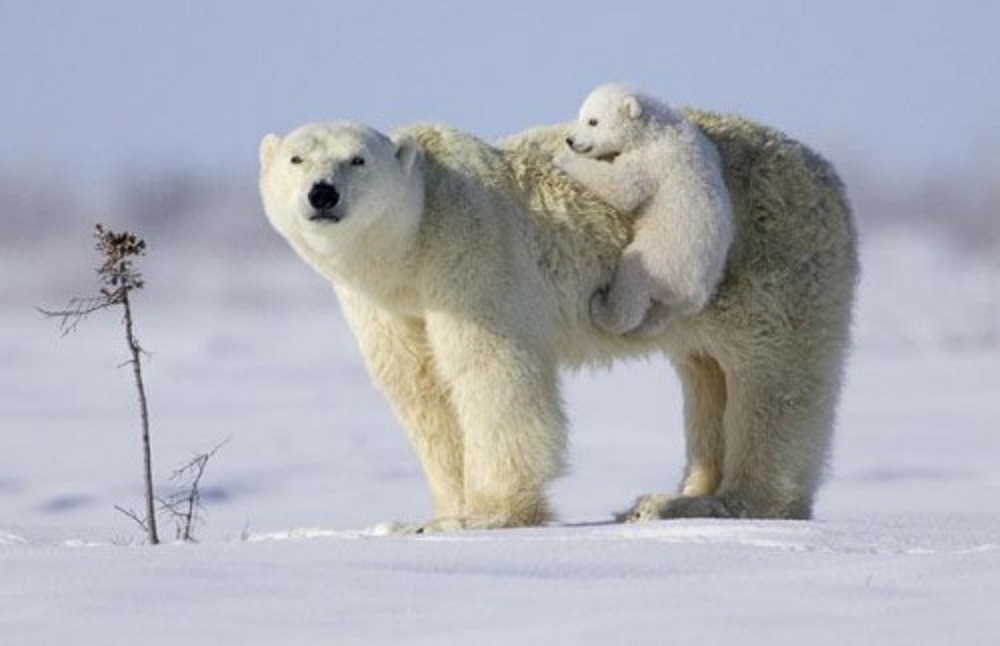
Right now there is a lot of talk about whether polar bears will go extinct as the climate changes.
The animal has become very much a symbol of demise of ice in the Arctic Ocean, where the bears prey on seals that that whelp on the ice.
The theory goes that if polar bears, they are automatically doomed to extinction.
I have always found this to be a very simplistic (and somewhat alarmist) proposition.
Please note that I do believe climate change is a major problem, and yes, we must do what we can to reduce greenhouse gases in the atmosphere.
What I don’t accept is that polar bears are automatically doomed by climate change.
There are two major reasons why:
The first is that polar bears are not stupid animals. They can learn to utilize new food sources fairly easily, and I don’t think for a minute that they are doomed because they can no longer hunt ice seals. The seals themselves might be doomed, because if they try to whelp on shore, they are going to be easy pickings for just about every predator. Climate change is happening too fast for these seals to evolve new reproductive strategies.
But polar bears themselves can learn to hunt other things. I see a future in which polar bears become the ultimate scavengers, competing with wolf packs that have brought down moose. Wolves will have a very hard time protecting their kills from such behemoth scavengers, and this certainly will put a new selection pressure on wolves in northern Canada and Alaska, who have had to worry only about about more omnivorous and generally smaller brown bear subspecies scavenging their kills.
Also, for those of you who are not aware, the short arctic summer brings about some of the most productive avifaunal events in the world. There are hundreds of birds that fly north to the arctic each spring to lay their eggs.
Why do they do this?
Well, during the summer, the sun is beating down almost 24 hours a day. That’s very good for plants, and it’s also good for insects that eat the plants, which are very good for certain birds to eat.
So if you’re a small insectivorous bird, and you want to raise your chicks in a productive environment, you go to the arctic to raise your young. There are hundreds of species that have evolved to do just that.
And then there are other birds that fly up there to hunt those little birds, and there are others, such as snow geese, that fly up there to raise their offspring in vast green meadows that erupt each summer.
There is already evidence that polar bears are taking advantage of the arctic’s annual avifaunal glut.
Polar bears are eating now eating snow goose eggs, which are quite high in fat. The geese produce enough eggs every year to sustain a healthy population of polar bears, and if polar bears began to capitalize on birds, they would be able to survive a warming climate, where ice seals are either extinct or whelping elsewhere.
The other thing is that polar bears have survived warming periods before.
And how do we know this?
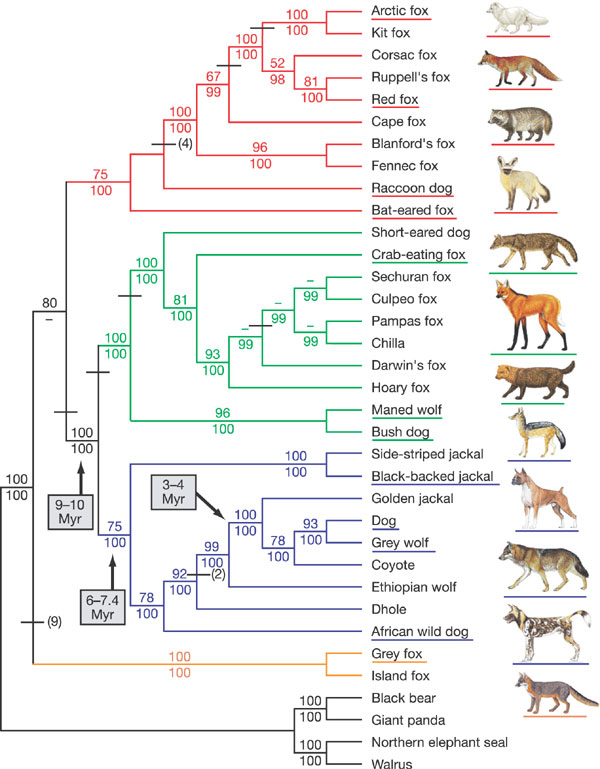
Well, it turns out that brown and polar bears are very close relatives. The two species can interbreed and produce fertile offspring, which has caused quite a bit of confusion about the age of the polar bear species.
Early mitochondrial DNA studies have suggested that polar bears are a recent offshoot of the brown bear lineage. If this were true, it would mean that the polar bear rapidly evolved to fit its niche within the past 150,000 years, which would almost make them a subspecies of the brown bear. Later genome-wide analysis revealed that the polar bear actually an older species. It evolved some 600,000 years ago from the brown bear lineage. Even more extensive genome-wide analysis found that polar bears were more likely in the 4 to 5 million year old range.
This discovery highlighted the perils of constructing phylogeny and taxonomy using only mtDNA data.
But it actually showed that polar bears have survived warming periods before, and they very likely will survive this one. If polar bears were a very recent offshoot of brown bears that had become specialized to arctic sea ice, their chances of survival would be much lower than they are now, but it now turns out that they aren’t as specialized to sea ice as we may have originally believed.
The other way we know polar bears have survived warming periods is through the evidence of hybridization in brown bear populations.
We actually now have two very good examples of this hybridization.
The first of these was the discovery that extinct Irish brown bears had almost the same mitochondrial DNA as polar bears.
And back when we believed polar bears were fairly recent species, it was suggested that all polar bears evolved from those Irish brown bears.
There was also another population of brown bears that had similar mtDNA to polar bears. The brown bears of Alaska’s Admiralty, Baranof, and Chichagof (“ABC” ) Islands, also share an mtDNA sequence that is similar to that of polar bears. For a very long time, it was believed that polar bears evolved from these brown bears.
But the separation was even more recent– only 14,000 years ago. If this were true, then polar bears would be a species younger than the domestic dog.
Of course, that notion was destroyed through the genomic analysis. Mitochondrial DNA is only a tiny piece of the genome, and it is inherited only via the female ancestors. Studies that use only this data simply do not get the full picture, and there are many, many revisions in the literature that have come from errors in mtDNA analysis.
So I was quite pleased to see a recent study on the ABC Islands’ brown bear population. It was a genomic study, and it found that these bears are actually derived from polar bears, not the other way around.
The researchers conclude that at some point during a warming period, a population of polar got stranded on these islands. They remained on those islands, feeding on a wide variety of food sources for male brown bears to reach them.
This study also suggested that initial finding that polar bears were derived from Irish brown bears was also in error. Instead, something similar had happened. Female polar bears became stranded in Ireland and then mated with native Irish brown bears. Over time, the main mtDNA lineage of Irish brown bears was replace by that of those bears that were derived from those polar bears– perhaps the polar bear blood infusion was a bit of genetic rescue or provided some other competitive advantage.
These genetic studies show that polar bears are not bound to the sea ice.
As intelligent, opportunistic predators, they have been able to survive warming periods, and they have been able to survive through hybridization with their closest relative.
If I were going to bet on the future of the polar bear, I would have to bet that it will survive the current warming period.
I’m not so sure about the ice seals, and I think they are a more appropriate icon for the movement to reduce greenhouse gas emissions.
When it comes to adapting to change, one would not be wise to bet against any species of bear, unless we’re talking the giant panda.
The panda is pretty much screwed.
No arguments there.
But I think the future for the polar bear in this warming world is much better than many people are forecasting.
This isn’t an overly specialized animal in the same way a giant panda is.
It can adapt. It can learn.
It’s not as bound to the ice as people think.
It’s evolutionary history clearly reveals this fact.
***
Now, before commenting on this post. Please read it in its entirety.
I am not denying climate change. Nowhere in that post do you see the words “Global warming is a hoax.” (except right here!)
Posted in dog breeding, dog health, tagged brachycephalic dogs, bulldog, English bulldog on March 19, 2013 | 9 Comments »
This dog is missing something. I can’t figure out what it is.
See related posts:
Posted in Absolute Piffle, wild dogs, tagged Kristoffer Clausen on March 18, 2013 | 13 Comments »
“It tastes the same as it smells.”


 | williewestfall on Bobcat scat |
 | cyborgsuzy on Forgive the gratuitous ne… |
 | retrieverman on Forgive the gratuitous ne… |
 | pondpawed on Forgive the gratuitous ne… |
 | Eugenie on Tailgate |