Canis lupus arabs— the Arabian wolf:
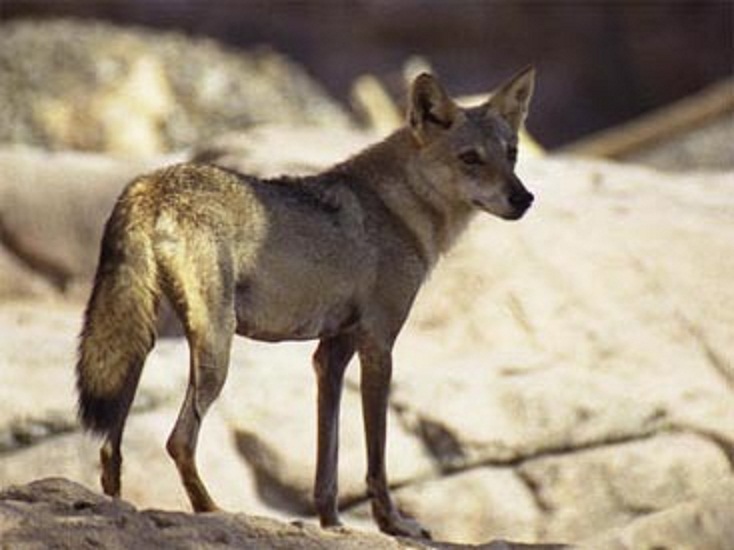
And Canis lupus pallipes– the Iranian wolf:

According to recent genome-wide analysis, most domestic dogs share many more genetic markers with Middle Eastern wolves than with any other subspecies.
Arabian wolves weigh 25-55 pounds. Arabian wolves have the same “small dog” gene that causes very small size in domestic dogs. They also have the fused middle toes on the front feet, a trait they share with basenjis.
Iranian wolves go 55-70 pounds, rough the same size as a typical golden retriever.
Neither of these wolves are the big “moose-killer” wolves from the northern parts of Eurasia and North America that every knows so well, that everyone sees in zoos, and that everyone thinks are the primary ancestors of the domestic dogs. Research that in anyway compares dogs to these wolves is methodological murky, for these wolves are actually quite specialized in their behavior. These smaller Middle Eastern wolf subspecies are much more generalist in their behavior and prey choices. It might be a better study to compare “primitive” domestic dogs, like dingoes and basenjis, with these wolves.
The unfortunate problem with this suggestion is there aren’t many of these wolves in captivity in the West, and many of those in captivity in other parts of the world are crossbred with dogs and other wolf subspecies.
But it isn’t fair to compare border collies and golden retrievers, highly specialized dog breeds, to the large northern wolves, which are highly specialized wild wolves.
But even comparisons between dogs and these wolves are problematic. These are not exactly the same wolves that were domesticated over 15,000 years ago. These wolves had the misfortune of living in the part of the world where agriculture took first took hold, and they also happen to live where people first started to herd sheep and goats. Wolves are never welcome where sheep and goats are being raised.
So these were likely the first wolves to be persecuted.
And as I’ve always noted, the effects of persecution on changing wolf behavior– both in terms of learned behavior and brain chemistry– are not considered carefully enough when trying to make comparisons between wild wolves and domestic dogs. It was likely that the original wolves were much less reactive animals than they are now and were much more willing to live near people and consider them social partners. We see this same sort of tameness in all sorts of wild dogs when they are not persecuted. Arctic foxes were not widely persecuted until recently, and they were very easy to kill and even tame as adults.
It seems to me that these ancestral Middle Eastern wolves were much more like these unpersecuted arctic foxes and not like these paranoid and emotionally reactive animals they are today.
They had to have been very easy to tame, for domestic dogs, unlike other domestic species, were not domesticated by breeding tame individuals to other tame individuals. If that were the case, we would have a clear genetic bottleneck that could be compared to wild wolf DNA to determine when dogs were domesticated. We have not found this genetic bottleneck. Instead, we have found that, as a population, domestic dogs retain much of the wolf’s genetic diversity.
That means that dogs evolved as a population of wolves. They were not domesticated by breeding tame to tame, as has been the case with virtually every other domestic species. And those domestic animals have far lower genetic diversity than their wild ancestors do.
Dogs lost genetic diversity only when they were made into breeds.
And just because domestic dogs likely derive from these two subspecies, we cannot assume that they actually became dogs, as we know them as distinct from wolves, in the Middle East.
But we just don’t know where these wolves evolved into dogs. We have some guesses.
But it is possible that wolves of this type would have followed people throughout Eurasia, and they could have started to turn into dog-like phenotypes anywhere in Eurasia– even Africa cannot be ruled out entirely.
So we know which subspecies are most closely related to dogs and could be called their most likely primary ancestors.
But everything else is still a bit of a guess.




it doesn’t explain the W6/D6 MTDNA group which clearly does tie to European wolves. Nor does it explain where the 31,000 year old dogs from Belgium come from (has DNA ever been pulled from the fossils there?). Not to mention the Chinese who assert the origin of dogs as “dinner” (which I find very hard to believe). The similarity could just as easily be that a common pool of wolves diverged into dogs/Canis lupus pallipes/arabs and the Tibetian wolf (which IRRC, also shows a lot of very close relationships to dogs). I don’t think the first domestic dog came from tundra wolves, but I also think that it’s likely that it isn’t as “clean” as “this one subspecies” — especially as the original parent subspecies may well be extinct . The similarity could as well be due to a Near East version of the red wolf as much as anything else, given that humans have inhabited this area a lot longer and more intensively than almost any other location on the planet.
Peggy.
Scottie already covered the genetics of European wolves emerging in dogs:
https://retrieverman.wordpress.com/2010/07/09/wolf-hybridization-in-scandinavian-and-finnish-spitz-type-dogs/
MtDNA is only a tiny part of the genome. The Wayne study looked at many more parts of the genome than that. You can get coyotes with MtDNA from dogs that have almost no dog in them at all.
This is so wrong.
Everybody know that dogs were tamed in China and pekingese are the oldest breed they date back 10,000 years to the Gobie Dessert.
Pekingese is the closest thing to a wolf and they are nothing like these jackals from the Middle East.
There no wolves in the Middle East, just jackals.
You are misinformed to the extreme.
Pekingese are an old breed, only in that they are derived from an old landrace, which included the ancestors of the pugs, the pekes, and the shih tzu.
The reason I bring up the issue is that the evaluation assumes that the Iranian/Arab wolves are essentually unchanged from the time of domestication of the dog. I find that a bit hard to believe because the environment has drastically changed — or at least, the documentation regarding conversion of the “Egyptian” and similar areas from grasslands to semi-desert would indicate that. Wolves that occupied a “savanna grasslands” would have different behaviors than those that occupy deserts. And, I would think, at least some differing genetics as well. We know humans were around at the time — we find the drawings of the giraffe, etc that no longer live in these areas. I would speculate that the native wolves would have migrated to more suitable environments or evolved to meet the new one (or both). One could possibly verify this one way or the other by comparing DNA from fossil wolves of the area to the modern ones and other wolves. As Retrieverman says, the wolves have likely evolved to be less trusting of humans — my guess is that they have also evolved in other ways from those present some 31-40,000 + years ago. I suspect that whatever wolf H. Sapiens first encountered was the one domesticated — that would imply the Iranian/Arab ones, but it may also be that adjacent wolf subspecies were also involved as much. I await the discovery of a 31,000+ fossil dog from these areas and hopefully, some DNA from it as well.
Peggy Richter
[…] The primary ancestors of the domestic dog (retrieverman.wordpress.com) […]
[…] A voir aussi : Les ancêtres du chien domestique : The primary ancestors of the domestic dog […]
[…] The primary ancestors of the domestic dog […]
Great post. Yes, it does appear that the domestic dog has descended primarily from southern wolves (Arabian and/or Iranian wolves), which are significantly smaller than northern wolves (e.g. Eurasian and American). This helps explain why giant breeds of dog (molossers) tend to develop joint and cardiovascular problems, as well as a shortened lifespan, even in the absence of inbreeding depression. They may be the same size as northern wolves (100+ lbs), but they have not had the time to properly evolve a large body, the way northern wolves and other giant animals have. It seems that the domestic dog – like Arabian and Iranian wolves – evolved to be medium-to-large sized, i.e. about 40-70 lbs. Anything much larger than that, and they develop health problems. Anything much smaller, and they have trouble defending themselves (although terriers do appear to occupy a new niche: underground hunter).
Having said all that, at some point, domestic southern wolves probably interbred with northern wolves. Thirty-to-forty thousand years is not that long of a time from an evolutionary standpoint, but today’s husky-type dogs are just as cold-tolerant as northern wolves and other northern mammals. Therefore, they must have gotten those genes for a dense underfur by interbreeding with northern wolves after they had begun to move north with their human partners. This is probably why we find some northern wolf genes in domestic dogs, even though most of their genome probably comes from southern wolves.
BTW – This probably holds true for domestic cats, too. They were domesticated from southern wildcats around 9,000-10,000 years ago in the Near East, and yet today, like dogs, you find hot-climate and cold-climate cats. This is probably because, at some point, domestic southern cats came north with people, and interbred with northern wildcats, yielding thick-furred house cats.