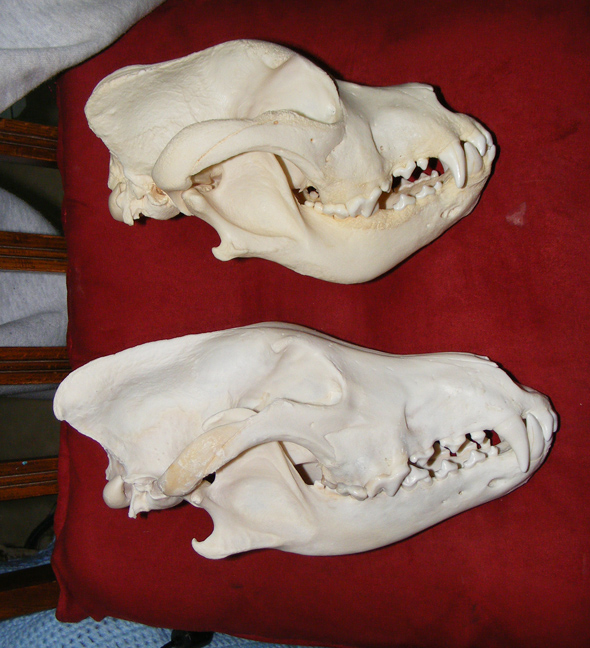
Neapolitan mastiff skull on top. Wolf skull on the bottom.
Dogs have much smaller skulls in proportion to body size than northern wolves do. This wolf is likely from one of the big game hunting wolves that lives in Alaska or Canada.
This wolf likely weighed around a hundred pounds, which is about average for one of the large northern wolves, but this mastiff was probably at least 120 pounds.

Wolf skull on the left. Neapolitan mastiff skull on right.
Both animals have evolved to grapple with large animals in close combat, but their skulls are still quit different. Indeed, the Neo’s skull looks more like that of a bear or lion than that of a wolf, yet we know that Neapolitan mastiffs and northern wolves belong to the same species.
Because the two animals have had similar selection pressures for strong bites, one would think that the skulls would be very similar. They aren’t.
The northern wolves evolved from generalist southern wolves that specialize din hunting large ungulates.
Neapolitan mastiffs, like all European mastiffs, are derived from Middle Eastern wolves, which have retained the ancient southern wolf phenotype. Most modern dogs are essentially modified Middle Eastern wolves, representing the subspecies arabs and pallipes.
Not only are the bulk of dogs derived from smaller wolves, small size was one of the first traits that humans bred for in domestic dogs. Small size is actually quite a common trait in domestic dogs throughout the world and has been for a long time. It is very likely that these mastiffs were at least partially derived from much smaller ancestors that were in no way adapted to fighting large animals or people.
So Neapolitan mastiff’s skull and size are built upon the relatively smaller size of its ancestors. They have left an historical legacy of those features, and upon that legacy, its phenotype been built.
This evolution likely took several hundred years, and Neapolitan mastiffs likely crossbred with other Italian dogs that didn’t have these features following Rome’s defeat. Then this breed became “improved” for the show ring after the Second World War, and whatever features it had were greatly exaggerated by selective breeding. Although these dogs had to fight as part of their work, they did not have to fight every time it wanted to eat.
These northern wolves likely began evolving their phenotype hundreds of thousands of years ago. Their ancestors specialized in hunting large ungulates, and every time those wolves wanted to eat, they had to grapple with game that was both large and dangerous. Over time, those selection pressures would lead to wolves with very large heads and teeth and very powerful bites.
So on the surface, it would appear that a gladiator dog would have the same skull and power as a wolf that has to fight moose on a regular basis, the reality is that the Neapolitan mastiffs have not evolved anything like a wolf’s skull. It may be more powerful than the average domestic dog, but the northern wolf will still have the upper hand.
A northern wolf evolved to live in a much more intense environment than Rome’s gladiatorial circuses. And there is not a lot of good evidence that suggests that the Neopolitian mastiff is actually the same strain that the Romans used. The type may be old, but the strain most likely has very different genetics now. I’ve never seen any genetic study that finds this breed to be ancient, though the signatures of antiquity in its DNA could have been lost through regular crossbreeding after the fall of Rome.
We do know that much of the Neapolitan mastiff’s features have been exaggerated since it became a show dog, but the wolf can vary only so much in head structure before it becomes unable to take down a moose effectively.
So although it appears that Neapolitan mastiffs might be closer to wolves in their fighting abilities and phenotype, the two animals are quite different.
And if the two should ever get into a fight, my money would be on the northern wolf. I don’t know of any dogs that could be a northern wolf by itself. Maybe the only exception I can think of is if an Irish wolfhound caught the wolf on the run and killed it before it could stand and fight.
The only disadvantage the wolf would have in any encounter is its much thinner skin, and if the wolfhound got the wolf by the throat before it could engage in combat, it might be able to inflict mortal wounds.
But those are big ifs.